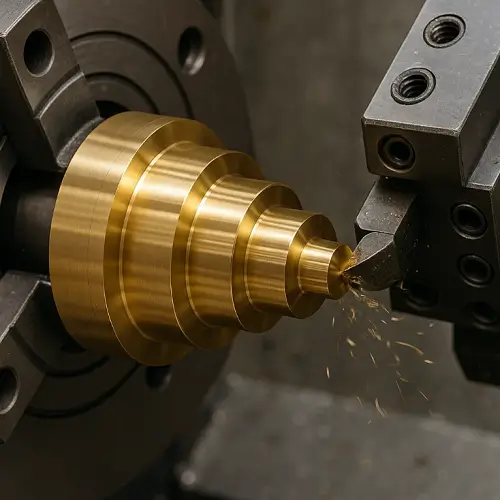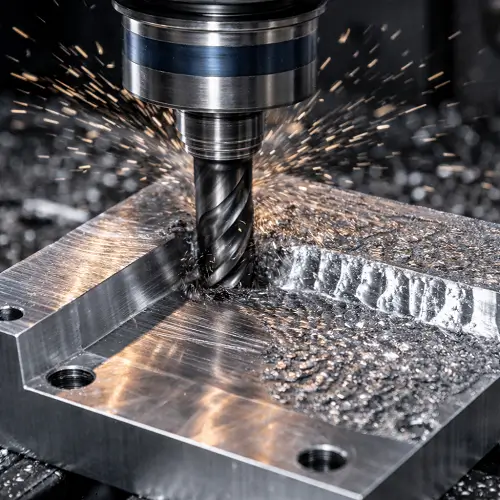
Stainless steel turned parts are used in fittings, sleeves, shafts, valves, and sensor housings where corrosion resistance matters alongside accurate dimensions. However, two parts with the same shape can require different grades. A locating pin inside a dry machine faces different conditions from a threaded fitting exposed to cleaning chemicals.
The material choice affects machining time, surface finish, welding, and service life. Choosing a grade that meets the operating conditions—and specifying the dimensions that control assembly—helps avoid paying for unnecessary requirements or receiving parts that fit but fail in use.
What Are Stainless Steel Turned Parts?
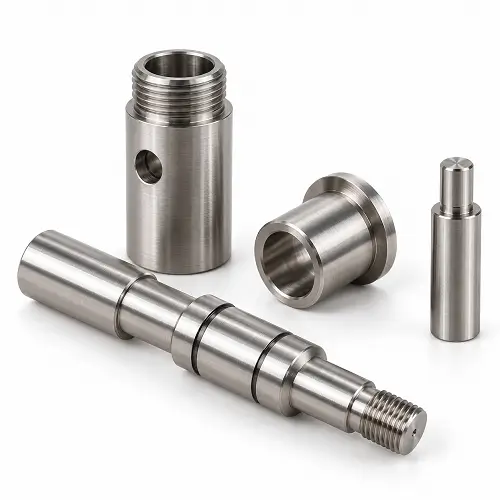
Stainless steel turned parts are components made by rotating stainless steel stock against cutting tools on a lathe. CNC turning produces outside diameters, shoulders, grooves, threads, and internal bores. Common examples include bushings, spacers, threaded adapters, valve stems, and cylindrical housings.
Most turned features share a central axis. A sleeve, for example, may have an outside diameter that fits into a housing and an internal bore that guides a shaft. Turning can produce both features, but their relationship must be controlled if the sleeve needs to keep the shaft aligned.
Stainless steel turned components can also include features that are not round. Wrench flats, side holes, and slots can be added with live tooling or a separate milling operation. The complete geometry determines whether the part can be finished in one machine or needs additional setups.
What Parts Can Be Made by Stainless Steel CNC Turning?
Sleeves, Bushings, and Spacers
Sleeves and bushings usually require control of the bore, outside diameter, and wall thickness. A mounting sleeve may only need clearance for a bolt, while a guide bushing may require a much closer fit around a moving shaft.
The important question is what the bore does. If a shaft must slide through it, specify the required clearance or mating shaft dimensions. If the sleeve is pressed into a housing, the outside fit and any resulting change in the bore need consideration.
Stainless steel offers corrosion resistance, but it is not automatically the best bearing material. A stainless shaft sliding directly against a stainless bushing can suffer adhesive wear or galling. Load, lubrication, speed, and the mating material should be reviewed before choosing both components.
Threaded Adapters, Fittings, and Connectors
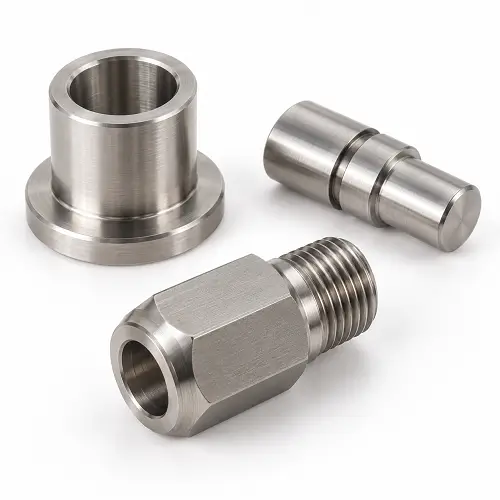
Stainless steel threaded adapters may combine an internal passage, external threads, wrench flats, and a sealing face. Each feature has a separate job: the thread holds the assembly together, the flats allow tightening, and the seal prevents leakage.
A thread that screws together does not necessarily create a leak-tight connection. Some designs seal through tapered threads and sealant; others use an O-ring, gasket, or metal seat. The drawing should identify the thread standard and sealing arrangement rather than leaving the supplier to infer them from appearance.
For hexagonal stainless steel parts, the manufacturer may start with hex bar and turn the round sections. Alternatively, the shop can turn round stock and mill the flats. Available stock sizes, dimensional requirements, and order quantity influence which route makes sense.
Pins, Shafts, and Valve Stems
Locating pins, stepped shafts, and valve stems often have several diameters with different functions. One section may locate in a housing, another carry a bearing, and another hold a thread or retaining ring.
For these parts, the relationship between features can matter as much as individual diameters. Two journals can each meet their size limits while excessive runout still causes poor rotation or uneven loading.
Strength also matters. A lightly loaded locating pin and a valve stem carrying substantial force should not receive the same material recommendation simply because both are cylindrical.
Sensor Housings and Instrument Bodies
Cylindrical housings may include a deep internal cavity, thin walls, mounting threads, and a sealing shoulder. Stainless steel CNC turning can produce these features, with additional drilling or milling for cable outlets and mounting flats.
A deep cavity and thin wall make the part more difficult to hold and inspect. The drawing should distinguish surfaces that locate or seal from surfaces that merely provide clearance. That allows machining effort to focus on features that affect the finished assembly.
Is 303, 304, or 316 Better for Turned Parts?
For turned parts, 303 is often a practical choice when machining efficiency matters and the environment is mild. Choose 304 when broader corrosion resistance or welding is needed. Consider 316 for greater resistance to chloride-related corrosion, while checking the actual exposure. When strength dominates, evaluate a heat-treated grade such as 17-4 PH.
When Is 303 Stainless Steel a Good Choice?
303 contains added sulfur to improve machinability. This helps chip breaking and makes it easier to produce detailed turned features compared with conventional 304.
303 stainless steel turned parts are worth considering for spacers, locating pins, threaded components, and instrument parts used in relatively mild environments. For a complex pin inside a dry machine, 303 may meet the service requirements while reducing machining difficulty.
The tradeoff is reduced corrosion resistance and poor weldability compared with 304. If the part will be welded, exposed to aggressive cleaning, or used where contamination and corrosion are critical concerns, choosing 303 solely because it machines well can create problems later.
A material substitution also requires approval. A supplier should not replace specified 304 with 303 simply to shorten the machining cycle.
When Should the Part Use 304 Stainless Steel?
304 provides a useful balance of corrosion resistance, availability, and weldability. It is a common candidate for equipment fittings, housings, and components that face moisture or need to join a welded assembly.
304 stainless steel turned parts generally require more attention to chip control and tool condition than comparable 303 parts. That does not make 304 unsuitable for precision turning; it means the supplier must account for its cutting behavior when estimating machining time and planning the process.
For example, a threaded housing that will later be welded to a bracket may justify 304 even if the same housing would cost less to machine in 303. Where welding is involved, confirm whether the specification calls for 304L or an acceptable dual-certified material.
When Is 316 Worth the Additional Cost?
316 contains molybdenum, which improves resistance to pitting and crevice corrosion in many chloride-containing environments compared with 304.
316 stainless steel turned parts are candidates for fittings, valve components, and instrument bodies exposed to more demanding fluids or cleaning conditions. However, “used outdoors” or “used near water” is not enough information to select the grade confidently.
The difference between 304 and 316 stainless steel becomes more useful when the fluid, chloride concentration, temperature, and cleaning method are known. A continuously wet crevice presents a different risk from a surface that is occasionally splashed and then dries.
316 is not immune to corrosion, and it is not an automatic approval for seawater or every chemical process. For welded components, the drawing may require 316L. Confirm the required grade before requesting comparable quotes.
When Should You Consider 17-4 PH?
17-4 PH is a precipitation-hardening stainless steel used when higher strength and hardness are needed. It can be considered for loaded pins, shafts, and valve components where annealed 303, 304, or 316 does not provide the required mechanical properties.
The heat-treatment condition is part of the material requirement. A drawing that specifies only “17-4 PH” leaves an important question unanswered because different aging conditions produce different combinations of strength and toughness.
Heat treatment also affects the manufacturing sequence. The supplier needs to determine whether critical features should be finished before or after aging and whether additional finishing allowance is needed.
| Grade | A practical reason to consider it | What must be checked |
|---|---|---|
| 303 | Detailed turned parts in mild environments where machinability matters | Corrosion exposure and any welding requirement |
| 304 / 304L | General corrosion resistance and components involving welding | Cleaning conditions, chloride exposure, and specified grade |
| 316 / 316L | Greater resistance to chloride-related pitting than 304 | Actual chemical exposure, temperature, and crevices |
| 17-4 PH | Higher-strength pins, shafts, and loaded components | Required aging condition, toughness, and final dimensions |
Consider the same threaded adapter in three applications. Inside a dry instrument, with no welding required, 303 may be suitable. If the adapter will be welded to a tube, 304L or 316L becomes more relevant, depending on the service conditions. If its passage carries a chloride-containing fluid, the concentration and operating temperature need to be reviewed before settling on 316.
The geometry has not changed, but the material decision has. When requesting a quote, describe what the part contacts and how it joins the assembly. Those details are more useful than asking for the “best stainless steel.”
Why Is Stainless Steel Difficult to Machine?
Stainless steel can work-harden during cutting. If a tool rubs instead of cutting effectively, the surface becomes harder and the next pass becomes more difficult. This is particularly relevant when turning conventional austenitic grades such as 304 and 316.
The practical response involves suitable cutting geometry, controlled feeds, rigid workholding, and consistent coolant delivery. Simply reducing the cutting speed without considering the rest of the process may not solve the problem.
For the customer, these difficulties appear in specific features.
A deep, narrow bore requires a long cutting tool, which is more likely to deflect or chatter. The result can be taper or an uneven surface even when the bore entrance measures correctly. The supplier may need staged drilling, boring, or another finishing operation depending on the required geometry.
A thin-walled sleeve can distort under chuck pressure. It may measure correctly while clamped and change shape when released. Suitable jaws, internal support where practical, and inspection in the free state help address this.
Long chips can wrap around tools or mark finished surfaces. Small cross holes and internal thread exits can also retain burrs. Where a passage carries fluid or receives a seal, inaccessible burrs deserve explicit attention because they can obstruct flow or damage the mating component.
A drawing review should identify these features before production. For example, if a deep bore only provides clearance, a demanding finish requirement may be unnecessary. If the same bore guides a moving shaft, its diameter, straightness, and surface condition become functional requirements that the machining plan must address.
What Tolerances Can Stainless Steel Turned Parts Hold?
There is no single tolerance that applies to every stainless steel turned part. A short, rigid outside diameter is easier to control than a deep bore in a thin wall or a journal on a slender shaft.
For preliminary discussion, ±0.001 in may be a reasonable target for selected dimensions on a stable part. Requirements such as ±0.0005 in or tighter need a feature-specific review of geometry, material condition, workholding, finishing, and inspection. These figures are discussion points, not a blanket capability guarantee for every part or dimension.
The quotation should confirm the critical tolerances individually. It should also identify the condition in which they apply—for example, after heat treatment or final surface finishing—and any additional operations needed to achieve them.
Consider a sleeve with a 0.5000 in bore specified at ±0.0005 in. Its acceptable bore size is 0.4995–0.5005 in. Whether that range provides the intended fit still depends on the shaft limits. The bore tolerance alone cannot establish the assembly clearance.
For bearing fits, also consider roundness, taper, shoulder geometry, and surface finish. A diameter measurement at one location cannot confirm all of these.
Threads need their own requirements. Identify the thread size, pitch, standard, class where applicable, and usable thread length. A nominal thread diameter alone does not tell the supplier how to manufacture and gauge the connection.
Specify surface roughness where it affects sealing, sliding, or bearing contact. “Smooth finish” is difficult to inspect consistently. Conversely, applying the same fine finish to hidden clearance surfaces can add cost without improving function.
For precision stainless steel turned parts, the most useful drawing clearly separates functional requirements from general dimensions. The supplier can then explain which features can be finished by turning and which may need grinding, honing, or another finishing process.
Do Stainless Steel Turned Parts Need Passivation?
Passivation is often specified after machining to remove free iron contamination and help the surface achieve the corrosion resistance expected from the selected stainless grade. Contamination can come from tooling, handling, or contact with other metals during manufacturing.
It is particularly relevant when the drawing, customer specification, or operating environment requires controlled corrosion performance. A part can look clean and still carry contamination that later produces rust staining.
However, stainless steel passivation does not turn 303 into 316, remove machining grooves, or correct an unsuitable material choice. It also does not replace deburring or the removal of heavy oxide scale.
The treatment must suit the alloy. Sulfur-containing grades such as 303 require particular care during process selection and rinsing. Blind holes and internal passages must be cleaned and rinsed effectively rather than trapping residues.
If passivation is required, identify the applicable specification and acceptance testing on the drawing or purchase order. If a brighter appearance or reduced surface roughness is also needed, discuss that separately; passivation is not a polishing process.
How Much Do Stainless Steel Turned Parts Cost?
A useful price requires the drawing, material grade, quantity, and finishing requirements. Part diameter alone is not enough: two components with the same outside dimensions can have very different machining times.
For example, a short spacer with a clearance bore may need straightforward facing, turning, drilling, and cutoff. A similarly sized sleeve with a close-tolerance bore, thin wall, internal groove, and fine sealing surface may require additional tooling, slower finishing, and more inspection.
Material choice also affects the total. 303 can reduce cutting difficulty when its service properties are suitable. Selecting 316 without an exposure-related reason may increase cost unnecessarily, but replacing required 316 with 303 to reduce the quote is not an acceptable saving.
Quantity spreads programming, setup, and first-piece inspection costs across more parts. A prototype order therefore often has a higher unit price than a repeat production batch. Share both the initial quantity and the expected reorder quantity so the supplier can evaluate each stage.
Stock selection matters for hexagonal parts. Hex bar can avoid milling wrench flats when its dimensions and condition suit the design. Round bar may be preferable when suitable hex stock is unavailable or the geometry requires a different approach.
The most useful way to reduce CNC machining cost is to identify requirements that can change without affecting function. A noncritical bore might accept a wider tolerance, an unnecessary deep recess might be shortened, or a difficult internal corner might allow a larger radius. Any change should be approved before manufacturing.
When comparing quotes, confirm that they include the same material condition, finishing, inspection, and documentation. A lower price that excludes passivation or final inspection is not a like-for-like comparison.
How Do You Choose a Stainless Steel Turned Parts Manufacturer?
Start with parts similar to the one being ordered. If the project involves a thin-walled 316 housing with an internal thread, photographs of solid pins provide limited evidence of relevant experience. Ask to see comparable bores, walls, threads, or sealing features and have the supplier explain which areas of the drawing need attention.
A useful technical response should connect a feature to a manufacturing decision. For example, the shop might explain how it will support a thin wall, remove a burr where two passages intersect, or inspect a bore along its depth. “We use advanced machines” does not answer those questions.
Ask how the important dimensions will be checked. Outside diameters, deep bores, threads, and runout require different inspection approaches. The equipment and method should match the tolerance rather than relying on one general inspection statement.
A stainless steel turned components supplier should also confirm material traceability when it is required. The specified grade and condition should connect to the purchased stock and supporting records. Appearance is not a reliable way to distinguish 303, 304, and 316.
For repeated orders, discuss drawing revisions, retained setup information, first-piece approval, and checks during production. One acceptable sample shows that a part can be made; it does not establish how later batches will be controlled.
If passivation, heat treatment, or grinding is outsourced, clarify who manages the specification, delivery schedule, and final acceptance. A qualified outside processor can be part of a practical manufacturing plan, but responsibility for the delivered part must remain clear.
A suitable CNC machining supplier should be able to explain both what it can produce and what still needs clarification. Questions about a missing thread class, an unspecified heat-treatment condition, or an unclear sealing surface help prevent production based on the wrong assumptions.
Conclusion
Choosing stainless steel turned parts starts with the conditions they will face. 303 may suit detailed components in mild environments, 304 can support broader corrosion and welding needs, and 316 may be justified by more demanding exposure. Higher-strength applications may require 17-4 PH with a defined heat-treatment condition. The selected grade must then be matched to the part’s fits, threads, surface requirements, and inspection plan.
JeekRapid provides stainless steel CNC machining for custom prototypes and production components. Send the CAD model, dimensioned drawing, order quantity, and required material and finish for a machining review and quotation. If the grade is still undecided, include the operating environment, mating components, and any welding or cleaning requirements.
The review can help identify features that need additional finishing, requirements that increase cost, and material or drawing details that must be confirmed before production. This gives a clearer basis for comparing options and ordering custom stainless steel turned parts that meet the assembly requirements.