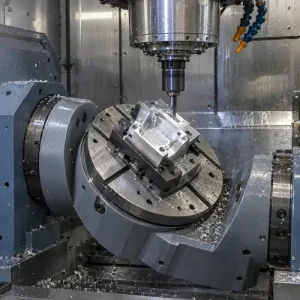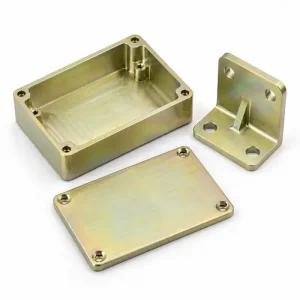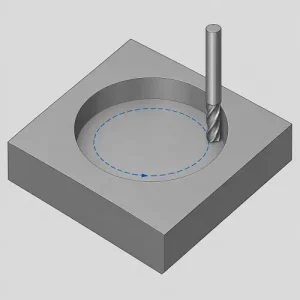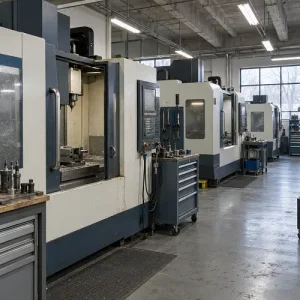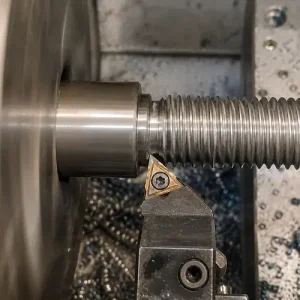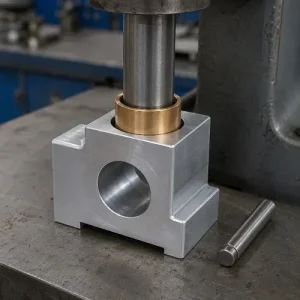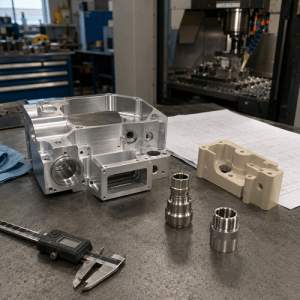
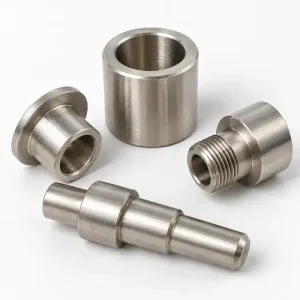
CNC machining process showing a metal part being cut with stable tool engagement and consistent machining behavior

Precision vs Accuracy in Machining

Precision vs Accuracy in Machining

In machining work, precision and accuracy are often treated as the same thing. On the shop floor, they are not. Confusing the two usually leads to the wrong adjustments and the wrong priorities. A setup may look fine during the first checks, then create problems once parts reach assembly or …

CNC milling process cutting an engineering plastic part with visible machining marks

Plastic Warping in CNC Machining: Causes and Process Control

In CNC machining, most discussions naturally focus on metals, including hardness, cutting forces, and tool wear. On the shop floor, however, CNC machining is not limited to metal parts. A wide range of plastic components are routinely produced using CNC processes, particularly in low-volume production, prototyping, and functional applications where precise geometry is still required.…

Finished aerospace blisk after CNC machining placed on a clean metal inspection table

Blisk Machining for Aerospace Engines

Blisk machining for aerospace engines is fundamentally a 5-axis CNC problem.
The component combines twisted airfoil geometry, thin structural sections, high-strength alloys, and extreme accuracy requirements into a single rotating part. Without continuous 5-axis control, stable production of aerospace blisks is not realistically achievable.

In real manufacturing work, the difficulty of blisk machining does not …

5-axis CNC rough machining of turbine blade airfoil with visible tool tilt and real metal chips

Turbine Blade Machining: Using 5-Axis CNC for Complex Airfoil Geometry

Turbine blades sit at the center of modern turbomachinery. In aerospace engines, industrial gas turbines, and steam turbines, blade geometry directly governs thermal efficiency, mechanical reliability, and long-term service life. As operating temperatures and rotational speeds continue to rise, turbine blade manufacturing has become one of the most demanding disciplines in precision machining.

In real …

Finished CNC machined metal impeller part with complex curved blades and precision surface finish

Impeller Machining: 5-Axis CNC for Complex Blade Geometry and Accuracy

In real production, impellers almost always require 5-axis CNC machining. This is not a matter of machine preference or equipment marketing. The reason is straightforward: the hydraulic performance of an impeller is controlled by blade geometry, hub alignment, and the consistency of the flow surfaces, and these features cannot be held reliably with simple 3-axis …

Finished aluminum part produced by precision CNC machining with high dimensional accuracy

What Is Precision Machining? Process, Advantages, and Applications

In many industries such as aerospace and medical devices, standard CNC machining is no longer sufficient to meet the required accuracy. Precision CNC machining refers to the ability to consistently manufacture parts with tolerances of ±0.001 inch or tighter under real production conditions.

At JeekRapid’s production floor, precision is not defined by machine manuals, but …

CNC machined aluminum part made from 6061 and 7075 aluminum on industrial workbench

CNC Material Selection and Cost Trade-offs

Material choice is one of those decisions in CNC machining that looks simple on paper, then quietly controls everything that follows — cycle time, tool life, scrap rate, even whether the schedule survives first article.

Anyone who has run real projects has seen the same drawing produce very different numbers on the quote sheet, just …

CNC machined parts

Top CNC Machining Companies in 2026: Leading Suppliers in Asia & Worldwide

The CNC machining industry in 2026 looks very different from just a few years ago. Global supply chains have become more regional, product lifecycles are shorter, and engineers now expect manufacturing partners to contribute technical input rather than simply execute drawings. Speed, engineering feedback, process stability, and real production transparency are now as important as …

Brass CNC machining process with cutting tool and metal chips in real workshop environment

Copper vs Brass vs Bronze: How to Choose the Right Material for CNC Machining

Copper, brass, and bronze are widely used engineering metals known for their high electrical and thermal conductivity, corrosion resistance, and long-term durability. These three copper-based materials are commonly applied in electrical systems, mechanical assemblies, fluid control components, architectural hardware, and industrial equipment. Because their color and general appearance are similar, they are often confused during …

CNC machining chatter causing vibration and uneven surface finish during milling

What Causes Tool Chatter in CNC Machining?

Tool chatter starts when the cutting system loses stability.
In practical terms, the tool, machine, and workpiece stop behaving like a rigid structure and begin vibrating against each other. Once that vibration becomes self-exciting, surface finish degrades, tool life drops, and dimensional accuracy becomes difficult to hold.

On the shop floor, chatter rarely appears without …

Scroll to Top