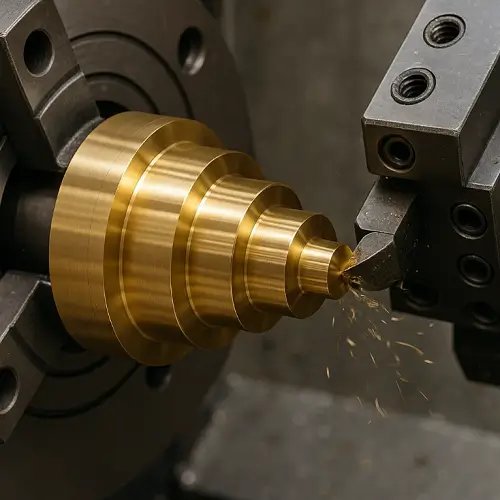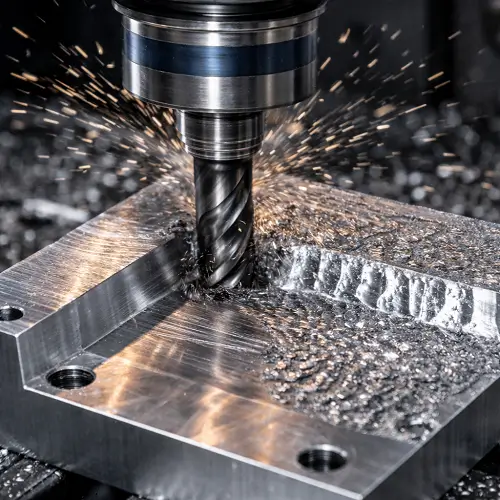
Many seating problems start around the hole, not in the hole. A bolt head, washer, or nut may be the correct size, yet still fail to sit flat because the surrounding surface is rough, curved, or locally distorted. This is common on castings, weldments, forgings, and angled faces where the fastener seat cannot be trusted by default.
Spotfacing solves that problem locally. Instead of machining the whole area, CNC machining removes only enough material to create a clean, flat seat where the hardware actually loads the part. That is why a spotface is small on the print but often important in the assembly.
What Is a Spotface in CNC Machining?
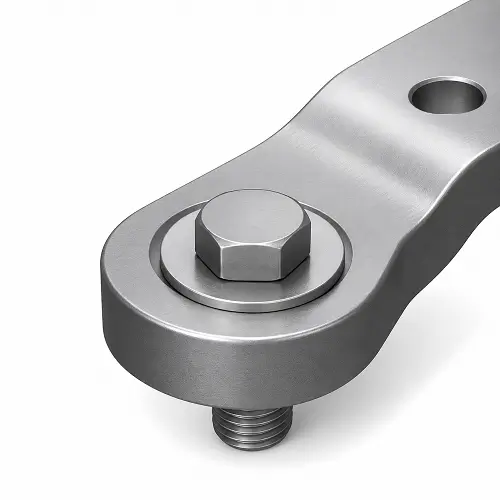
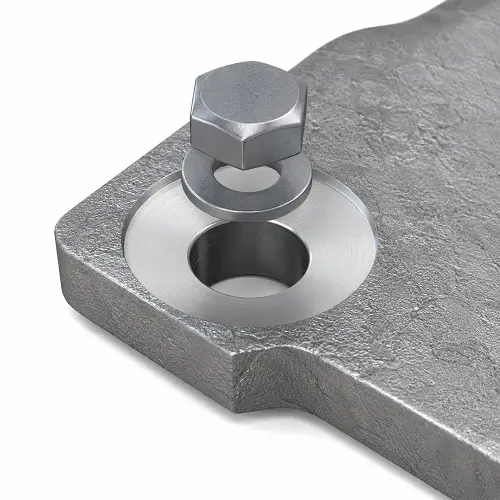
A spotface is a shallow, flat-bottomed machined surface made around a hole or local contact area. The goal is to create a reliable seat for a bolt head, washer, nut, or another mating feature. In most cases, a spotface is only deep enough to clean up the local surface. It is not meant to bury the fastener head far below the part surface. It is meant to make sure the hardware bears on something flat and stable.
That point matters because a spotface is easy to confuse with other hole features. A chamfer changes the edge condition. A countersink creates an angled seat for a flat head screw. A counterbore creates a deeper cylindrical recess, usually for head clearance as well as seating. A spotface is different. The function is not head clearance. The function is local seating correction.
On simple flat plates, a spotface may not be needed because the face is already suitable. On rough, curved, cast, forged, or welded parts, a spotface often becomes much more important.
What Is the Purpose of a Spotface?
The first purpose of a spotface is to create a flat seat where the original surface is not good enough. A bolt head or washer needs a stable contact area. If the surface is rough, angled, curved, or locally high on one side, the fastener may only touch part of the seat. Once that happens, the load enters the part unevenly.
The second purpose is to improve clamp load consistency. When the seat is flat and centered, tightening the fastener produces a more predictable result. When the seat is uneven, the hardware may rock slightly, drag the washer, or begin loading the joint off-center before full clamp load is reached.
The third purpose is to reduce unnecessary machining. If only the fastener seat matters, machining the entire surrounding face is often wasteful. A spotface solves the seating problem only where it exists.
The fourth purpose is to improve assembly reliability. Assemblers usually notice seat problems before inspectors do. A washer that rocks, a bolt head that never quite sits square, or a fastener that tightens with an odd feel often points back to the local seat condition.
Where Is Spotface Commonly Used on Machined Parts?
Spotfaces are common on cast housings, forged brackets, welded frames, machine bases, hydraulic parts, and structural components where the original surface is not ideal for direct fastener seating. Any part that combines a hole with a rough or non-flat outside face is a likely candidate.
They are also common on angled surfaces where the fastener still needs a flat bearing area. In those cases, the part may not need the entire face machined normal to the hole. It may only need a limited flat area around the hole itself.
Heavy fabricated parts often use spotfaces because full-face finish machining would remove too much material and add too much cost. A local seat around the hole is usually enough.
Spotfaces also matter wherever washers are used. A washer only works properly when the surface under it is stable. If the washer lands on rough cast skin, forged scale, weld distortion, or a curved pad, the load path changes immediately.
Spotface vs Counterbore: What Is the Difference?
A spotface and a counterbore can look similar because both create a flat-bottomed circular feature around a hole. The difference is mainly depth and purpose.
A counterbore is usually deeper and is often intended to recess the head of a socket head cap screw or similar fastener. The head sits inside the feature for seating and clearance. A counterbore is often part of a head-clearance design.
A spotface is usually shallow. The purpose is not to hide the head. The purpose is to clean up the seating area. If the surrounding face is already flat and the fastener head still needs to sit below the surface, a counterbore may be the right choice. If the head can remain above the surface and only needs a reliable seat, a spotface is often enough.
Spotface vs Counterbore Quick Comparison
| Feature | Spotface | Counterbore |
|---|---|---|
| Main purpose | Create a flat local seat | Recess and seat a fastener head |
| Typical depth | Shallow, cleanup-oriented | Deeper, clearance-oriented |
| Fastener head position | Usually remains above the main surface | Often sits below the main surface |
| Best use case | Rough, angled, curved, or uneven seat area | Socket head or recessed head design |
| Material removal | Minimal | Greater |
How Spotface Is Machined in CNC Parts
Spotfacing is usually simple in concept but not always simple in practice. On a flat plate, the seat can often be machined with an end mill, a face-milling pass, or a dedicated spotface tool centered on the hole. On a more difficult part, the challenge is less about cutting the circle and more about how the part is held, referenced, and related to the hole axis.
An end mill is common when the seat diameter is moderate and access is easy. A counterbore-style tool or spotface cutter may be used when the geometry favors that approach. Circular interpolation may also make sense depending on tool size and feature size.
Rough castings and forgings create a different problem. Tool entry is no longer smooth and uniform. The cutter may contact the surface on one side before the other. That interrupted cut is normal, but it changes how the seat cleans up.
Angled and curved faces need even more attention. If the seat must be normal to the hole axis, the setup has to reflect that. If the part is referenced from the wrong face, the spotface may still be flat, but not flat in the direction that matters.
What Affects Spotface Quality?
Tool rigidity matters. A small seat on a simple part is easy. A larger seat on a rough, interrupted, or unsupported surface is less forgiving.
Part stability matters too. If the part shifts under clamping, the spotface may machine cleanly but still not stay square to the hole or stable under the fastener. Thin sections and welded structures are especially sensitive here.
Hole location accuracy matters because the spotface is tied to the hole center. If the hole is misplaced or the seat is machined off-center, the hardware may not bear evenly even when the seat itself looks smooth.
Material condition matters as well. Cast iron, cast aluminum, stainless weldments, and forged steel do not machine the same way. Scale, local hardness change, interrupted skin, and previous distortion all affect how well the seat forms.
Local wall thickness cannot be ignored. A spotface may look minor in CAD, but on a thin boss or weak section, even a shallow cleanup cut can remove more support than expected.
Common Problems When Spotfaces Are Poorly Designed or Machined
One common problem is a spotface that is too small. The washer or bolt head partly overhangs the cleaned-up area, so the hardware still loads the rough surrounding face. The seat exists, but the fastener cannot fully use it.
Another common problem is excessive depth. The designer may only need a light cleanup cut, but the feature is made deeper than necessary. That removes extra material, weakens the local section, and can even affect stack height or grip length.
A third problem appears when the seat is machined on a rough or irregular surface but still does not clean up fully. One part of the ring may remain rough because local variation was greater than expected. If full cleanup matters, the drawing and process need to reflect that.
Tilt is another issue. If the seat is not correctly oriented to the hole axis, the fastener head may still sit unevenly after machining. This becomes more obvious on sloped or curved surfaces.
There is also a more subtle mistake: assuming that once a spotface exists, the seating problem is solved. A spotface helps, but washer size, fastener head style, hole position, and local stiffness still matter.
Spotface Size and Depth: How Much Is Enough?
A spotface should be only as large as needed to support the seating element properly. In most cases, that means the bolt head or washer needs full, stable contact with reasonable margin, but not an unnecessarily oversized machined pad.
Depth should follow the same logic. The cut should go deep enough to establish a reliable seat, but not deeper than function requires. On a rough cast face, that may mean a little more cleanup. On an already machined face with only local irregularity, only a shallow cut may be needed.
Too shallow and the seat may still be unreliable. Too deep and material is removed without benefit. On thin sections, the penalty for extra depth rises quickly.
The best way to size a spotface is to work backward from the seating requirement. What has to sit there? How poor is the original surface? How much material can the part safely lose in that local area?
When a Spotface Is Enough, and When Full-Face Machining Makes More Sense
A spotface is enough when only the local seating condition matters. If a bolt head, washer, or nut only needs a clean, flat contact patch around the hole, machining the whole face is usually unnecessary.
Full-face machining makes more sense when the surrounding surface also affects function. That happens when the part needs broad-area mounting stability, gasket sealing, sliding contact, or full-face support. In those cases, a local spotface may solve the hardware seat while leaving the rest of the functional face unsuitable.
The simplest question is this: does only the fastener seat need to be flat, or does the whole surface need to behave like a machined face? If the answer is local seating only, a spotface is often the right choice. If the answer involves full-face contact or support, broader machining is usually the better answer.
This distinction matters because spotfaces are sometimes used where face machining was actually required, and just as often omitted where a local cleanup cut would have solved the problem quickly.
Spotface on Angled, Curved, and Rough Surfaces
This is where spotfacing becomes genuinely valuable.
On a rough casting, a washer placed directly over a drilled hole may only contact on a few high points. Tightening the fastener can crush those points, tilt the washer, or produce misleading torque feel before real clamp load is reached. A spotface removes that uncertainty.
On a curved face, the problem is more obvious. A flat washer does not belong on a curved seat unless some local correction is made. A spotface provides that correction without forcing the entire surface to be machined flat.
On an angled face, the main risk is getting the seat orientation wrong. The seat usually needs to relate correctly to the hole axis, not just to some convenient exterior face. If that relationship is off, the fastener still will not seat the way the design intended.
This is why spotfaces show up so often on fabricated and non-prismatic parts. These are exactly the parts where “close enough” surface conditions turn into assembly problems later.
How to Specify a Spotface on a Drawing
A drawing should make clear that the feature is a spotface, not just an undefined shallow recess. Diameter should be specified. Depth should be specified when depth control matters. The relationship to the hole center should be clear.
The drawing should also show what the seat is for. Is it for a bolt head, a washer, a nut, or another mating element? If only local cleanup is required, the callout should reflect that instead of implying a deeper recessed feature.
If a rough surface must clean up completely inside the seat diameter, that expectation should be reviewed early. Not every rough face will fully clean up with a minimal cut. If full cleanup is part of the function, the process and depth may need more attention.
The more important the seating condition is to clamp load, sealing, or alignment, the less safe it is to leave the spotface vague.
Practical Design Tips Before Releasing a Spotface Feature
Use a spotface when local seating matters more than full-face machining. That is the feature’s real advantage.
Do not make the feature deeper than needed. A shallow, functional seat is usually better than an aggressive recess when clearance is not the real issue.
Confirm the washer or bolt head size before fixing the seat diameter. A seat that is too small solves very little.
Review local wall thickness before adding the feature. On thin sections or weak bosses, even a shallow spotface can reduce support more than expected.
Pay extra attention on angled, curved, or rough surfaces. These are the parts where spotfacing adds the most value, but they are also the parts where orientation and cleanup condition need more careful review.
If clamp load consistency matters, review spotface size, depth, and machining strategy early. It is a small feature, but it can decide whether the fastener behaves like a proper clamp or just presses against a bad surface.
Conclusion
A spotface in CNC machining is not just a shallow circular cut around a hole. It is a functional seating surface. On rough, angled, curved, or uneven parts, a spotface often makes the difference between a fastener that only touches the part and one that actually seats correctly.
That is why spotfaces deserve more attention than they often get. When local seat condition matters, a spotface can improve clamp load consistency, reduce assembly problems, and avoid unnecessary full-face machining.
If a part includes cast surfaces, curved faces, welded structures, or critical fastener locations, send the drawing to JeekRapid so spotface size, depth, and machining practicality can be reviewed before production.
FAQs
What is a spotface in CNC machining?
A spotface is a shallow, flat-bottomed machined surface created around a hole to provide a clean seating area for a bolt head, washer, or nut. It is commonly used when the original surface is rough, curved, angled, or uneven.
What is the purpose of a spotface?
The main purpose of a spotface is to create a flat local seat so a fastener can bear correctly. It helps improve clamp load consistency, reduces rocking under the fastener head, and avoids machining the entire surface when only a small seating area needs to be flat.
What is the difference between a spotface and a counterbore?
A spotface is usually shallow and intended only to clean up the seating surface. A counterbore is usually deeper and is often used to recess a fastener head below the outer surface while still providing a flat seat.
When should a spotface be used on a machined part?
A spotface should be considered when a fastener needs to seat on a rough casting, forging, welded structure, angled face, curved face, or any surface that is not naturally flat enough for reliable seating.
How should a spotface be specified on a drawing?
A drawing should clearly define the spotface diameter and, when needed, the depth. It should also make clear whether the seat is for a bolt head, washer, or nut, and whether full cleanup of the local surface is functionally important.