Blog

CNC machined parts

Top CNC Machining Companies in 2026: Leading Suppliers in Asia & Worldwide

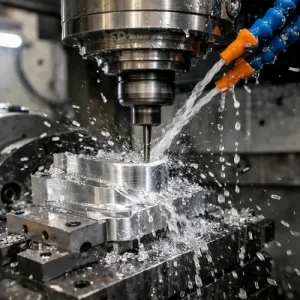
The CNC machining industry in 2026 looks very different from just a few years ago. Global supply chains have become more regional, product lifecycles are shorter, and engineers now expect manufacturing partners to contribute technical input rather than simply execute drawings. Speed, engineering feedback, process stability, and real production transparency are now as important as …

CNC machined aluminum part shown next to engineering drawing and measurement tools during production review

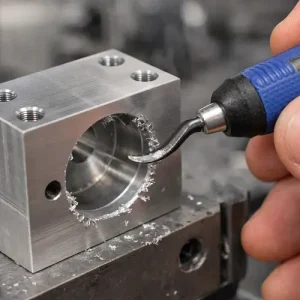
Burrs in CNC Machining: Causes, Risks, and Proven Solutions

If a part “looks fine” but still won’t assemble, burrs are usually the reason. Dimensions can be on print and surface finish acceptable, but edge condition causes assembly failure. A small exit burr can stop a press-fit, a micro burr on a sealing land can cause a slow leak, and a sliver of copper burr …

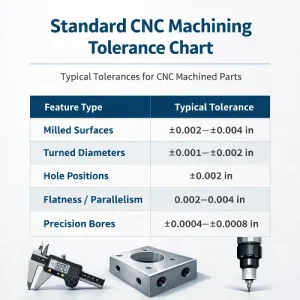
Standard CNC machining tolerance chart for precision parts

CNC Machining Tolerances: Standards, Charts, and Inspection Methods

On real CNC jobs,CNC Machining tolerances show up when parts stop fitting, when inspection starts rejecting pieces that look “fine,” or when cost suddenly jumps for no obvious reason. Most of the time, the root cause is the same: tolerances were chosen without thinking through how the part will actually be machined and measured.

If …

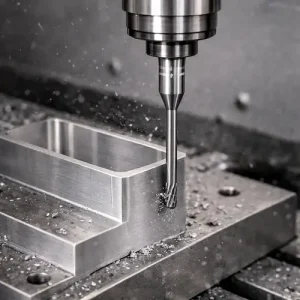
CNC machining aluminum thin-wall parts during milling

Challenges of CNC Machining Thin-Wall Parts

Thin-wall machining appears in far more CNC projects than many people expect. Thin edges, ribs, and reduced wall sections are rarely added for appearance. In most cases, they exist because the part must fit into a tight assembly, meet weight targets, or satisfy functional constraints.

The real question is not whether thin walls exist in …

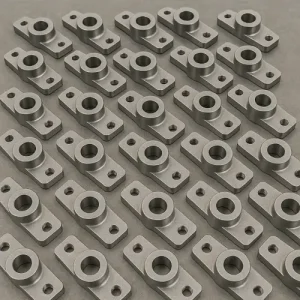
Low-volume CNC machined parts showing complex geometry, surface finish, and secondary operations

What Drives the Cost of Low-Volume CNC Machining

When requesting a quote for low-volume CNC machining, many buyers have the same reaction: the quantity is small, so why isn’t the price low?
This is a common question—and a reasonable one. The answer lies in how cost behaves in small batch production, where preparation and process control matter far more than part count.

Low-volume …

Low-volume CNC machined parts for functional testing and pilot production

Low-Volume CNC Machining for Functional Parts and Prototypes

Low-volume CNC machining typically refers to short production runs made from real engineering materials, often ranging from a few pieces to a few hundred parts. The exact quantity is rarely fixed. What defines “low-volume” is the context: the design is still evolving, functional validation is ongoing, or the program is not yet stable enough to …

CNC Machining Wall Thickness: Practical Guidelines Engineers Actually Use

Wall thickness is one of the most overlooked and problematic dimensions when doing CNC design or machining evaluations. What looks like a distance between two parallel lines on a drawing can affect material forces, heat transfer, clamping methods, tool deflection, and final assembly accuracy once it hits the cutting edge. In our daily machining at …

Reaming in Manufacturing: A Guide You Need to Know

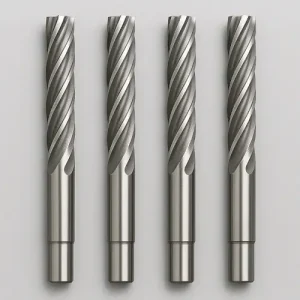
In the 21st century era of industrial advancement, the size and quality of holes in components often determine the performance of the entire part. From bearing housings in automotive engines to hydraulic passages in aerospace systems, poorly machined holes can lead to misalignment, leakage, or premature failure. When drilling fails to meet precision requirements, and …

Black Oxide Coating in Metal Surface Treatment

Black oxide coating is a widely used finishing process in metal manufacturing. Instead of adding an external layer such as paint or plating, it chemically converts the surface of the base metal into a thin, stable black oxide film. This finish is valued for its uniform dark appearance, dimensional stability, and cost efficiency.

The process …

Transparent vs Translucent vs Opaque Materials: Choosing the Right Components, Methods, and Projects

In manufacturing, the way a material interacts with light is more than an aesthetic detail—it often dictates design feasibility and production methods. Engineers choosing between transparent, translucent, and opaque materials are not simply deciding how a product will look. They are defining performance in optical clarity, light diffusion, or complete light blocking. These properties determine …

Scroll to Top