Counterbore and countersink are both common hole features in CNC machining, but they are not interchangeable. Both are used to prepare a hole for a fastener head, and that is where many drawings stop. On real machined parts, the choice affects much more than appearance. It affects how the screw head is supported, whether the surface stays flush, how much material remains around the hole, how the feature behaves during assembly, and how easy it is to machine consistently.
This is where a lot of avoidable problems start. A drawing may show a recessed screw head and assume either feature will work. In production, that is not how it goes. A counterbore and a countersink solve different design problems. One usually makes more sense when the fastener needs a flat, stable bearing seat. The other usually makes more sense when the fastener head must sit flush with the outer surface. If the wrong one is chosen, the part may still be machinable, but the result can be poor seating, weak edge support, awkward assembly, or unnecessary machining cost.
For machined metal and plastic parts, the right choice should come from fastener style, part thickness, surface function, and machining practicality. Shape matters, but function matters more.
What Is a Counterbore in CNC Machining?
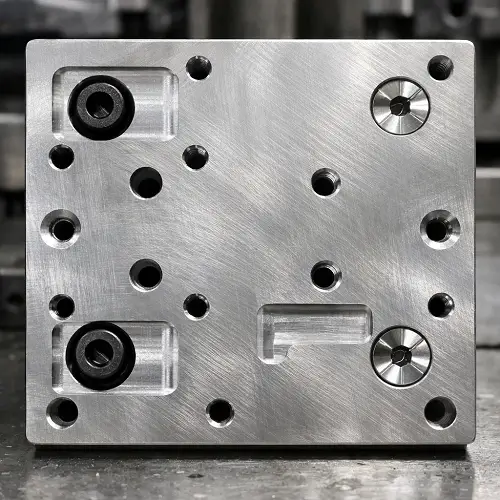
A counterbore is a cylindrical recess machined into the top of a hole. The wall is straight, and the bottom of the recess is flat. The purpose is usually to create a seat for a screw head or bolt head that needs a flat bearing surface. Socket head cap screws are one of the most common examples.
In CNC machining, a counterbore is often used when the fastener head needs to sit below or partially below the surface, but still bear against a flat seat. That flat seat is the key point. The screw head is not only recessed. It is supported in a stable, predictable way.
That matters more than many drawings show. If the seat is flat and sized correctly, the head contacts the material properly and the clamp load is transferred in a controlled way. If the recess is too shallow, too loose, poorly aligned, or not flat enough at the bottom, the head may still enter the feature, but the assembly can feel wrong once tightened.
Counterbores are common on fixture plates, mounting brackets, housings, machine components, and structural parts where screw heads need clearance but the design still wants strong head support.
What Is a Countersink in CNC Machining?
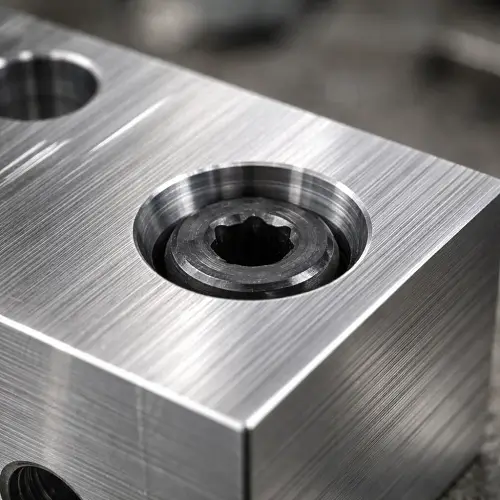
A countersink is a conical recess machined into the top of a hole. It is normally used with flat head screws so the screw head can sit flush with the outer surface or slightly below it. Instead of bearing on a flat-bottom seat, the head bears on the angled walls of the countersink.
In CNC machining, a countersink is usually selected when surface flushness matters. If the screw head must not protrude above the face, a countersink is often the first choice. This is common on covers, outer surfaces, compact assemblies, sliding-contact areas, and parts where clearance or appearance matters.
That does not mean countersinks are only cosmetic. They can be functionally necessary. A flush head may be required so another component can pass over the surface, so a mating face can sit cleanly against the part, or so the outer profile stays smooth in a tight assembly. But countersinks are also less forgiving in some situations. The seat angle must match the fastener head, the material around the hole must be thick enough to support the feature, and the entrance quality matters more than many people expect.
A countersink can look simple on a drawing, but on real machined parts it needs the right fastener, the right angle, and enough surrounding material to work well.
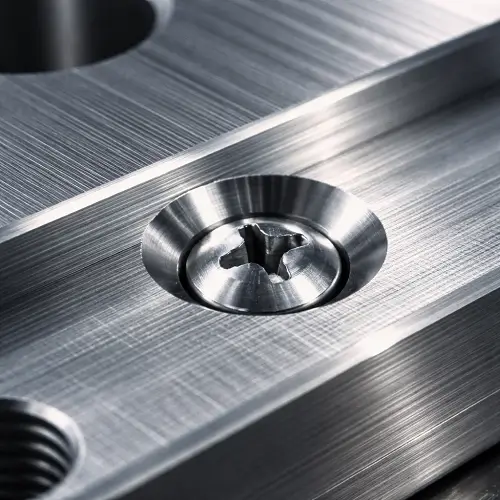
Counterbore vs Countersink: Quick Comparison
| Feature | Counterbore | Countersink |
|---|---|---|
| Basic shape | Cylindrical recess with a flat bottom | Conical recess with an angled seat |
| Typical fastener | Socket head cap screw, cylindrical-head fastener | Flat head screw |
| Seating style | Flat bearing seat under the head | Angled seating around the screw head |
| Surface result | Head can sit recessed, but not necessarily flush | Head can sit flush with the outer surface |
| Best use case | Stable head support and clamp seating | Flush surface and clearance above the face |
| Sensitivity | Depth, bottom flatness, concentricity | Angle match, burrs, edge condition, local thickness |
| Common limitation | Needs enough depth and local material | Can weaken thin parts or reduce edge support |
Counterbore vs Countersink: What Is the Real Difference?
The basic geometric difference is easy to explain. A counterbore has a straight wall and a flat bottom. A countersink has an angled wall and no flat seating floor. That part is simple.
The real difference is how the fastener head is supported and what the design is trying to achieve.
A counterbore is usually chosen when the fastener head needs a flat, stable seat. It works well when the design allows the head to sit below the surface without demanding a completely flush outer face. That is why it is so common with socket head cap screws and similar fasteners. The load goes into a flat surface, and the seating condition is easy to understand.
A countersink is usually chosen when the fastener head needs to sit flush with the surface. It is the more natural choice for flat head screws. Instead of relying on a flat seat, it uses the cone angle of the screw head to create seating. That gives a cleaner outer face, but it also makes the feature more dependent on angle match, edge condition, and local material thickness.
So the real question is not which one looks cleaner in CAD. The real question is what the fastener needs to do after assembly. If the priority is stable support under the head, a counterbore usually makes more sense. If the priority is a flush outer face, a countersink usually makes more sense.
Use a Counterbore When…
Use a counterbore when the design uses a socket head cap screw or another fastener with a cylindrical head and a flat bearing surface. That is the most natural application.
Use a counterbore when the fastener head needs stable seating support more than a perfectly flush outer surface. On machined brackets, fixture plates, machine parts, and mounting blocks, that usually matters more than appearance.
Use a counterbore when the part has enough thickness to support a cylindrical recess without weakening the surrounding material too much.
Use a counterbore when the screw head needs to sit lower than the top surface for clearance, but there is no real requirement for a flat head flush finish.
Use a counterbore when you want a feature that is usually more forgiving in assembly, especially when head support and clamp stability matter more than surface flushness.
Use a Countersink When…
Use a countersink when the design uses a flat head screw. That is the intended pairing.
Use a countersink when the screw head must sit flush with the outer surface. This matters on covers, exposed surfaces, sliding-contact areas, and assemblies with limited clearance above the part.
Use a countersink when the design needs a cleaner exterior profile and there is enough material thickness around the hole to support the conical seat properly.
Use a countersink when the surface itself is part of the product function, not just the fastener location. If another component has to move across the face, sit on the face, or seal against that area, a flush head may be necessary.
Use a countersink when flushness is truly required, not simply because it looks neater on the model.
Real Part Examples Where the Choice Matters
A fixture plate is a good example of where counterbores usually make more sense. The screws often need to sit below the working surface so clamps or other parts do not hit them, but the main goal is still strong, repeatable seating. A flat-bottom counterbore supports that well. A countersink would make little sense in many of those applications because flush appearance is not the main need.
A housing cover is a common example where countersinks may make more sense. If the screw heads need to sit flush on the outer surface, especially on a cleaner-looking enclosure or a cover that mates closely with surrounding components, countersinks are often the better choice. But even there, the part thickness has to be checked. On a thin cover, a countersink can remove more support than expected.
A thin aluminum panel is where designers often get into trouble. Flush screws look attractive, so countersinks are chosen by default. Then the material around the top of the hole becomes too weak, the seat quality becomes sensitive to burrs or over-tightening, and the final assembly does not feel as solid as expected. In many of those cases, the visual preference for a flush head needs to be balanced against the actual strength and seating condition.
A machined mounting bracket often favors a counterbore because the screw head needs a solid bearing seat and the outer face usually does not need to remain perfectly flush. If the head can be recessed and still clear neighboring geometry, a counterbore is usually the more robust choice.
How Fastener Type, Material Thickness, and Surface Requirements Affect the Choice
Fastener type should be the first filter. If the part uses a socket head cap screw, the natural feature is usually a counterbore. If the part uses a flat head screw, the natural feature is usually a countersink. Starting from the fastener avoids feature mismatch later.
Material thickness is the next major filter. A countersink removes material at the top of the hole in a way that can quickly reduce local support on thin parts. That is why flush head screws on thin components often need more review than they appear to need. The feature may be possible, but that does not automatically make it the best design choice.
A counterbore also removes material, but its geometry and support condition are different. Whether it works well depends on wall thickness, edge distance, and local part stiffness. A deep counterbore on a weak section can also become a problem if the surrounding structure is already thin.
Surface function matters just as much. If the face is an exterior cosmetic face or a clearance-critical face, a countersink may be the better option because flushness has real value. If the face is more about structural fastening, clamping, or mounting stability, a counterbore often makes more sense.
That is why feature choice should never be made by shape alone. The fastener, the available thickness, and the real purpose of the surface all matter.
Common Design Mistakes With Counterbores and Countersinks
One common mistake is choosing a countersink simply because a flush head looks cleaner, even though the part is too thin to support it properly. The assembly may still go together, but the seating area becomes narrow, the edge support becomes weaker, and the feature becomes more sensitive to burrs, angle mismatch, and over-tightening.
Another mistake is choosing a counterbore when the design actually needs a fully flush outer surface. The screw head may still sit lower than the face, but not low enough to avoid interference with another part or sliding surface. The feature is technically machined correctly, but functionally wrong.
A third mistake is ignoring fastener type during the hole design stage. A counterbore and a countersink are not general-purpose decorations around holes. They are fastener-driven features. If the fastener is not clearly defined first, the feature decision often turns into guesswork.
Drawings also get into trouble when the feature is shown too vaguely. A shallow conical chamfer is not the same thing as a real countersink for a flat head screw. A cylindrical recess without clear diameter and depth is not enough to define a reliable counterbore. Shops can only machine what the drawing communicates clearly.
Another real issue appears when designers assume either feature will be easy regardless of hole size. On small holes, thin parts, or features close to an edge, the practical machining window becomes tighter. The feature may still be possible, but it should not be treated as a casual detail.
Machining Considerations: Tolerance, Burrs, Seat Quality, and Alignment
In CNC machining, these features are not difficult in theory, but the quality of the finished seat matters more than many people expect.
For counterbores, seat depth and concentricity with the drilled hole are important. If the recess is not aligned well with the hole, the screw head may still enter, but the seating load will not be centered properly. The flatness and finish of the counterbore bottom also matter when the head needs to sit squarely and carry clamp load evenly.
For countersinks, angle match is critical. If the countersink angle does not match the fastener head correctly, the contact will be incomplete. The screw may appear seated, but the bearing condition will be poor. That affects both appearance and load transfer. Hole-edge burrs matter more with countersinks because the head interacts directly with the conical seat near the top edge of the feature.
Material behavior changes everything. Aluminum, stainless steel, brass, and engineering plastics do not machine the same way. Burr formation, edge sharpness, seat finish, and local deformation risk all change with material. The smaller the feature and the thinner the part, the less forgiving the process becomes.
This is why these hole features should not be treated as small drawing details that will automatically “work out in machining.” On simple parts, they may machine easily. On tighter parts, seat quality becomes part of the functional result.
CNC Machining Capabilities for Counterbores and Countersinks
JeekRapid can machine both counterbores and countersinks on metal and plastic parts, but the practical range always depends on part geometry, tool access, material, and hole size. Standard recessed hole features on common machined parts are usually straightforward. Very small holes, deep recesses, thin-wall areas, edge-close features, or tightly controlled seating requirements usually need drawing review before production.
This is especially important when the design depends on a flush head condition, precise seating depth, or a close relationship between the hole and surrounding mating surfaces. In those cases, the feature is no longer just a drilled detail. It becomes part of how the assembly works.
Why Deep Hole Capability Matters on Some Parts
Standard counterbores and countersinks are usually straightforward when the hole itself is short and accessible. The challenge increases when the part combines a counterbored or countersunk entrance with a long drilled hole below it. In those cases, the issue is no longer just the seating feature at the top. Hole depth, straightness, tool stability, burr control, and the alignment between the drilled hole and the seating feature all become more demanding.
Some shops handle standard recessed hole features well, but stability often becomes harder as drilling depth increases. JeekRapid can support deeper drilled hole features in reviewed applications, including hole depths around 160 mm, 170 mm, and in some cases 180 mm, depending on diameter, material, and part geometry. That matters on parts such as fixture plates, manifolds, housings, and other components where a counterbored or countersunk entrance is combined with a long through-hole or deep internal passage.
If your parts use socket head screws, flat head screws, flush mounting requirements, or long drilled holes below a recessed feature, it helps to identify that clearly during quoting. That gives the machining team a better chance to review the design before it turns into a production problem.
What to Confirm on the Drawing Before Production
The drawing should make the feature intent obvious. First, the fastener type should be clear. A feature cannot be reviewed properly if the shop has to guess what kind of head it is meant to seat.
Second, the key dimensions of the counterbore or countersink must be defined clearly. That includes the major diameter, the angle if it is a countersink, and the depth if it is a counterbore. Leaving that information vague often creates confusion between a true seating feature and a simple chamfer.
Third, the drawing should show whether flushness is functionally important. If the surface must stay smooth because another part passes over it, that matters. If the fastener head only needs clearance and stable support, that matters too. The shop needs to know what the feature is trying to accomplish.
Fourth, the material and thickness should already be part of the design review. A countersink that works well in a thick steel plate may be a weak choice in a thin aluminum cover. A counterbore that looks simple in CAD may remove more support than expected if the local wall thickness is already limited.
The more clearly the drawing shows the feature purpose, the easier it is to machine the right result.
Conclusion
Counterbore and countersink are both common in CNC machining, but they should not be treated as interchangeable hole details. A counterbore is usually the better choice when the fastener head needs a flat, stable seat and the design does not require a flush outer surface. A countersink is usually the better choice when a flat head screw must sit flush and surface clearance matters.
The right decision comes from function, not shape alone. Fastener style, material thickness, seat quality, outer surface requirements, and machining practicality all affect the correct choice. If those factors are not considered early, the wrong feature can create assembly trouble, weak support around the hole, or unnecessary machining difficulty later.
JeekRapid machines both counterbores and countersinks for machined metal and plastic parts. For parts with flush-mounting requirements, critical seating features, or recessed hole features combined with long drilled holes, send the drawing to JeekRapid before production so the feature choice, hole size, seat depth, and machining practicality can be reviewed early.
FAQs
What is the difference between a counterbore and a countersink in CNC machining?
A counterbore is a cylindrical recess with a flat bottom, usually used for cylindrical-head fasteners such as socket head cap screws. A countersink is a conical recess, usually used for flat head screws so the head can sit flush with the part surface.
When should I use a counterbore instead of a countersink?
A counterbore is usually the better choice when the fastener head needs a flat, stable bearing seat and the outer surface does not need to stay fully flush. It is commonly used on fixture plates, mounting brackets, and machine parts.
When should I use a countersink on machined parts?
A countersink is usually the right choice when a flat head screw must sit flush with the surface or when head clearance above the part is limited. It is often used on covers, exterior faces, and parts where a smooth outer profile matters.
Is a countersink weaker than a counterbore on thin parts?
It can be. On thin parts, a countersink may remove too much material around the top of the hole and reduce local support. That is why thin sections often need review before a countersink is used as the default choice.
Are counterbores easier to machine than countersinks?
Not always, but counterbores are often more forgiving when flat seating support is the main goal. Countersinks can be more sensitive to angle match, burrs, and surface condition, especially on small holes or thin materials.
Can counterbored or countersunk holes be combined with deep drilled holes?
Yes, but that usually requires more review. When a recessed hole feature is combined with a deep drilled hole, alignment, hole straightness, burr control, and seat quality become more important.