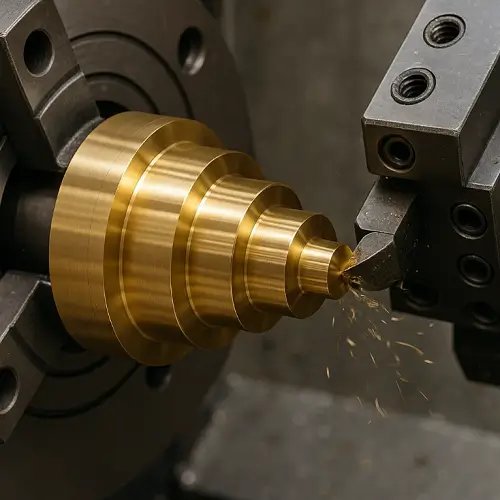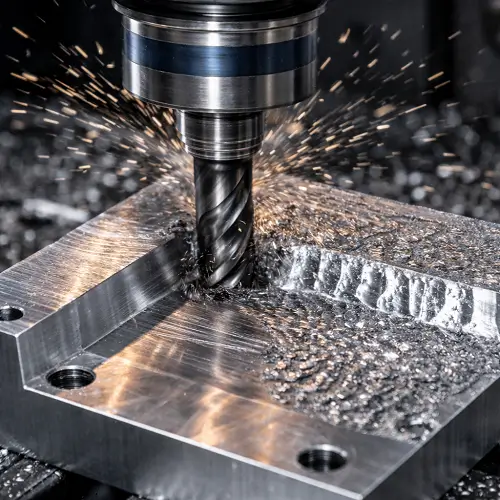
CNC machined manifolds combine internal passages, threaded ports, valve locations, and mounting features in a single block. They are used to distribute or control hydraulic oil, compressed air, water, coolant, gas, and vacuum within industrial equipment.
A custom manifold can replace several separate hoses, fittings, and connection points, helping the system fit into a smaller space and making the piping layout easier to manage. The block still needs to match the selected valves, pumps, cylinders, sensors, fittings, and available installation space, so most manifold projects are produced from a customer drawing rather than selected as a standard part.
Although a manifold may look like a simple rectangular block, its internal structure is usually the most important part. Ports must connect to the correct passages, intersecting holes must be properly cleared, and sealing areas must match the fittings or valves used in the final assembly.
What Are CNC Machined Manifolds?
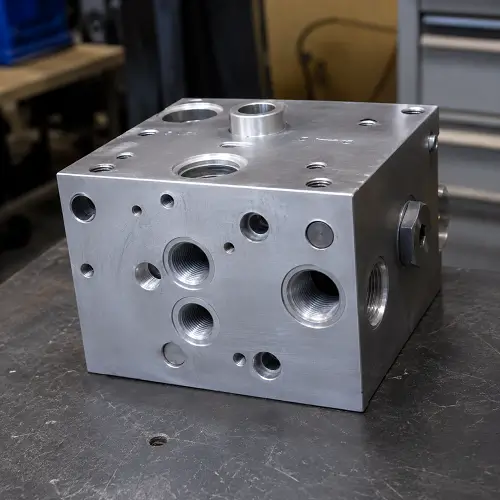
CNC machined manifolds are metal or engineering-plastic blocks with internal passages used to distribute liquids, air, gas, coolant, or vacuum between different system components. External ports connect the manifold to pumps, valves, cylinders, hoses, sensors, filters, and other equipment.
These blocks may also include valve cavities, threaded mounting holes, plugged cross-drilled passages, O-ring grooves, sealing faces, and equipment mounting features. Combining these functions into one part can reduce the number of separate hoses, fittings, and connection points required in the system.
CNC manifold machining is used when the internal passage layout, port positions, thread standards, mounting dimensions, or material must be customized for a specific machine or fluid system. It is suitable for prototypes, replacement parts, special equipment, and low-volume manifold production.
CNC machining produces the manifold block and its required features, but final pressure capacity, flow performance, sealing, and media compatibility still depend on the passage design, wall thickness, fittings, plugs, seals, valves, assembly, and functional testing.
Common Types of CNC Machined Manifolds
Hydraulic and Pneumatic Manifolds
Hydraulic manifold machining is used to produce blocks that connect pumps, valves, cylinders, hydraulic motors, pressure controls, and other components carrying pressurized oil. These parts are commonly found in industrial machinery, material-handling equipment, agricultural machines, test systems, and hydraulic power units.
A hydraulic manifold block may contain several valve cavities, pressure and return passages, threaded ports, plug locations, and mounting holes. The block material and internal wall thickness must match the intended system requirements rather than being selected only by part size.
Pneumatic manifold machining is used for compressed-air distribution in automation equipment, fixtures, cylinders, vacuum systems, valve stations, and production machinery. Pneumatic blocks are often smaller and lighter than hydraulic valve blocks, but port locations, thread types, air passages, and leakage requirements still need to be defined clearly.
Coolant, Water, and Vacuum Manifolds
Coolant and water manifolds distribute fluid between several circuits or components. They may be used in battery cooling, power electronics, laser systems, industrial machines, mold-temperature equipment, laboratory systems, and other temperature-control applications.
A CNC machined cooling block can contain inlet and outlet ports, branching passages, mounting features, sensor locations, and connections to hoses or tubing. The material should be compatible with the coolant or water used in the system, as well as the operating temperature and surrounding environment.
Vacuum and gas manifolds are used in vacuum fixtures, testing equipment, analytical instruments, semiconductor equipment, laboratory systems, and gas-distribution assemblies. These applications may have more specific requirements for material compatibility, cleaning, sealing, and testing, so they should be reviewed individually before production.
Valve and Fluid-Control Blocks
Valve blocks combine internal passages with valve cavities, control ports, sensor connections, plugs, and mounting features. They can be used to control the direction, pressure, or distribution of liquid or gas in a compact assembly.
Custom valve block machining is useful when standard valve assemblies take up too much space or cannot match the required port layout. The block can be machined around specific cartridge valves, fittings, sensors, or other purchased components.
Valve and fluid-control blocks may overlap with hydraulic, pneumatic, coolant, or gas manifolds. The main difference is that the block does more than distribute a medium; it also provides locations for components that control how the medium moves through the system.
Materials for CNC Machined Manifolds
The right manifold material depends on the working fluid or gas, operating temperature, pressure, corrosion exposure, weight limit, thread requirements, and project budget. A stronger or more expensive material is not automatically the better choice.
| Material | Common Grades | Typical Applications | Main Advantages | Considerations |
|---|---|---|---|---|
| Aluminum | 6061, 7075 | Pneumatic manifolds, cooling blocks, automation equipment, lightweight fluid systems | Lightweight, corrosion resistant, and efficient to machine | Pressure, thread wear, surface treatment, and fluid compatibility must match the application |
| Stainless Steel | 304, 316, 17-4PH | Chemical systems, food equipment, medical equipment, outdoor systems, corrosive environments | High strength and corrosion resistance | Heavier and more expensive to machine than aluminum |
| Carbon and Alloy Steel | 1018, 4140 | Hydraulic valve blocks, industrial machinery, higher-load systems | Good strength for demanding mechanical applications | Usually needs corrosion protection and fluid-compatibility review |
| Brass | C360 | Air, water, instrument, and small fluid-control manifolds | Good machinability, corrosion resistance, and thread quality | Heavier and generally more expensive than aluminum |
| Engineering Plastics | POM, PTFE, PEEK | Chemical handling, laboratory equipment, insulating parts, lightweight fluid systems | Chemical resistance, electrical insulation, and low weight | Temperature, pressure, creep, sealing, and thread strength require careful review |
6061 aluminum is a practical starting point for many pneumatic, cooling, and general industrial manifolds because it offers a useful balance of weight, machinability, corrosion resistance, and cost. Higher-strength aluminum such as 7075 may be considered when the application requires it, although strength alone should not determine the final material.
304 and 316 stainless steel are commonly considered when corrosion resistance matters. For exposure to moisture, chemicals, cleaning fluids, or more demanding environments, 316 may be more suitable than a standard aluminum or carbon-steel block.
Steel can be useful for hydraulic and industrial manifolds that need greater strength, while brass is often selected for smaller air, water, and instrument components. Plastic manifolds need closer review because pressure, temperature, long-term load, and thread strength can significantly affect their performance.
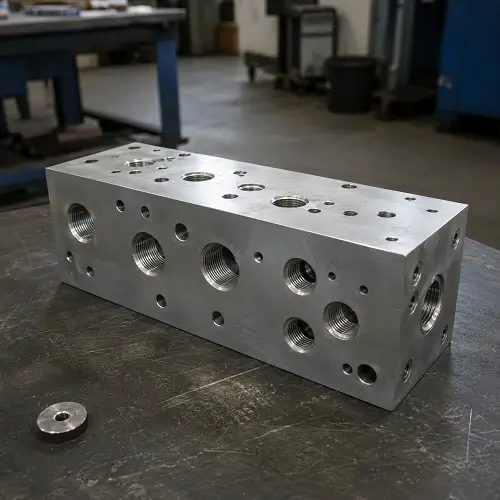
Industries That Use CNC Machined Manifolds
Industrial Automation and Robotics
Automation equipment often uses pneumatic manifolds, vacuum manifolds, air-distribution blocks, and actuator-control blocks. These parts can supply several cylinders, grippers, suction cups, clamps, or motion components from one compact location.
A custom manifold is useful when the equipment has limited installation space or when valves, sensors, and fittings need to follow a specific machine layout. Robotic end-effectors and automated fixtures may also use small vacuum or pneumatic blocks close to the working area.
Hydraulic Equipment and Heavy Machinery
Hydraulic manifolds are used in construction equipment, agricultural machinery, machine tools, lifting systems, presses, material-handling equipment, and hydraulic test stations.
These blocks connect pumps, cylinders, valves, motors, filters, and pressure-control components. Compared with a pneumatic manifold, a hydraulic valve block may require more attention to material strength, passage layout, sealing details, internal cleanliness, and testing requirements.
Electronics, Batteries, and Cooling Systems
Liquid-cooling manifolds distribute coolant through battery modules, power electronics, controllers, servers, laser equipment, test systems, and industrial electronic assemblies.
These projects often have limited space around heat-generating components. The manifold may need to fit beside an enclosure, cold plate, pump, or heat exchanger while keeping the inlet, outlet, sensor, and mounting positions accessible.
Material compatibility and leakage risk are especially important when coolant passages are located close to batteries, circuit boards, connectors, or power modules.
Medical, Laboratory, and Analytical Equipment
Medical, laboratory, and analytical systems may use small manifolds to control liquid, air, gas, or vacuum between pumps, valves, sensors, sample containers, and testing components.
The material, internal cleanliness, chemical compatibility, documentation, and testing requirements should be confirmed before quotation. Machining a manifold does not automatically make it suitable for a regulated medical or analytical application.
Semiconductor and Vacuum Equipment
Semiconductor and precision manufacturing equipment may use manifolds for vacuum distribution, process-gas routing, cooling, testing, and fixture control.
These parts can have stricter requirements for material selection, internal cleanliness, sealing methods, surface condition, and residual particles. A standard industrial air manifold should not be treated as equivalent to a high-vacuum or process-gas component without reviewing the application.
What Makes Manifold Machining Difficult?
The main challenge in manifold block machining is that much of the important geometry is hidden inside the part. External dimensions can be inspected directly, but internal passages may intersect from several directions and remain difficult to access after machining.
Cross-drilled holes can leave burrs where two passages meet. Chips or loose material remaining inside the block may later enter a valve, seal, pump, or connected component. The manufacturing plan therefore needs to consider how internal passages will be deburred, cleaned, and checked.
Deep or narrow passages also increase machining difficulty. Longer tools have less stability, chip removal becomes more difficult, and the drill must stay within the intended path without breaking through a nearby wall.
Ports require more than a nominal hole diameter. The drawing should identify the correct thread standard, size, depth, orientation, and sealing method. NPT, BSPP, BSPT, SAE straight threads, and metric ports do not all seal in the same way and should not be substituted without confirmation.
Sealing faces, valve mounting areas, O-ring grooves, and plug locations also affect final assembly. These features may require more controlled dimensions and surface conditions than the outside faces of the block. Applying tight tolerances only to the functional features usually makes more sense than assigning the same requirement to the entire part.
Before machining begins, the port standards, internal passages, plug locations, sealing faces, and testing requirements should be checked against the 2D drawing. This review can identify blocked passages, insufficient wall thickness, inaccessible plugs, and unclear sealing requirements before material is cut.
The block can be machined to the drawing, but system pressure, sealing integrity, and flow performance should still be confirmed through the appropriate assembly and functional testing. Any required pressure, flow, or leakage test should be discussed before quotation.
CNC Manifolds for Prototypes and Low-Volume Production
CNC machining is suitable for prototype manifolds because the block can be produced without a casting die or dedicated production tool. Port positions, passage layouts, mounting holes, and the outside shape can be changed while the equipment design is still being developed.
During a new machine or fluid-system project, the selected valve, sensor, pump, fitting, or connector may change after the first assembly. A prototype manifold allows the customer to check whether the ports are accessible, the fittings have enough clearance, the passages connect correctly, and the block fits within the available equipment space.
A prototype can also reveal practical issues that are difficult to see in a CAD model. A hose may interfere with a nearby component, a plug may be difficult to reach, or a maintenance tool may not have enough room around a fitting.
Once the design is stable, CNC machining can continue to support low-volume hydraulic blocks, pneumatic manifolds, cooling blocks, and fluid-control components. Repeat production requires consistent port locations, thread quality, sealing areas, materials, cleaning, and inspection methods.
What Affects CNC Machined Manifold Cost?
The cost of a CNC machined manifold depends on the material, block size, number of ports, internal passages, hole depth, thread standards, sealing features, machining sides, inspection, cleaning, and order quantity.
A small aluminum pneumatic block with several short passages and standard threaded ports is generally easier to produce than a stainless steel hydraulic valve block containing deep cross-holes, multiple valve cavities, sealing faces, and several thread types.
More ports do not only mean more drilling. Each port may require drilling, boring, threading, spot-facing, deburring, cleaning, and inspection. Passages entering from several sides can also require additional setups and more complex workholding.
Material also changes the final CNC machining cost. Aluminum is usually faster to machine than stainless steel, alloy steel, or some high-performance plastics. Surface treatments, corrosion protection, material certification, internal-cleanliness requirements, and special inspection can add cost and lead time.
Pressure, flow, or leakage testing may also affect the quotation when requested. The required test medium, pressure, duration, acceptance standard, fixtures, and documentation should be confirmed before the order because not every project requires the same validation method.
What Is Needed for a Manifold Quote?
A manifold quotation should be based on both the physical part and its function in the fluid system. A 3D model helps define the external shape and internal passages, while a 2D drawing is normally needed to communicate threads, sealing features, tolerances, inspection, and testing requirements.
The quotation information should include:
- 3D CAD model and 2D drawing
- Material and grade
- Order quantity
- Port sizes and thread standards
- Internal passage layout
- Valve, fitting, plug, and sensor interfaces
- Working liquid, gas, coolant, or vacuum
- Expected operating pressure and temperature
- Sealing method
- Surface treatment
- Cleanliness and inspection requirements
- Any required pressure, flow, or leakage testing
Critical ports, valve cavities, sealing faces, and mating surfaces should be identified clearly rather than applying unnecessarily tight requirements to every dimension. This makes the drawing easier to review and helps the quotation reflect the features that matter to the final assembly.
Get a CNC Machined Manifold Quote
Each manifold project should be reviewed around the working medium, port standards, sealing method, pressure and temperature, cleanliness level, and required testing before production.
JeekRapid provides CNC machining services for custom hydraulic, pneumatic, coolant, water, gas, vacuum, and fluid-control manifold blocks.
Upload your 3D CAD model and 2D drawing so the material, ports, internal passages, sealing features, quantity, inspection, cleaning, and testing requirements can be reviewed before quotation.