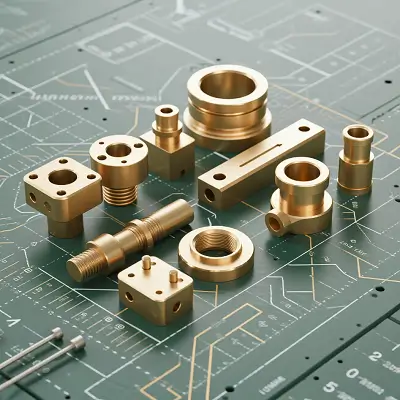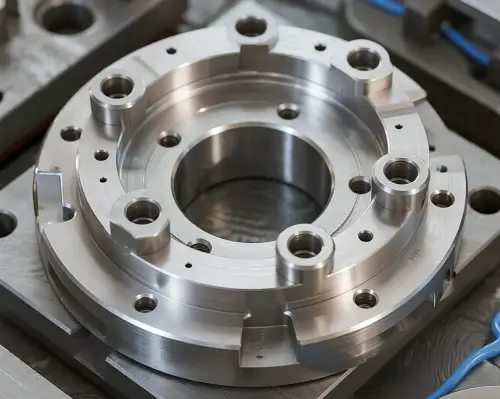
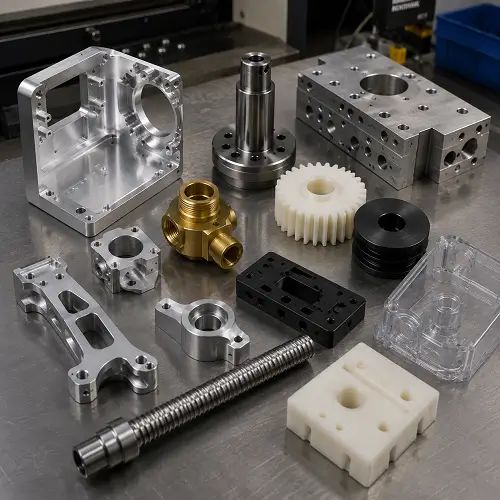
For many CNC machining projects, the material choice can be narrowed down to a small group of common metals and engineering plastics. Aluminum 6061, aluminum 7075, stainless steel 304 or 316, carbon and alloy steel, brass, POM, nylon, ABS, and polycarbonate cover many prototype and production requirements.
The difficult part is not knowing which materials CNC machines can cut. It is deciding which material provides enough strength, stability, corrosion resistance, temperature performance, and service life without adding unnecessary cost.
A general housing may work in aluminum, stainless steel, or plastic. A shaft may require carbon steel, alloy steel, or stainless steel. A gear may be machined from POM, nylon, brass, or hardened steel. The final choice depends on what the part must do, where it will operate, which dimensions are critical, and how much the complete part will cost to manufacture.
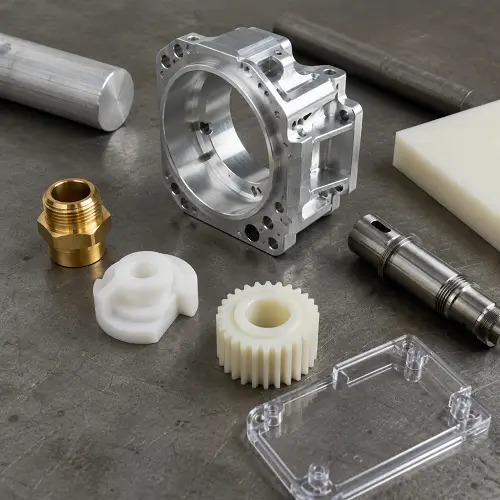
Common CNC Machining Materials at a Glance
The following materials provide a practical starting point for most custom CNC machining projects.
| Material | Common Applications | Main Reason to Choose It | Main Point to Consider |
|---|---|---|---|
| Aluminum 6061 | Housings, brackets, fixtures, frames and heat sinks | Good balance of machinability, weight, strength and cost | Not intended for severe wear or very high structural loads |
| Aluminum 7075 | Aerospace parts, robotics components and high-load brackets | Higher strength than 6061 without the weight of steel | Higher material cost and limited weldability |
| Stainless steel 304 | Food equipment, outdoor parts and general machine components | Good general corrosion resistance | Requires more machining time than aluminum |
| Stainless steel 316 | Marine, medical, chemical and fluid-handling parts | Better resistance to saltwater and demanding chemical environments | Usually costs more than 304 |
| 1018 carbon steel | Plates, pins, brackets and fixtures | Economical, strong and widely available | Usually needs protection against corrosion |
| 4140 alloy steel | Shafts, gears, couplings and tooling components | Higher strength and wear resistance | Machining depends on the supplied hardness |
| Brass | Fittings, valves, connectors and threaded parts | Excellent machinability and good corrosion resistance | Exact alloy should be confirmed |
| POM | Gears, bushings, rollers, guides and precision plastic parts | Good dimensional stability and low friction | Lower temperature resistance than high-performance plastics |
| Nylon | Rollers, gears, pulleys and wear components | Tough and suitable for many sliding applications | Moisture absorption can change dimensions |
| ABS | Housings, covers and appearance prototypes | Low cost and relatively easy machining | Limited heat, wear and chemical resistance |
| Acrylic | Transparent covers, displays and light guides | Good optical clarity | Brittle around stressed holes and sharp corners |
| Polycarbonate | Guards, protective covers and machine windows | Better impact resistance than acrylic | May require polishing for a clear machined finish |
| PEEK | Medical, aerospace, semiconductor and high-temperature parts | High-temperature and chemical performance | High material and machining cost |
These recommendations are starting points. Wall thickness, part size, loading direction, threads, operating temperature, surface treatment, certification, and production quantity can change the final choice.
What Are the Best CNC Materials for Common Parts?
Starting with the part type is often easier than comparing every available material.
| Part Type | Common Starting Material | When to Consider Another Material |
|---|---|---|
| General bracket | Aluminum 6061 | Use 7075 or steel when the load or stiffness requirement is higher |
| Electronic housing | Aluminum 6061 or ABS | Use aluminum for heat dissipation, durable threads and greater stiffness |
| Machine mounting plate | Aluminum 6061 or 1018 steel | Use steel when rigidity matters more than weight |
| Shaft | 1045 or 4140 steel | Use stainless steel when corrosion resistance is important |
| Gear | POM or nylon | Use brass or steel for higher loads or longer service life |
| Bushing | POM, nylon or bronze | Use bronze or hardened steel for higher contact pressure |
| Heat sink | Aluminum 6061 | Use copper when higher conductivity justifies the added weight and cost |
| Fluid component | 304, 316, brass or POM | Select according to the actual fluid, pressure and temperature |
| Transparent cover | Acrylic or polycarbonate | Use polycarbonate when impact resistance matters more than optical clarity |
| Inspection fixture | Aluminum 6061 or POM | Use POM for lightweight and non-marring contact surfaces |
| Outdoor component | Anodized aluminum or stainless steel | Use 316 for saltwater or more aggressive environments |
| High-temperature plastic part | PEEK | Use only when common engineering plastics cannot meet the temperature requirement |
The same part type may still require different materials. A housing used indoors has different requirements from a housing exposed to saltwater, heat, impact, or repeated cleaning.
Aluminum 6061 vs 7075 for CNC Machining
Aluminum 6061 is the usual starting point for general CNC machined metal parts. It is widely available, machines efficiently, and supports finishes such as anodizing, bead blasting, painting, and powder coating.
It is commonly used for housings, fixtures, frames, mounting plates, heat sinks, and moderate-load brackets.
Aluminum 7075 is selected when the part requires higher strength while remaining lightweight. Typical applications include aerospace components, robot joints, structural arms, high-load fixtures, and performance equipment.
| Requirement | Aluminum 6061 | Aluminum 7075 |
|---|---|---|
| General-purpose parts | Usually preferred | Often unnecessary |
| Strength | Moderate | Higher |
| General corrosion resistance | Better | May require more surface protection |
| Welding | More suitable | Usually not preferred |
| Material cost | Lower | Higher |
| Typical use | Housings, fixtures and frames | Aerospace and high-load lightweight parts |
The choice is not simply “6061 for inexpensive parts and 7075 for better parts.” A thicker 6061 component may sometimes provide sufficient stiffness and load capacity at a lower total cost than a thinner 7075 design.
7075 makes sense when its higher strength solves a real weight, space, or loading problem. For ordinary housings, covers, fixtures, and moderate-load brackets, 6061 is usually the more practical choice.
Stainless Steel 304 vs 316 for CNC Machining
Stainless steel is selected when a part needs corrosion resistance, strength, cleanliness, or an unfinished metallic surface.
Stainless steel 304 is commonly used for machine components, food-processing equipment, outdoor hardware, medical equipment housings, and parts exposed to normal cleaning or moisture.
Stainless steel 316 is more suitable for saltwater, marine environments, aggressive cleaning agents, and certain chemical or fluid-handling applications.
| Requirement | Stainless Steel 304 | Stainless Steel 316 |
|---|---|---|
| General corrosion resistance | Good | Better in demanding environments |
| Indoor and normal outdoor equipment | Common choice | Often unnecessary |
| Marine and saltwater exposure | Limited | Usually preferred |
| Material cost | Lower | Higher |
| Machining considerations | More demanding than aluminum | More demanding than aluminum |
| Typical use | General equipment and hardware | Marine, chemical, medical and fluid systems |
316 is not automatically the better choice. When a part operates indoors or in a normal outdoor environment, 304 may provide sufficient corrosion resistance at a lower material cost.
For valves, fittings, manifolds, and chemical-processing components, the actual fluid, concentration, temperature, and cleaning method should be confirmed before the grade is selected.
1018 vs 4140 Steel for CNC Parts
Carbon and alloy steels are used when a part needs more stiffness, load capacity, or wear resistance than aluminum or plastic can provide.
1018 steel is suitable for general plates, brackets, pins, spacers, fixtures, and machine components. It is widely available, relatively economical, and suitable for welding. Its main limitation is corrosion, so many parts require black oxide, plating, painting, or powder coating.
4140 steel is used for shafts, gears, couplings, high-load pins, tooling components, and parts exposed to repeated mechanical stress or wear.
| Requirement | 1018 Steel | 4140 Steel |
|---|---|---|
| General machine parts | Usually suitable | May be unnecessary |
| High load or wear | Limited | Better |
| Welding | Easier | Requires more consideration |
| Heat treatment | Limited improvement | Commonly heat-treated |
| Material and machining cost | Lower | Higher |
| Typical use | Plates, brackets and pins | Shafts, gears and couplings |
The drawing should specify the supplied condition or final hardness when 4140 is required. Annealed, pre-hardened, and fully hardened 4140 do not machine in the same way.
If heat treatment is performed after machining, critical dimensions may need additional finishing or grinding because the treatment can cause distortion.
POM vs Nylon for CNC Machined Plastic Parts
POM and nylon are common choices for gears, bushings, rollers, guides, and wear components, but they should not be treated as interchangeable materials.
POM, also called acetal, is often the safer starting point for a precision plastic part. It machines cleanly, provides low friction, and generally maintains dimensions more predictably than nylon.
Nylon is tough and performs well in many sliding, impact, and wear applications. Its main limitation is moisture absorption, which can change dimensions and affect the fit of a finished part.
| Requirement | POM | Nylon |
|---|---|---|
| Dimensional stability | Better | More affected by moisture |
| Tight-tolerance plastic parts | Usually preferred | Requires more consideration |
| Wear performance | Good for low-friction precision parts | Often suitable for tougher sliding and impact applications |
| Toughness and impact resistance | Good | Often better |
| Typical use | Precision gears, guides and fixtures | Rollers, pulleys and wear pads |
Choose POM when dimensional stability, predictable fit, and machining accuracy are the main concerns.
Choose nylon when toughness, impact resistance, and wear performance have greater priority than maintaining a very precise size in changing humidity.
For a tight-fitting bushing or precision guide, changing from nylon to POM may be more reliable than simply applying a tighter tolerance to the nylon part.
Acrylic vs Polycarbonate for Clear CNC Parts
Acrylic and polycarbonate are both used for transparent machined components, but they solve different problems.
Acrylic provides good optical clarity and is commonly selected for displays, light guides, inspection windows, covers, and decorative parts. It is relatively brittle and can crack around sharp corners, countersinks, or tightly fastened holes.
Polycarbonate provides better impact resistance and toughness. It is more suitable for machine guards, protective covers, safety windows, and transparent components exposed to vibration or impact.
| Requirement | Acrylic | Polycarbonate |
|---|---|---|
| Optical clarity | Better | Good |
| Impact resistance | Lower | Higher |
| Crack resistance | Lower | Better |
| Decorative appearance | Usually preferred | Suitable |
| Protective guards | Limited | Usually preferred |
Machined surfaces on both materials may show tool marks or appear cloudy. Polishing may be required when the finished part needs a clear optical surface.
The mounting design is also important. A suitable transparent material can still fail when a small hole is overtightened or placed too close to a sharp edge.
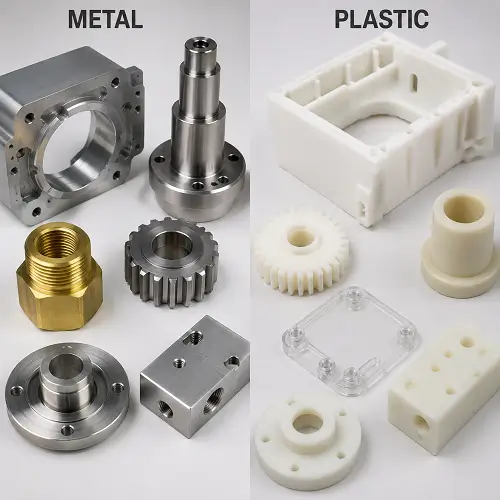
Should You Choose Metal or Plastic for CNC Machining?
Metal is normally preferred for structural loads, pressure-bearing parts, high temperatures, durable threads, and assemblies that require high stiffness.
Plastic is often selected for electrical insulation, low weight, chemical resistance, reduced noise, and low-friction movement.
| Requirement | Metal | Plastic |
|---|---|---|
| High strength and stiffness | Usually better | Limited by grade and temperature |
| Low weight | Aluminum or titanium | Usually lighter |
| High temperature | Usually better | Requires a suitable high-performance polymer |
| Electrical insulation | Requires isolation or coating | Usually better |
| Thermal or electrical conductivity | Aluminum, copper or brass | Generally unsuitable |
| Low-friction movement | Bronze or treated metal | POM, nylon or PTFE |
| Tight tolerances | Usually more predictable | Depends heavily on the plastic |
| Corrosion resistance | Stainless steel, titanium or coating | Many plastics resist water and chemicals |
| Durable threads | Better | Inserts may be required |
| Low-cost appearance prototype | Aluminum may work | ABS is often practical |
Plastic is not automatically cheaper. High-performance polymers such as PEEK may cost more than common metals. Soft plastics may also need special fixtures, reduced clamping pressure, slower finishing passes, and more realistic tolerances.
A metal part should not be changed to plastic based only on weight or raw material price. Threads, wall thickness, long-term loading, creep, temperature, and assembly method must also be reviewed.
How Do You Choose a CNC Machining Material?
Start with the part function and operating environment. These two factors usually remove most unsuitable materials. The remaining options can then be compared according to load, weight, dimensional stability, surface requirements, and total manufacturing cost.
What Does the Part Need to Do?
The material should support the part’s main function.
A housing needs enough stiffness to protect internal components. A shaft needs strength, fatigue resistance, and wear resistance. A gear needs suitable tooth strength and friction performance. A heat sink needs thermal conductivity. An electrical spacer needs insulation.
A general housing may work in aluminum 6061 or ABS. A loaded shaft is more likely to require steel. A sliding guide may work better in POM or nylon. A busbar or cooling plate may require copper or aluminum.
Starting with the function prevents unrelated materials from being compared.
How Much Load Will the Part Carry?
The design should consider static load, impact, vibration, torque, repeated loading, and long-term stress.
Aluminum is suitable for many lightweight structures. Steel is usually preferred for heavily loaded shafts, clamps, gears, and machine components. Plastic works well for covers, guides, rollers, and low-load mechanical parts but can deform under continuous structural load.
Stiffness also matters. A material may be strong enough to avoid breaking but still flex too much to maintain alignment or positioning accuracy.
Where Will the Part Operate?
The operating environment can determine the material before strength is considered.
Water, saltwater, chemicals, humidity, continuous temperature, outdoor exposure, food contact, cleaning agents, dust, and abrasion can all affect material performance.
A normal indoor bracket does not need the same material as a marine valve body. A plastic that performs well at room temperature may soften or move near a motor, heater, or exhaust component.
For chemical applications, provide the exact fluid, concentration, and temperature. Broad descriptions such as “chemical resistant” do not provide enough information for a reliable recommendation.
Does Weight, Conductivity, or Insulation Matter?
Aluminum is commonly selected when low weight and moderate strength are required. Titanium provides higher strength-to-weight performance, but the material and machining costs are much higher.
Copper and aluminum are used for heat transfer and electrical conductivity. Brass provides useful conductivity with better general machinability than pure copper.
POM, nylon, PEEK, PTFE, and other engineering plastics provide electrical insulation. The correct option still depends on temperature, mechanical load, chemical exposure, and dimensional stability.
Which Dimensions Are Actually Critical?
Material behavior affects how reliably a part can hold its specified dimensions.
Aluminum, steel, stainless steel, brass, and POM generally provide predictable machining results. Nylon may absorb moisture, while softer plastics such as PTFE and HDPE can deform during machining or inspection. Large plastic components and thin aluminum walls may also move as internal stress is released.
Tight tolerances should be reserved for features that control fit, sealing, location, or movement. When a plastic part requires the same tolerance as a metal part, the material, part size, wall thickness, operating temperature, and inspection conditions should be reviewed before production.
In some cases, changing from nylon to POM, increasing the wall thickness, or modifying the geometry is more reliable than simply specifying a tighter tolerance.
What Surface Finish Does the Part Need?
The selected material must support the required finish.
Aluminum can be anodized, hard anodized, bead blasted, painted, plated, or powder coated. Stainless steel can be passivated, electropolished, brushed, or polished. Carbon steel often requires plating, black oxide, painting, or powder coating to prevent corrosion.
A coating can affect holes, threads, sealing surfaces, and mating dimensions. Surface treatment should therefore be defined before machining begins.
Stainless steel may cost more to machine than carbon steel, but it may remove the need for a separate corrosion-resistant coating. The complete manufacturing route should be compared rather than only the raw material price.
What Is the Total Manufacturing Cost?
Raw material price is only one part of CNC machining cost.
The final quotation also depends on available stock sizes, cutting speed, tool wear, number of setups, deformation risk, heat treatment, surface finishing, inspection, and certification requirements.
Aluminum 6061 is often economical because it is widely available and machines efficiently. Stainless steel and titanium normally require longer machining times. Copper may cost more and be more difficult to machine than brass. PEEK has a high stock cost, while soft plastics may require more careful workholding.
The useful comparison is the finished-part cost, not the price per kilogram.
How Does Material Choice Affect CNC Machining?
Material selection changes the machining plan, fixture design, achievable tolerances, inspection method, and sometimes the part geometry.
| Material | Common Machining Concern | What the Drawing or Quote Should Confirm |
|---|---|---|
| Aluminum 6061 | Thin walls and large flat areas may distort | Wall thickness, flatness and anodizing requirements |
| Aluminum 7075 | Higher material cost | Whether the additional strength is necessary |
| Stainless steel | Heat, work hardening and tool wear | Critical finishes, threads and passivation |
| 4140 steel | Machining changes with hardness | Supplied condition, final hardness and heat treatment |
| Brass | Different alloys have different machinability and compliance requirements | Exact alloy, fluid exposure and cosmetic finish |
| POM | Thermal expansion can affect precision fits | Operating temperature and critical dimensions |
| Nylon | Moisture can change dimensions | Humidity, fit and conditioning requirements |
| Acrylic | Cracking around sharp corners and stressed holes | Corner radii, hole position and mounting method |
| Polycarbonate | Cutting heat can affect the surface | Optical finish and polishing requirements |
| PEEK | High stock and scrap cost | Exact grade, certification and whether PEEK is necessary |
Thin Walls and Large Flat Parts
Removing material reduces part stiffness and can release internal stress. Thin aluminum walls, large plates, soft plastics, and uneven geometries are more likely to move during machining.
These components may require rough and finish machining, balanced material removal, temporary support features, reduced clamping force, stress-relieved stock, or additional inspection between operations.
Changing a design from steel to aluminum or plastic without reviewing the wall thickness can create new flatness and tolerance problems.
Plastic Movement and Internal Stress
Plastic parts can expand with temperature, absorb moisture, or move after material is removed.
POM is generally more dimensionally stable than nylon, HDPE, PTFE, or UHMW. Nylon may change size after absorbing moisture. Soft plastics can deform under clamps or excessive measuring force.
Large plastic parts may need time to stabilize between rough machining, finish machining, and final inspection. The inspection temperature may also matter when the part has a close fit.
Material Hardness and Heat Treatment
The same steel grade can behave differently depending on its hardness.
Annealed steel is normally easier to machine. Pre-hardened material requires suitable tools and more conservative cutting conditions. Fully hardened components may require grinding or EDM for critical features.
Heat treatment can distort a part. When final hardness is important, the production route may include rough machining, heat treatment, and final finishing rather than completing every feature before treatment.
Threads and Inserts
Metal components generally support stronger and more durable threads. Plastic threads can work for light assembly but may wear or strip after repeated use.
Threaded inserts are often a better option when a plastic component will be assembled many times or must support a higher fastening load.
The material around the threaded hole also needs sufficient wall thickness. Replacing a metal part with plastic without reviewing the threads can lead to cracking or weak assembly.
Stock Size and Material Availability
CNC parts are produced from bars, plates, tubes, or blocks. The supplier must purchase stock large enough to contain the complete part.
An unusual thickness or uncommon material grade may require a larger block, a minimum purchase quantity, or additional sourcing time. A small change in part thickness may sometimes allow the use of a standard plate and reduce waste.
For prototypes and low-volume production, standard stock availability can have a noticeable effect on price and delivery.
Practical CNC Material Selection Examples
Lightweight Equipment Bracket
A general equipment bracket may initially be specified in aluminum 7075 because of its higher strength. If the available space allows a slightly thicker section, aluminum 6061 may provide enough strength and stiffness while reducing material cost and simplifying surface finishing.
The decision should be based on the actual load and geometry rather than comparing alloy strength alone.
Precision Plastic Guide
Nylon may appear suitable because of its toughness and wear performance. For a close-fitting guide used in changing humidity, POM may provide more predictable dimensions.
Nylon may still be the better choice when impact resistance and toughness have priority. POM becomes more practical when fit and dimensional stability are more important.
Corrosion-Resistant Machine Part
Stainless steel 316 may be specified for a machine component because it offers better corrosion resistance than 304. If the component is used indoors and only experiences occasional water exposure, stainless steel 304 may already meet the requirement.
The actual fluid, cleaning process, temperature, and expected service life should be confirmed before accepting the higher material cost of 316.
When Are Special CNC Materials Necessary?
Titanium, copper, PEEK, and other special materials should solve a specific design problem rather than simply appear as premium choices on a drawing.
Titanium
Titanium is appropriate when the part requires high strength at a low weight, strong corrosion resistance, biocompatibility, or performance in demanding aerospace, marine, and medical applications.
A general bracket or housing usually does not require titanium when aluminum or stainless steel can meet the functional requirements.
Copper
Copper is selected for busbars, electrodes, electrical contacts, cooling plates, and heat-transfer components.
Aluminum may be more economical for a heat sink, while brass may be easier to machine for a fitting or connector. Pure copper is most useful when high electrical or thermal conductivity is a primary requirement.
PEEK
PEEK is used for high-temperature, chemical, medical, semiconductor, and high-performance mechanical components.
POM, nylon, or another engineering plastic will normally cost less when the part does not need PEEK’s temperature, chemical, or regulatory performance.
The quotation should confirm the exact PEEK grade and certification requirements because the stock cost can be significant.
What Material Information Should Be Included in a CNC Quote?
When the material has already been selected, the drawing should specify the exact grade rather than only “aluminum,” “steel,” “stainless steel,” or “plastic.”
The quotation information should include the material grade, temper or hardness, heat treatment, surface finish, coating thickness, certification requirements, critical tolerances, quantity, and cosmetic requirements.
When the material has not been confirmed, provide the part function, expected load, operating temperature, fluid or chemical exposure, critical dimensions, required surface finish, quantity, and target budget.
These details allow the machining supplier to narrow the choice to two or three practical options instead of recommending an unnecessarily expensive material.
Conclusion
Most CNC machining projects can be narrowed down to a few practical material options. Aluminum 6061 is a common starting point for lightweight general parts, stainless steel is selected when corrosion resistance matters, and steel provides greater stiffness and wear resistance. For plastic components, POM is often suitable for precision parts, while nylon is used where toughness and wear performance have greater priority.
Special materials such as titanium, copper, and PEEK should be selected only when their specific properties are required.
Upload your CAD model and 2D drawing with the part function, quantity, operating environment, critical tolerances, and surface requirements. JeekRapid can compare suitable CNC machining materials based on manufacturing risk, availability, and finished-part cost.