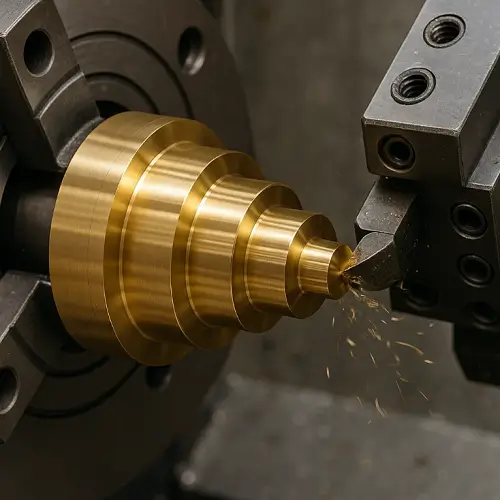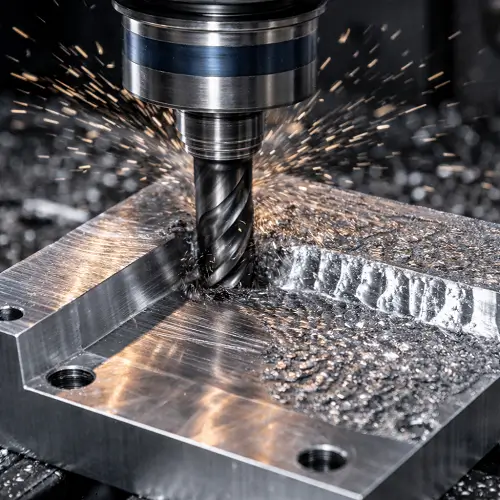
Shaft collars are commonly CNC machined components used to position bearings, rollers, pulleys, and other parts along a shaft. Turning creates the bore and locating faces, while drilling, tapping, and milling produce the locking and mounting features. These features determine how the collar fits the shaft, holds its position, and connects to the surrounding assembly.
Different applications need different collar designs. A collar that slides on from the shaft end may not suit an assembly with limited access, while a set-screw design may be unsuitable when the shaft surface must remain unmarked. When standard sizes or mounting arrangements do not fit, custom CNC machining allows the bore, body profile, and attachment features to match the assembly.
What Is a Shaft Collar?
A shaft collar is a ring-shaped component secured around a shaft to locate parts or limit axial movement, meaning movement along the shaft’s length. Its central bore fits the shaft, while a set screw, clamping mechanism, or threaded connection holds the collar in position.
For example, a collar installed beside a roller assembly can help prevent that assembly from shifting sideways along its supporting shaft. On a stationary guide rod, it can establish an adjustable stop position.
The term “locking collar for a shaft” describes the same general purpose, but it does not identify the locking mechanism or load capacity. Those depend on the specific design.
A shaft collar is different from a shaft coupling. A collar generally positions components on one shaft. A coupling connects two shafts and transmits rotation and torque between them. A simple positioning collar should not be used as a substitute for a coupling.
How Do Shaft Collars Work?
Shaft collars hold their position through screw contact, clamping friction, or thread engagement. Understanding the difference helps explain why one style may suit an assembly better than another.
A set-screw collar has a screw that presses directly against the shaft. Depending on the screw tip and shaft hardness, this contact may create an indentation that helps resist movement. The same indentation can make later adjustment or removal more difficult.
A clamping shaft collar has a split in its body. Tightening the clamping screw contracts the bore around the shaft. Contact between the bore and shaft creates friction that resists movement without deliberately driving a screw tip into the shaft surface.
A threaded shaft collar engages matching external threads on the shaft. Turning it adjusts its axial position, and the engaged threads carry the axial load. A locking feature may then prevent unwanted rotation.
Two collars with the same bore diameter can therefore perform differently. Holding capacity also depends on screw specifications, collar geometry, shaft condition, and installation torque. Tightening beyond the specified limit can damage the screw or collar instead of improving retention.
What Are the Different Types of Shaft Collars?
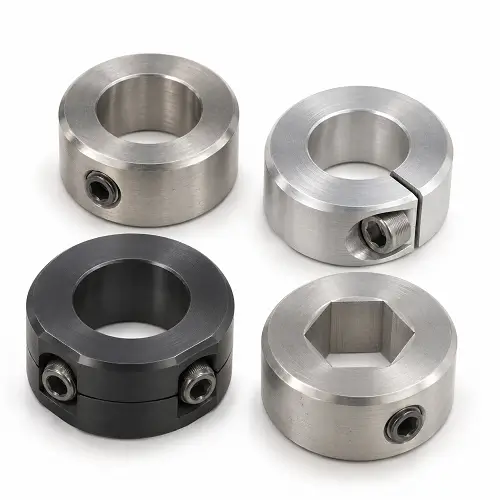
Common types include set-screw collars, one-piece and two-piece clamping collars, threaded collars, quick-release collars, and mountable collars. Special bore shapes accommodate shafts that are not plain and round.
These descriptions can overlap. A two-piece collar may also have a keyed bore or mounting holes. “Two-piece” describes its construction, while “mountable” describes an additional function.
Set-Screw Shaft Collars
Set-screw shaft collars have a solid ring body with one or more radial threaded holes. A screw passes through the collar wall and presses against the shaft.
Their simple construction suits positioning tasks where adjustment is infrequent and a contact mark on the shaft is acceptable. Examples include locating lightly loaded components in basic machinery or securing a stop that rarely changes position.
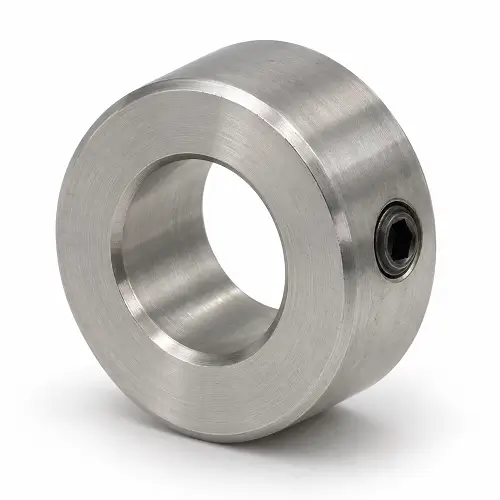
The main limitation is concentrated contact at the screw tip. On a softer shaft, the screw can leave a depression or raise a burr. On a hardened shaft, it may not develop the same engagement.
If the collar will be repeatedly moved along a finished shaft, a clamping design is usually a better starting point. For a set-screw design, select the screw tip and installation torque for the shaft and required holding load.
One-Piece Clamping Shaft Collars
A one-piece clamping collar has a single split and a screw that draws the sides of the split together. The body remains in one piece while its bore contracts around the shaft.
This design is useful when the collar needs occasional adjustment and the shaft surface should remain free of set-screw indentations. Loosening the screw allows the collar to be repositioned.
Installation normally requires access to a shaft end. If a gear, bearing, or housing blocks that path, fitting the collar may require removing other components.
One-piece shaft clamp collars suit accessible shafts in roller assemblies, positioning mechanisms, and adjustable equipment stops. Before choosing one, check both the installation path and the space needed to reach the clamping screw.
Two-Piece Clamping Shaft Collars
Two-piece clamping shaft collars consist of two separate halves secured around the shaft with screws.
Their clearest advantage is installation access. The halves can be placed around an existing shaft without sliding over its end. This can avoid removing a pulley, bearing, or another nearby component.
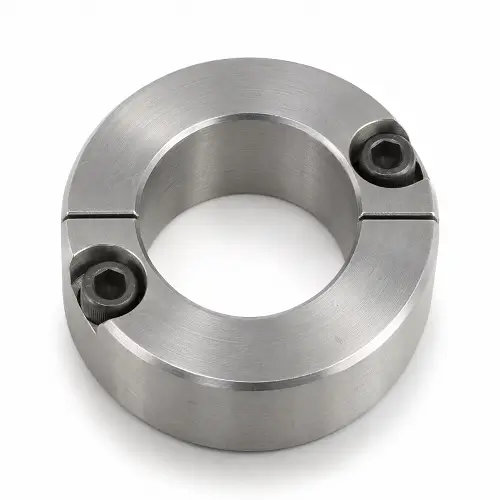
They also simplify replacement during maintenance, provided there is enough radial space to separate the halves and reach the screws.
Some two-piece designs offer greater holding power than comparable one-piece collars, but this is not a universal rating. The actual screw arrangement, body geometry, material, and installation conditions still matter.
For custom CNC machined shaft collars, the two halves need to function as a matched assembly. Misaligned bores or screw holes can cause uneven contact and make assembly difficult.
Threaded Shaft Collars
Threaded shaft collars have internal threads that engage a threaded shaft. Rotating the collar moves it axially, making this style useful for adjustable positioning and retention on threaded members.
The thread form, diameter, pitch, and direction must match the shaft. A similar nominal diameter is not enough to establish compatibility.
The design also needs a way to retain the adjusted position. Depending on the collar, this may involve a clamping feature or another locking arrangement.
A threaded collar should not automatically be substituted for a bearing locknut. Bearing retention and preload applications may require a particular contact face, locking method, and adjustment procedure.
Quick-Release Shaft Collars
Quick-release shaft collars use a lever or another rapid locking mechanism to reduce repeated tool use.
They are useful where operators frequently reposition guides, stops, or accessories during machine changeovers. A quick-release mechanism can make those adjustments easier to repeat.
However, the mechanism requires clearance. A projecting lever may interfere with nearby parts, guards, or an operator’s access.
For rotating applications, confirm that the collar is suitable for the operating speed and that the mechanism remains secure and clear of surrounding components. Fast manual adjustment does not automatically make a collar suitable for high-speed rotation.
Mountable Shaft Collars
Mountable shaft collars include features for connecting another component. These may be threaded face holes, radial mounting holes, flats, or a flange.
For example, a bracket can attach to a collar on a stationary rod, allowing the bracket’s position to be adjusted without drilling additional holes into the supporting structure.
The attached component changes the loading. A bracket extending away from the shaft creates leverage and may try to rotate the collar, even when its direct axial load is small.
Mounting-hole position, remaining wall thickness, and clamping-screw access therefore need to be considered together. Custom machining is useful when an existing collar cannot accommodate the required attachment.
Special-Bore Shaft Collars
Special-bore collars fit shafts with profiles such as hexagonal, D-shaped, or keyed cross-sections.
The bore must match the complete shaft profile. Maximum width alone does not define the fit; flats, corner geometry, and keyway dimensions can also affect installation and contact.
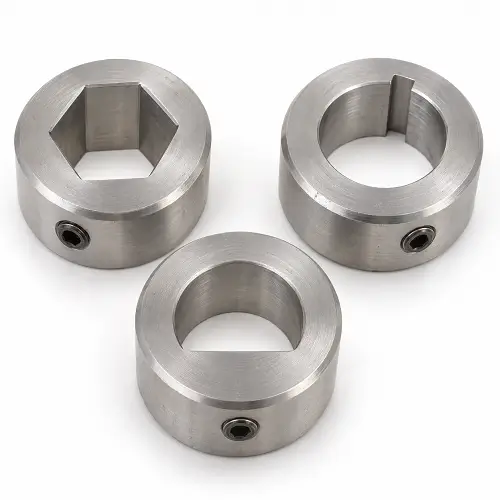
A keyed collar can provide rotational engagement where the assembly requires it. However, a key generally does not prevent the collar from sliding along the shaft. An appropriate axial retention method is still needed.
These collars are useful when a standard round bore cannot seat correctly or when the collar must both locate and connect to another component.
What Are Shaft Collars Used For?
Shaft collars are used for positioning, spacing, travel limitation, and mounting. Their role depends on which component must stay in place and what forces will try to move it.
Positioning Rollers in Conveyor Equipment
A shaft collar can limit a roller assembly’s sideways movement along its supporting shaft. This helps keep the roller in the intended position across the conveyor.
The collar must act on the correct locating surface. If the roller needs to rotate freely, the arrangement should not squeeze the rotating assembly and create drag.
Depending on the design, the collar may locate a bearing inner ring, a spacer, or another stationary surface. The contact position and required clearance should follow the roller assembly rather than simply placing collars tightly against both ends.
Locating Bearings, Pulleys, and Sprockets
In transmission assemblies, shaft collars can provide an axial locating surface beside bearings, pulleys, and sprockets.
The collar’s face matters as well as its bore. A locating face that is not sufficiently square to the bore may contact the adjacent component unevenly.
For bearings, the collar must contact the intended ring or locating feature. It should not rub against a seal or create unintended preload.
A collar may control axial position while a key, spline, or another connection transmits torque. These functions should be identified separately when designing the assembly.
Providing Adjustable Stops in Automation Equipment
Collars on stationary rods or guides can establish repeatable stop positions. This is useful in packaging machines and positioning mechanisms where settings change between products or setups.
The load condition matters. A collar supporting a steady force is not doing the same job as one repeatedly struck by a moving assembly.
Repeated impacts may require cushioning, a positive shoulder, or another mechanical retention feature. Increasing collar size or screw torque alone does not establish that the stop can withstand those impacts.
Maintaining Component Spacing
Collars can help maintain axial spacing between components where the assembly permits adjustable positioning.
They are particularly useful when the final position needs to be set during assembly rather than fixed entirely by machined shoulders.
However, a collar is not always a direct substitute for a spacer. A spacer establishes distance through its length, while a collar relies on its locked position. If the assembly requires a fixed stack length, a machined spacer may be the more appropriate part.
Mounting Accessories in Instruments and Machinery
Mountable collars can support brackets, indicators, and other accessories on shafts or rods.
In laboratory and inspection equipment, this can provide adjustable mounting positions without modifying the supporting rod. In industrial equipment, it can connect an accessory where a standard bracket has no suitable attachment point.
The collar must resist the complete load from the accessory, including any turning moment caused by an offset mounting position.
How Do You Choose the Right Shaft Collar?
Start with installation access, surface requirements, loading, and adjustment frequency. These conditions narrow the options more effectively than choosing by appearance.
| Your assembly requirement | Type worth considering | Main point to check |
|---|---|---|
| Simple positioning where shaft marking is acceptable | Set-screw collar | Shaft hardness, screw contact, and holding requirement |
| Occasional adjustment on an accessible shaft | One-piece clamping collar | Shaft-end access and screw clearance |
| Installation without removing adjacent components | Two-piece clamping collar | Radial clearance and access to both screws |
| Adjustable positioning on a threaded shaft | Threaded collar | Matching thread and position-locking method |
| Frequent manual adjustment | Quick-release collar | Holding rating, mechanism clearance, and operating conditions |
| Attachment of a bracket or accessory | Mountable collar | Mounting geometry and applied moment |
| A non-round or keyed shaft | Special-bore collar | Complete shaft profile and axial retention |
Confirm the Shaft Size and Bore Fit
Check whether the shaft is inch or metric and use its specified dimensions.
A 1/2-inch shaft measures 12.70 mm, not 12 mm. These sizes are not interchangeable simply because they appear close.
For custom assemblies, account for shaft size variation and any coating on the mating surfaces. An oversized bore may not clamp correctly, while an undersized bore can prevent installation.
The collar should be designed to fit the intended shaft, rather than relying on excessive screw torque to compensate for a mismatch.
Decide Whether Surface Marks Are Acceptable
If the collar will be repositioned or the shaft has a finished working surface, direct set-screw contact may be undesirable.
Clamping shaft collars avoid deliberately indenting the shaft with a screw tip. They still need clean, properly finished bores. Trapped chips or burrs can scratch the shaft during installation.
For equipment requiring frequent adjustments, consider both the locking method and how easily the collar slides when released.
Match the Collar to the Actual Load
Identify whether the collar must resist a steady axial force, vibration, reversing loads, or impact.
There is no single holding-force value that applies to every collar of a given diameter. Screw grade, geometry, shaft condition, material, and installation torque all affect performance.
Use the holding data for the specific standard product. For a custom collar, establish the required retention load and how it will be verified.
A dimensional inspection confirms size and geometry. It does not automatically establish the collar’s load capacity.
Check the Surrounding Space
The collar must fit more than the shaft diameter.
Check its outside diameter and width, but also allow room for screw heads, tools, mounting brackets, and any quick-release lever. A collar can fit the available space while still being impossible to tighten after the surrounding parts are assembled.
If access is restricted, a different screw position or split arrangement may solve the problem more effectively than reducing the entire collar.
Choose Material and Finish for the Environment
Steel can suit general industrial machinery when corrosion protection is appropriate. Stainless steel may suit moisture or cleaning exposure, depending on the grade and chemicals involved. Aluminum can reduce weight where its strength and thread capacity meet the application.
Do not assume otherwise identical collars in different materials have the same holding capacity.
Surface treatments also need consideration. A coating can change bore size, thread fit, or contact conditions, so the finished part requirements should include the specified treatment.
Why Does a Shaft Collar Slip After Tightening?
A collar can slip even when its screw feels tight. The cause may be insufficient clamping contact, an incorrect fit, an installation problem, or a load beyond the design’s capacity.
Check the following before applying more torque:
- The bore matches the actual shaft diameter.
- The clamping gap has not closed before adequate grip develops.
- The screw is not bottoming out before the collar clamps.
- The screw specification and tightening torque match the design.
- The shaft and bore are in the surface condition required for the rated holding performance.
- The operating load, including impact, is within the intended capacity.
For a two-piece collar, tighten the screws according to the specified sequence so the halves seat correctly. Uneven tightening can leave the collar poorly aligned.
If the assembly continues to slip under the intended conditions, the locking method or retention arrangement may need to change. Repeatedly increasing torque risks stripped threads, damaged screws, or a distorted collar.
When Do You Need Custom Shaft Collars?
A standard collar is often the simplest choice when its bore, locking method, dimensions, and rating suit the assembly. Custom shaft collars become useful when the surrounding design requires features that standard parts do not provide.
Standard Dimensions Interfere with the Assembly
A standard collar may fit the shaft but contact a guard, housing, or nearby component.
A custom body can change the width, outside profile, or screw position. However, removing material also changes the stiffness and strength of the clamping section.
The revised shape must preserve enough material around the bore and fasteners to perform its function.
Additional Mounting Features Are Required
A collar may need face holes, a mounting flat, an integral flange, or a particular bolt pattern.
Machining those features into the collar can remove the need for a separate adapter. It can also place the connection closer to the shaft where space is limited.
The mounting features must not obstruct the locking screws or leave an inadequate section beside the clamping split.
The Shaft Has a Nonstandard Interface
A special diameter, keyway, flat, or other shaft feature may require a matching bore.
For these parts, the shaft and collar should be reviewed together. Their relationship controls installation, contact, and relative movement.
Reproducing only the visible outside shape of an existing collar will not establish the correct internal fit.
The Collar Also Acts as a Locating Component
Some collars locate another part through a face, shoulder, or mounting-hole pattern.
The drawing should identify the relationship between these features and the shaft bore. Overall dimensions alone may not control the position of the attached component.
At JeekRapid, custom machining can produce shaft collar bodies with specified bores, clamping slots, threaded holes, and mounting features. If the order also requires screws, assembly, or holding-force testing, these can be reviewed and included in the agreed supply scope.
How Are Shaft Collars CNC Machined?
Shaft collar machining usually combines turning with drilling, tapping, milling, or slot cutting. The sequence depends on the locking design and the relationships between the finished features.
Turning the Bore and Locating Faces
CNC turning produces the basic ring geometry, including the bore, outside diameter, and faces.
The bore establishes the shaft interface. The outside profile determines clearance around the assembly, while the faces establish width and provide any axial locating surfaces.
Where a face positions a bearing or another component, its relationship to the bore needs to be controlled. Meeting the overall width alone does not guarantee even contact.
Machining the Locking Mechanism
Set-screw collars require radial threaded holes positioned for the intended screw contact.
Clamping collars require a split, screw clearance, and a threaded section that work together as the screw tightens. Slot milling or another suitable cutting process creates the opening.
The gap is part of the mechanism. If it closes before the bore grips the shaft, further tightening may overload the screw without establishing adequate retention.
For two-piece collars, the machining and inspection method should preserve the alignment of the mating halves.
Adding Special Bores and Mounting Features
Additional operations produce flats, keyways, counterbores, and mounting-hole patterns.
Their position relative to the split and locking screws affects both strength and assembly access. A hole that is individually within tolerance can still be poorly located for the collar’s function.
When the collar is made for a custom shaft, reviewing the corresponding shaft machining requirements helps keep the mating features consistent.
Deburring and Applying the Specified Finish
Burrs at the bore entrance can scratch the shaft. Burrs around the split may interfere with closure, and damaged thread entries can prevent smooth screw installation.
Deburring should remove these unwanted edges without changing important locating surfaces or rounding features that need to remain defined.
Any specified coating or surface treatment must be considered in the finished dimensions, particularly at bores and threads.
Inspecting Fit and Function
Inspection should follow the drawing and the collar’s intended role. Relevant checks may include bore size, locating-face relationship, mounting-hole position, screw engagement, and the condition of the clamping gap.
Where assembled fit is important, a suitable shaft or inspection fixture can help confirm installation and closure.
If a custom design must hold a specified load, that requirement needs a defined test method and acceptance criteria. A visual check or successful trial fit alone does not demonstrate retention under operating loads.
Conclusion
A shaft collar needs to fit the shaft, hold the required position, and remain practical to install and adjust. Set-screw, clamping, threaded, and mountable designs address different needs, so the choice should follow the assembly’s loading, access, and connection requirements.
If standard collars cannot accommodate your shaft profile, available space, or mounting features, JeekRapid can review a custom machined design. Send your drawing or CAD model for a quote to discuss the collar body, mating features, and required delivery scope before production.