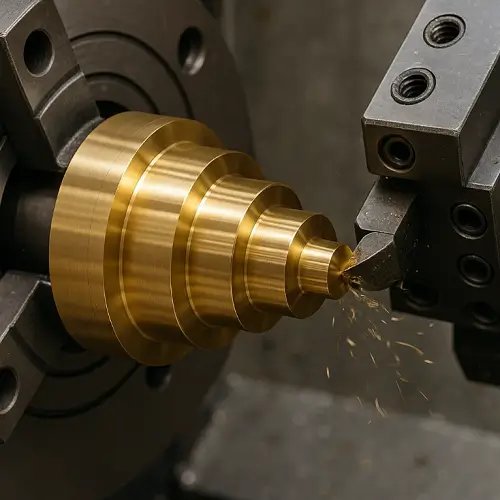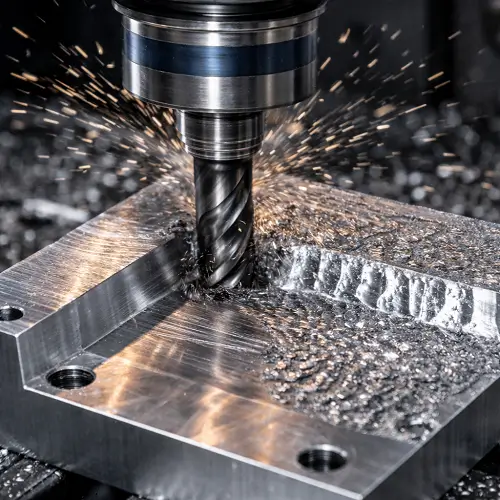
Custom CNC machined brackets are used when standard L brackets, U brackets, or catalog mounting hardware cannot match the required mounting position, hole pattern, thickness, clearance, load, or assembly layout. They are commonly made for motors, sensors, cameras, electronic enclosures, fixtures, machine modules, industrial equipment, and custom products.
A bracket may look simple, but it often decides whether two components can be installed in the right position and remain secure during use. A small difference in mounting height, hole spacing, angle, or material thickness can make an off-the-shelf bracket unusable. Custom CNC brackets solve these fit and installation problems by machining the part around the actual product instead of forcing the product to fit a standard part.
CNC machining is especially useful for prototype brackets, low-volume production, and parts with threads, counterbores, pockets, stepped surfaces, precise mounting faces, or features on more than one side. However, CNC is not automatically the best choice for every bracket. A simple bent sheet metal bracket may be more cost-effective when the geometry is simple and the order quantity is high.
Why Choose Custom CNC Machined Brackets?
A custom bracket is usually needed because a standard part does not fit the product or the installation space. The mounting holes may not align, the component may need to sit at a specific height, nearby parts may create clearance limits, or the bracket may need to support more load than a standard option can handle.
Custom CNC machined brackets can also combine several functions into one part. A motor mount may include the mounting pattern, locating surfaces, cable clearance, and a connection point for another structure. A sensor bracket may need to position the sensor at a fixed angle while protecting it from vibration or impact. An electronics bracket may need to hold a controller, PCB, enclosure, or heat sink within a limited internal space.
For custom equipment, CNC machining makes it easier to adjust the design during development. A bracket can be revised after a test fit, then machined again without waiting for a stamping die, forming tool, or production mold.
Types of Custom CNC Machined Brackets
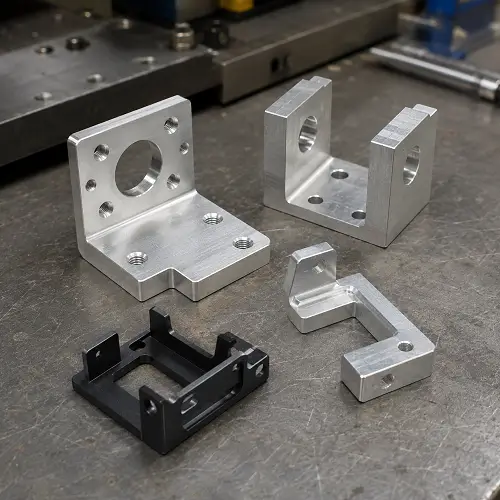
L-Shaped and U-Shaped Mounting Brackets
L-shaped and U-shaped brackets are among the most common custom mounting parts. They are used to connect a component to a frame, enclosure, panel, base plate, or machine structure.
A standard L bracket may work for a simple installation, but custom aluminum mounting brackets are often required when the hole positions, thickness, spacing, edge clearance, or mounting angle differ from standard hardware. U-shaped brackets are useful when a component needs support from two sides, such as a motor, sensor body, electronic module, or small fixture.
Z-Shaped and Offset Brackets
Z-shaped and offset brackets are used when two mounting surfaces do not sit on the same plane. They can move a component forward, backward, upward, or downward without changing the main structure.
This type of custom metal bracket is useful when a motor, camera, sensor, controller, or enclosure needs to avoid another component, align with a shaft or opening, or sit at a controlled distance from the mounting surface. CNC machining is often a practical choice when the offset includes machined steps, threaded holes, pockets, or precise contact faces.
Motor and Actuator Mounts
Motor mounts and actuator brackets are used in automation equipment, robotics, test systems, conveyors, positioning systems, and custom machinery. These parts need to hold the motor or actuator securely while keeping the mounting position stable.
A custom CNC machined motor mount may include a bolt pattern, locating bore, adjustment slot, cable opening, clearance pocket, or reinforced mounting area. Aluminum is common when low weight matters, while steel or stainless steel may be selected when the bracket carries higher loads, vibration, or repeated motion.
Sensor, Camera, and Electronics Brackets
Sensor brackets, camera mounting brackets, and electronics brackets are usually compact parts with specific installation requirements. They may need to hold a sensor at a fixed angle, position a camera at a certain distance, secure a small controller inside an enclosure, or create space for connectors and cables.
These brackets are often made from aluminum, stainless steel, POM, or other engineering materials depending on the environment. The main concern is usually not extreme load capacity. It is getting the position, clearance, cable access, and installation layout right.
Fixture and Industrial Equipment Brackets
Fixture brackets and industrial equipment brackets are used to connect modules, guide rails, guards, clamps, actuators, workholding elements, and machine components. These brackets may be small or large, but they often need to match an existing assembly exactly.
CNC machining is useful when the bracket requires multiple mounting faces, threaded holes, locating features, or a shape that cannot be produced with a simple bend. For recurring parts, stable CNC workholding and fixtures help keep important mounting features consistent from batch to batch.
Materials for Custom CNC Machined Brackets
6061 aluminum is often the practical starting material for lightweight custom brackets, while stainless steel is usually better when corrosion resistance or higher strength matters more than weight. Steel can be more suitable for higher-load industrial structures, while engineering plastics may be chosen when insulation, low friction, or chemical resistance is required.
Custom CNC machined brackets can be made from aluminum, stainless steel, carbon steel, alloy steel, brass, copper, titanium, and engineering plastics. The best choice depends on the load, weight limit, corrosion exposure, operating environment, electrical requirements, and budget.
| Material | Common Grades | Best For | Why Choose It | Considerations |
|---|---|---|---|---|
| Aluminum | 6061, 7075 | Electronics, automation equipment, sensor mounts, motor brackets, lightweight structures | Lightweight, easy to machine, and suitable for anodizing | 6061 is the common choice; 7075 provides higher strength but usually costs more |
| Stainless Steel | 304, 316, 17-4PH | Outdoor equipment, medical devices, food equipment, wet or corrosive environments | Strong, durable, and corrosion resistant | Heavier and slower to machine than aluminum; 316 is better suited to harsher corrosion exposure |
| Carbon and Alloy Steel | 1018, 1045, 4140 | Industrial equipment, heavy-duty mounting brackets, machine structures | Good strength and practical cost for load-bearing parts | Usually needs powder coating, black oxide, zinc plating, or other corrosion protection |
| Brass | C360 | Small connectors, instrument parts, electrical mounting components | Machines cleanly, resists corrosion, and supports reliable threads | Higher material cost than aluminum or standard steel |
| Copper | C110, C101 | Grounding brackets, electrical connections, thermal or conductive components | Excellent electrical and thermal conductivity | Soft, heavy, and more expensive; not normally the first choice for ordinary support brackets |
| Titanium | Grade 2, Grade 5 | Lightweight, high-strength, corrosion-resistant applications | High strength-to-weight ratio and strong corrosion resistance | High material and machining cost; usually selected only when the application justifies it |
| Engineering Plastics | POM, Nylon, PC, PEEK | Insulating brackets, light-duty fixtures, sensor mounts, chemical-resistant parts | Lightweight, non-conductive, and suitable for special environments | Long-term load, temperature, and thread strength should be checked before selection |
The most suitable material is not always the strongest one. A lightweight aluminum sensor bracket may work better than stainless steel when mass and installation space matter. A stainless steel bracket may be the better choice for a wet outdoor environment, even when aluminum would be cheaper. The material should match the bracket’s actual function, mounting environment, and expected service life.
CNC Machining vs Sheet Metal Brackets
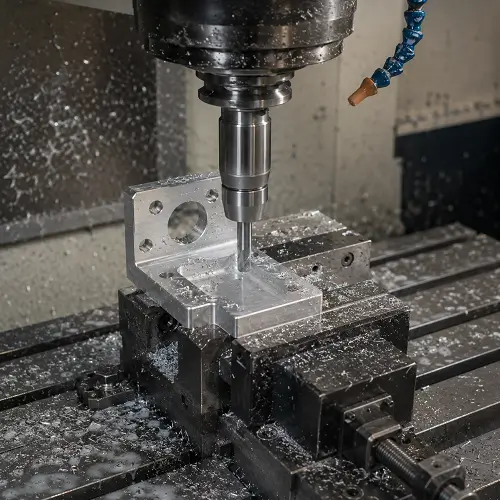
CNC machining is usually the better choice when a bracket needs thick material, threaded holes, machined steps, pockets, precise mounting faces, or frequent design changes. Sheet metal is usually more economical for simple bent brackets made in larger quantities.
CNC machined brackets start from solid plate, bar, or block material. They are well suited to thicker parts, precise mounting faces, pockets, threads, counterbores, stepped sections, and multi-sided features. CNC is also useful when the design may still change or when only a small number of brackets are needed.
Sheet metal brackets are made by cutting and bending metal sheet. They are usually more economical for simple L, U, or Z shapes produced in larger quantities. When the bracket mainly relies on bends and standard holes, sheet metal can reduce material use and production cost.
| Your Requirement | Better Choice | Why |
|---|---|---|
| Simple bent L, U, or Z bracket | Sheet metal fabrication | A standard sheet metal bend is often faster and more economical |
| Thick material, machined steps, or precise mounting faces | CNC machining | Machining controls thickness, steps, and contact surfaces more accurately |
| Small prototype or changing design | CNC machining | Design changes can be made without dedicated forming tools |
| Large quantity with simple geometry | Sheet metal fabrication | Stamping or bending becomes more efficient at volume |
| Threads, pockets, counterbores, or multi-sided features | CNC machining | These features are easier to machine directly into the bracket |
| Lightweight visual prototype with low load | 3D printing | Useful for quick fit checks before making metal parts |
A bracket does not need to be CNC machined simply because it is custom. A simple bent bracket may be better made through Sheet Metal Fabrication. CNC becomes the stronger option when the part needs more than a basic bend and hole pattern.
What Can Change the Cost of a Custom CNC Bracket?
The cost of a custom CNC bracket depends less on its name and more on what the part needs to do. Two brackets with similar outside dimensions can have very different costs if one needs only a few holes while the other needs threads, pockets, countersinks, several machined sides, tight mounting positions, and a finished surface.
Material and Bracket Size
Material is one of the first cost drivers. Small 6061 aluminum brackets are generally easier to machine than stainless steel, 4140, copper, titanium, or PEEK parts. Larger brackets also require more raw material, longer machining time, and sometimes larger workholding setups.
Bracket thickness matters as well. A thick mounting block with stepped features may need more machining than a thin part with the same outer shape. Material should be selected around the required load, environment, and function instead of choosing a high-cost grade by default.
Shape, Holes, and Mounting Features
A simple bracket with a flat profile and a few through-holes is usually straightforward to machine. Cost rises when the part includes deep pockets, many threaded holes, counterbores, side holes, angled features, narrow internal areas, or multiple mounting surfaces.
Hole position can matter as much as hole diameter. When a bracket needs to align a motor, sensor, actuator, enclosure, or another precision component, the critical hole pattern should be clearly identified on the drawing. This helps avoid paying for unnecessarily tight dimensions on every feature while protecting the dimensions that affect assembly. Relevant requirements can be planned with CNC machining tolerances in mind.
Surface Finish and Order Quantity
Anodizing, bead blasting, powder coating, black oxide, zinc plating, passivation, and other surface treatments can improve appearance, corrosion resistance, or durability, but they add to the final cost and lead time.
Quantity changes the unit price as well. A one-piece prototype carries programming, setup, and first-part inspection costs. When the same bracket is produced repeatedly, those setup steps can be reused, helping reduce the cost per part and improve consistency. For a broader explanation of what affects pricing, link CNC machining cost here.
The most accurate quote comes from the CAD model, drawing, material, quantity, and finishing requirements. A simple prototype bracket may cost far less than a multi-sided stainless steel bracket with threaded holes, finished surfaces, and critical mounting relationships.
Custom CNC Machined Brackets for Prototypes and Low-Volume Production
CNC machining is a practical option when a product is still being tested or when the bracket design may need to change after assembly. A prototype bracket can confirm hole locations, mounting height, component clearance, cable routing, load path, and overall fit before the design moves into a larger production stage.
For low-volume production, CNC can continue to be a good choice when the bracket has non-standard geometry or needs machining features that sheet metal cannot provide easily. This is common in automation equipment, electronics, test fixtures, robotics, laboratory systems, and custom machinery.
When a design becomes stable and quantities increase, the manufacturing method can be reviewed again. Some brackets will remain best suited to CNC machining, while simpler bent shapes may become better candidates for sheet metal, stamping, or another production process.
Get a Custom CNC Machined Bracket Quote
Brackets with critical mounting holes, mating faces, threaded features, or multi-sided geometry should be reviewed before machining so the process matches the required assembly function.
To quote a custom CNC machined bracket accurately, provide a 3D CAD model and a 2D drawing with the material, quantity, surface finish, critical mounting holes, threads, and any key assembly requirements. It is also helpful to explain what the bracket will hold, where it will be installed, and whether weight, vibration, corrosion, electrical insulation, or outdoor exposure matters.
JeekRapid provides CNC machining services for custom aluminum, steel, stainless steel, brass, copper, titanium, and plastic brackets. Upload your drawing for a review of the material, machining method, production approach, and cost factors for your project.