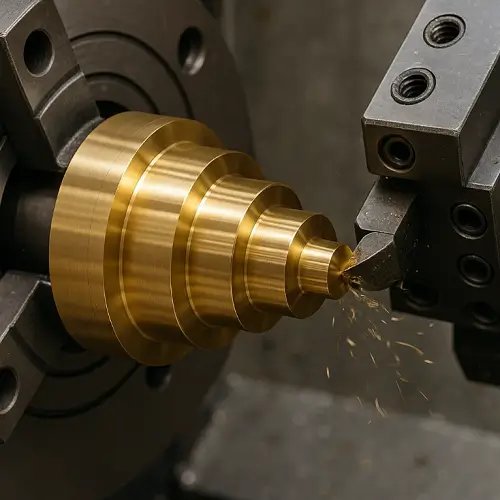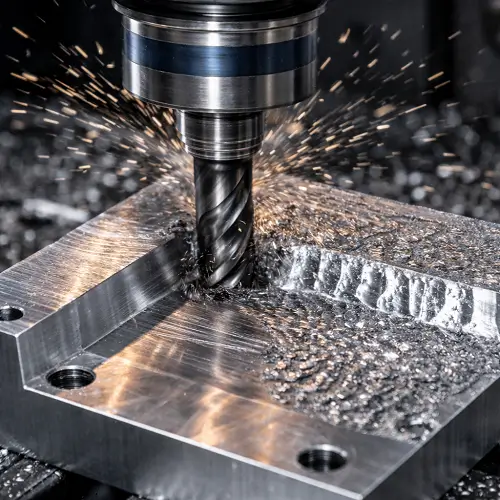
A CNC enclosure is a custom housing machined from a solid block of metal or engineering plastic. It is commonly used for electronic devices, controllers, sensors, instruments, battery systems, robotics modules, and industrial equipment.
A well-designed CNC enclosure does more than cover the components inside it. It can hold a circuit board in the correct position, provide threaded mounting points, create accurate openings for connectors, remove heat through fins or contact surfaces, and form a stable joint between a housing body and its cover. These details are difficult to achieve with a generic off-the-shelf box.
CNC enclosures are often made from aluminum, stainless steel, copper, or engineering plastics. The best choice depends on the enclosure size, expected quantity, heat dissipation, sealing requirements, environment, surface finish, and budget.
What Is a CNC Enclosure?
A CNC enclosure is produced by removing material from aluminum, stainless steel, copper, or plastic using CNC milling, turning, drilling, and tapping. The starting material may be a block, plate, tube, or bar. The machine creates the outside profile, internal cavity, screw holes, connector openings, mounting features, and other details required for the final assembly.
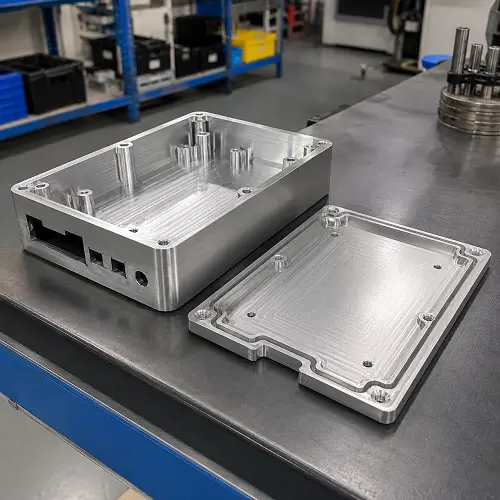
Many custom CNC enclosures use a two-piece structure. One half contains the internal cavity, mounting points, threaded holes, and connector cutouts, while the second half works as a cover. This makes assembly and inspection easier, and it gives the product team more flexibility when the internal electronics or connector layout changes.
A CNC enclosure is useful when a standard electrical box does not match the required size, material, hole pattern, sealing design, appearance, or assembly method. It is also a practical choice for a functional prototype that needs to perform much like the final production part.
When Is a CNC Enclosure the Right Choice?
CNC machining is a strong option when the enclosure needs real material performance and accurate functional details before the design is ready for expensive tooling.
It is especially suitable for projects that need internal pockets for electronics, accurate threaded holes for covers or circuit boards, connector cutouts, thermal contact surfaces, heat sink fins, or sealing grooves. An aluminum CNC enclosure is often selected for controllers, sensors, communication devices, test equipment, and compact industrial products because it offers a good balance of weight, strength, heat dissipation, and appearance.
CNC machining also works well when the design may still change. A revised CAD model can be machined without changing a mold, which makes CNC practical for prototypes, engineering validation, and low-volume production.
It is not always the best manufacturing method. A large and simple enclosure made mainly from flat panels and bends may be more economical with sheet metal. A presentation model that only needs to show shape and size may be faster with 3D printing. When a plastic or metal enclosure design is fixed and the production quantity becomes high, injection molding or die casting may reduce the unit price after tooling cost is recovered.
CNC Enclosure vs Other Manufacturing Methods
The right enclosure process depends on what the product needs to do, not only on the first quoted price.
| Manufacturing Method | Best For | Main Advantage | Main Limitation |
|---|---|---|---|
| CNC Machining | Functional prototypes, low-volume production, precision housings | Accurate holes, threads, internal cavities, sealing features, and real engineering materials | Deep cavities and complex multi-sided parts can increase cost |
| 3D Printing | Early concept models and complex shapes | Fast design validation and flexible geometry | Layer lines, lower surface quality, and less reliable threads or sealing surfaces |
| Sheet Metal Fabrication | Larger boxes, panels, bends, and simple shells | Cost-effective for larger simple enclosures | Less suitable for deep internal cavities and precision machined details |
| Injection Molding | High-volume plastic enclosures | Lower unit cost after tooling | Mold cost is high and design changes are slower |
| Die Casting | Medium- to high-volume metal enclosures | Good repeatability and lower unit cost at volume | Requires tooling investment and a stable design |
3D printing is usually better for early shape validation, visual models, and highly complex forms that do not require final material performance. CNC machining becomes more useful when the enclosure needs reliable threads, accurate connector openings, flat sealing surfaces, strong material properties, or a finish close to the final production version.
Sheet metal fabrication is often the better choice for a larger enclosure made from bent panels, especially when the structure is simple. CNC machining is more suitable for compact housings with precise internal cavities, multiple connector openings, heat sink details, O-ring grooves, or features that need to align closely during assembly.
For high-volume projects, injection molding and die casting can become more cost-effective. Before the design is fully proven, however, CNC machining provides more flexibility and avoids the risk of modifying expensive tooling after the first prototype is tested.
Materials for CNC Enclosures
Material selection affects the enclosure weight, strength, heat dissipation, corrosion resistance, surface finish, and machining cost. The material should match the working environment and product function rather than being chosen only for appearance.
Aluminum CNC Enclosures
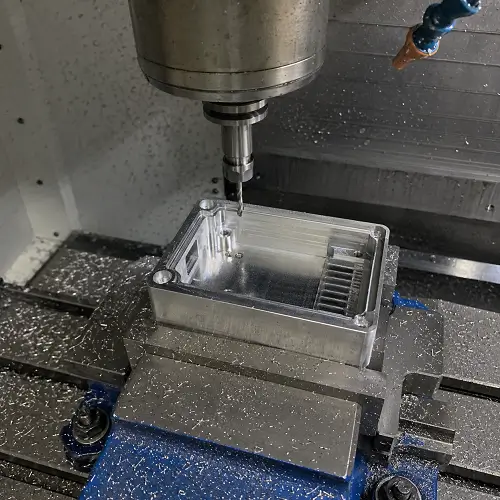
Aluminum is one of the most common materials for CNC enclosures. It is lightweight, corrosion resistant, easy to machine, and suitable for anodizing. Aluminum also transfers heat well, making it useful for electronic housings, controllers, LED systems, sensors, battery modules, and equipment that needs a heat-dissipating outer shell.
6061 aluminum is widely used for general-purpose CNC enclosures because it offers a practical balance of machinability, strength, corrosion resistance, and cost. 7075 aluminum may be used when the enclosure also needs higher structural strength, although it usually costs more and is less necessary for ordinary electronic housings.
An aluminum CNC enclosure is often the best starting point when a project needs a professional metal appearance, accurate features, and a practical lead time.
Stainless Steel Enclosures
Stainless steel enclosures are useful when strength, wear resistance, or corrosion resistance matters more than low weight. They are common in outdoor equipment, marine devices, food-processing equipment, medical equipment, and industrial systems exposed to moisture or chemicals.
The trade-off is that stainless steel is heavier than aluminum and generally takes longer to machine. It can be the right choice for demanding environments, but it is usually not the most economical option for a lightweight electronic enclosure that mainly needs heat dissipation.
Plastic CNC Enclosures
Plastic CNC enclosures are useful when electrical insulation, lower weight, chemical resistance, or a non-metallic housing is required. ABS, PC, POM, nylon, and PEEK are common options, depending on the strength, temperature, impact resistance, and environmental requirements of the product.
CNC machining is a practical option for plastic enclosures when the quantity is too low to justify injection molding or when the design still needs functional testing. It allows the product team to test real engineering plastic rather than relying only on a printed model.
Plastic does not always mean low cost. Large plastic blocks, deep pockets, thin walls, and tight tolerances can still increase machining time. The main advantage is flexibility during design development.
Copper Heat Sink Enclosures
Copper is used when thermal performance is critical. It is suitable for high-power electronics, heat transfer systems, RF equipment, and products where the enclosure also needs to work as a heat sink.
Copper is heavier and more expensive than aluminum. It is also softer, so finished surfaces can be marked more easily during machining and handling. For many electronic products, aluminum offers enough thermal performance at a lower cost. Copper is usually selected when the higher conductivity is necessary for the final design.
Common Features in CNC Enclosures
A CNC enclosure can include functional details directly in the housing, which reduces the need for extra brackets, welded sections, secondary drilling, or separate mounting components.
Internal cavities can be machined to hold circuit boards, batteries, sensors, screens, connectors, and mechanical parts. Threaded holes can be added for cover screws, mounting hardware, and internal components. Connector cutouts can be made for USB, Ethernet, HDMI, power plugs, cable glands, switches, displays, and custom interfaces.
Many CNC electronic enclosures also include mounting holes, ventilation slots, cable entry holes, display windows, and alignment features between two housing halves. A custom enclosure may use O-ring grooves and flat mating surfaces to support a sealed joint, while heat sink fins and thermal contact areas can help remove heat from internal components.
For housings with several critical holes, mating faces, or internal mounting features, the machining plan and CNC workholding and fixtures affect how consistently those features align during production.
CNC Enclosure Design Tips
CNC Enclosure Wall Thickness
Wall thickness affects strength, machining time, and enclosure stability. Very thin walls can flex during machining or assembly, while unnecessarily thick walls add material cost and increase the time required to remove material from the internal cavity.
A practical enclosure design keeps wall thickness reasonably consistent where possible. If a section needs extra strength around a connector, threaded hole, or mounting point, it is usually better to add material only where needed instead of making the entire enclosure thicker.
CNC Enclosure Threads and Connector Cutouts
Threaded holes and connector openings should be planned around the internal components, not added after the enclosure shape is finished. There should be enough material around a screw hole or large connector cutout so the wall remains strong during machining and assembly.
Connector openings also need sensible clearance. A USB, Ethernet, power, or cable opening that is too tight can create assembly problems after surface finishing. A feature that is too loose can affect appearance, sealing, or connector stability. When a drawing includes critical interfaces, it is useful to identify which dimensions are functional and which are mainly cosmetic.
CNC Enclosure Sealing Design
A sealed enclosure needs more than an O-ring groove. The mating faces, screw locations, groove dimensions, gasket compression, and cover alignment all work together.
O-ring grooves should be placed on stable, accessible surfaces that can be machined accurately. The sealing face should not contain deep tool marks, scratches, or unnecessary surface treatments that may affect flatness. A two-piece CNC enclosure should also use locating features such as a step, shoulder, tongue, groove, or dowel location so the cover aligns consistently instead of relying only on screws.
CNC Enclosure Heat Sink Design
Heat sink fins and thermal contact surfaces can be machined directly into an aluminum enclosure. This is useful for LED systems, power electronics, controllers, and compact devices where the outer housing helps move heat away from internal components.
Fins should be spaced wide enough for machining tools and chip removal. Extremely thin or tightly packed fins may look efficient in CAD, but they can significantly increase machining time and may not provide a practical cost-to-performance benefit. A thermal design should balance fin density, airflow, machining access, and the actual heat load of the product.
CNC Enclosure Cost Factors
The cost of a CNC enclosure depends on more than the outside dimensions. A small custom enclosure can still require substantial machining time when it includes deep internal pockets, many threads, close-tolerance connector cutouts, or several machined sides.
Material is an important cost driver. Aluminum is usually more economical than stainless steel, copper, or high-performance plastics. The size of the starting stock also matters, because a larger block increases both material cost and the amount of material that must be removed.
Internal cavity depth has a major effect on machining time. Deep narrow pockets often require longer tools and more careful cutting. Threaded holes, connector openings, heat sink fins, ventilation slots, O-ring grooves, and precision sealing faces each add separate operations.
The number of machining sides also affects the price. An enclosure machined mainly from one side is simpler than one that needs to be flipped several times for side features, bottom pockets, or angled cutouts. More setups can require more alignment control, inspection time, and fixture planning.
Surface finish, tolerance, and quantity also change the quote. Surface finishing such as anodizing, bead blasting, polishing, powder coating, or passivation adds processing steps. Tight tolerances may require more controlled machining and measurement. Low-volume prototype orders carry more setup cost per part, while repeat orders can spread that preparation across more pieces.
How Much Does a CNC Enclosure Cost?
CNC enclosure pricing varies because enclosure designs vary widely. A small open box with a few mounting holes is not comparable to a sealed aluminum housing with deep cavities, heat sink fins, several connector openings, and threaded cover screws.
A small and simple prototype CNC enclosure may start at around US$80–200, especially when it only needs a basic internal pocket, several mounting holes, and a simple cover structure. An aluminum CNC enclosure with multiple threaded holes, connector cutouts, and internal pockets will more often fall around US$200–600. A more complex enclosure with deep cavities, sealing grooves, heat sink fins, tight tolerances, or multi-sided machining may cost US$600–1,500+ at prototype quantity.
These ranges are only early budgeting references rather than fixed prices. The final quote depends on the material, enclosure size, wall thickness, cavity depth, number of machining sides, connector openings, thread quantity, tolerance requirements, finish, and order quantity.
The first order may cost more because programming, setup, inspection planning, and fixture preparation are spread across fewer parts. Once the design is stable and the same machining approach is used again, the unit cost can become more predictable.
CNC Enclosures for Prototypes and Low-Volume Production
CNC machining is especially useful during prototype and low-volume production stages.
For a prototype, it allows a product team to test real material, connector fit, threaded holes, sealing, thermal behavior, assembly fit, and appearance without waiting for a mold. If the enclosure needs a revision, the CAD model can be updated and machined again without changing expensive tooling.
For low-volume production, CNC enclosures can support projects that need tens, dozens, or several hundred parts. This is common for industrial equipment, laboratory instruments, robotics, specialized electronics, medical devices, and custom automation systems.
CNC machining is also useful when one product has several variants. Different connector layouts, internal mounting patterns, labels, enclosure heights, or cover designs can be produced from related machining programs without opening separate molds for every version.
When the design becomes stable and the quantity grows much higher, injection molding or die casting may be worth reviewing. Until then, CNC machining provides a practical balance of flexibility, quality, and production-ready material performance.
Get a CNC Enclosure Quote
A CNC enclosure should be reviewed as a complete functional part, not only as an outside shape. The material, internal cavity design, connector locations, threaded holes, sealing surfaces, finish, quantity, and assembly requirements can all affect the final machining method and cost.
JeekRapid provides CNC machining services for aluminum, stainless steel, copper, and engineering plastic enclosures. Upload your 3D CAD file and 2D drawing for a review of material choice, enclosure design, internal features, surface finish, quantity, and production cost.Get a Quote
For projects that may be better suited to another process, the team can also help compare 3D printing, sheet metal fabrication, injection molding, or die casting based on the enclosure structure and expected quantity.