Aluminum naturally resists corrosion because it forms a thin protective oxide layer in air. That layer reforms after CNC machining, so machining alone does not make chromate conversion coating necessary. Additional protection becomes useful when moisture, salts, or service conditions demand more than the natural oxide layer can provide.
Chromate conversion coating helps protect machined aluminum parts against corrosion and improves adhesion before painting. When the appropriate coating is specified, it can also support low electrical contact resistance at grounding and bonding surfaces. These benefits make it useful for aluminum housings, brackets, and covers whose requirements go beyond basic indoor corrosion resistance.
The choice depends on how the part will be used. A dry indoor bracket may not need conversion coating, while an enclosure exposed to condensation, a painted cover, or a mounting pad requiring electrical contact may benefit from it. The finish should address those needs while preserving critical dimensions and assembly fit.
Why Does Aluminum’s Natural Corrosion Resistance Sometimes Need Help?
Aluminum’s natural oxide layer provides a useful barrier, but it does not prevent corrosion under every condition. Salts can promote localized attack, moisture can remain trapped in joints, and contact with dissimilar metals can increase corrosion risk when an electrolyte such as water is present.
Consider a machined aluminum bracket installed outdoors with steel fasteners. Water can collect around the joint, creating conditions that differ significantly from those around a dry indoor component. A suitable protective treatment helps reduce the risk, although drainage, fastener selection, and joint design still matter.
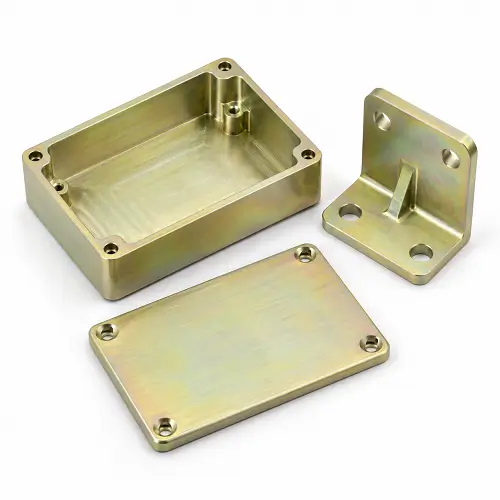
Chromate conversion coating reacts with the prepared aluminum surface to form a thin protective film. Commonly called chem film, it provides additional corrosion protection and can prepare the surface for painting. It does not deposit a shiny metallic chromium layer like chrome plating, and machining marks generally remain visible.
The reason to use it is therefore the finished part’s environment and function—not simply the fact that the aluminum has been machined.
When Is Chromate Conversion Coating a Good Choice?
Chromate conversion coating is worth considering for CNC machined aluminum housings, covers, mounting brackets, and support plates when corrosion protection, paint adhesion, or electrical contact matters more than surface hardness.
An electronics enclosure may need a painted exterior while its mounting pads maintain electrical contact with other components. A suitable conversion coating can support this combination, provided the contact areas remain free of paint.
A painted aluminum bracket has a different priority. Here, the treatment prepares the surface beneath the paint system, helping adhesion and corrosion protection. Planning both treatments together helps ensure the machined bracket arrives ready for its intended use.
A sliding guide presents another situation. Repeated rubbing can wear through a thin conversion film, so chem film alone is unlikely to provide adequate durability. Hard anodizing or another wear-resistant treatment should be considered instead.
The useful distinction is whether the surface needs corrosion protection, paint adhesion, electrical contact, or resistance to friction. Those requirements lead to different finishing choices.
Does Chromate Conversion Coating Allow Electrical Contact?
An appropriately specified conversion coating can support low electrical contact resistance. This makes it useful for grounding pads, bonding surfaces, and aluminum interfaces where an insulating finish would interfere with the connection.
However, the coating does not guarantee that every assembled joint will perform correctly. Contact area, cleanliness, clamping pressure, and the mating component’s finish also affect electrical resistance.
For example, a grounding lug may be bolted to a conversion-coated aluminum housing. If the grounding pad is subsequently covered with paint, the treatment underneath will not prevent the paint from interfering with contact. The drawing needs to identify the pad and require it to remain free of the topcoat.
Where electrical performance is critical, specify the contact surfaces and the required resistance or verification method. A general note such as “conductive finish” leaves the supplier without a clear acceptance requirement.
Chromate Conversion Coating vs. Anodizing: Which Should You Choose?
Choose the finish according to the surface’s job. Chromate conversion coating is useful for paint preparation and applications requiring low electrical contact resistance. Anodizing is generally more suitable when a part needs a harder surface, decorative color, or improved resistance to handling and wear.
For an aluminum enclosure with a visible colored exterior, anodizing may be the more practical option. For an internal mounting face that must maintain electrical contact, a conversion coating specified for that purpose may be more appropriate.
| Main requirement | More suitable starting point |
|---|---|
| Low electrical resistance at a joint | Conversion coating with a defined contact-resistance requirement |
| Pretreatment beneath paint | Conversion coating compatible with the paint system |
| Decorative color and resistance to everyday handling | Decorative anodizing |
| Repeated sliding or abrasive contact | Hard anodizing or another wear-resistant finish |
| Close dimensional fit | Review the complete finishing process against the final tolerance |
Some parts need different finishes in different areas. An enclosure may have an anodized exterior and conversion-coated grounding pads. The drawing should define the boundaries so the supplier can confirm the masking and processing sequence.
Considering surface finishing before machining helps identify these requirements early, particularly where coating buildup or masking affects a precision feature.
Will Chromate Conversion Coating Affect Precision Holes and Threads?
Chromate conversion coatings are thin and generally produce much less dimensional buildup than thicker finishes. This can make them useful for precision aluminum parts, but it does not mean the complete treatment has no dimensional effect.
Surface preparation matters too. Depending on the process, etching can remove aluminum before the conversion film forms. The finished dimensions therefore depend on both preparation and coating.
An ordinary clearance hole may have enough allowance that this creates no practical problem. A locating bore close to its tolerance limit deserves more attention. If that bore controls alignment, its dimensions should be evaluated in the finished condition.
The same principle applies to precision threads and mating surfaces. Identify critical dimensions that must be maintained after treatment so the machining and finishing sequence can account for them. Passing inspection before finishing does not automatically establish that the delivered part meets the drawing.
Masking selected features is possible, but it leaves those areas without the specified treatment. The decision should consider both the required fit and the corrosion protection needed at that location.
Can CNC Machined Aluminum Parts Be Painted After Conversion Coating?
Yes. Conversion coating is commonly used as a pretreatment before painting aluminum. A compatible treatment helps paint adhere and contributes to corrosion protection beneath the coating system.
The complete sequence matters. Cutting-fluid residue must be removed during surface preparation, and the treated part needs to remain clean before painting. Oil, fingerprints, or other contamination introduced between operations can interfere with adhesion. The conversion coating must also be compatible with the selected paint or powder-coating system.
For a painted housing with grounding pads, define both requirements at the start: which surfaces receive paint and which remain free of it. This avoids having to remove paint from contact areas during assembly.
Conversion coating will not hide deep scratches or machining marks. If a visible face needs a smoother or more uniform appearance, address its surface roughness and preparation before finishing.
What Do Type I, Type II, Class 1A, and Class 3 Mean?
A drawing specifying MIL-DTL-5541 may include both a type and a class. They describe different requirements and should not be treated as interchangeable labels.
Type I covers compositions containing hexavalent chromium. Type II covers compositions containing no hexavalent chromium. Type II does not necessarily mean chromium-free; a process may use trivalent chromium.
Class 1A is intended for maximum corrosion protection, painted or unpainted. Class 3 is intended for corrosion protection where low electrical resistance is required.
For a grounding interface, Class 3 is the relevant class to consider. For a component whose main requirement is corrosion protection, Class 1A may be appropriate. The selection should follow the application and the governing drawing.
Specifying only Type II does not establish the electrical-performance class. Likewise, Class 3 alone does not identify the chemistry category. Where an existing drawing specifies both, proposed substitutions should be approved before processing.
Should the Coating Be Clear or Yellow?
Conversion coatings can appear clear, pale yellow, golden, or iridescent, depending on the chemistry, aluminum alloy, and processing conditions. Appearance alone does not establish the coating’s type or performance.
A request for “yellow chromate” is therefore less precise than a defined coating specification with an agreed appearance requirement. It does not fully explain the required corrosion protection or electrical properties.
For an internal mounting bracket, some appearance variation may be acceptable. For visible covers installed next to each other, the same variation could matter. Identify cosmetic surfaces and agree on an acceptable sample or appearance range when consistency is important.
What Should Be Decided Before Machining and Finishing?
The most useful drawing shows what the important surfaces must do. For an aluminum enclosure, that may mean a painted exterior, grounding pads free of paint, and a locating bore whose tolerance applies after finishing.
These details allow CNC machining, surface preparation, masking, and final inspection to be planned together. They also help prevent a finishing operation from compromising a feature that was machined correctly.
If the finish is undecided, describe the operating conditions and assembly function. “Outdoor housing with a painted exterior and electrical contact at these mounting pads” provides a useful basis for review. It is more informative than choosing a coating name without explaining what the part needs to achieve.
Conclusion
JeekRapid provides custom aluminum CNC machining with surface finishing requirements reviewed as part of the project. For housings, brackets, covers, and other machined components, this means considering finished dimensions, corrosion protection, painted surfaces, and electrical contact areas together.
Send the CAD files, drawings, aluminum grade, and quantity for a machining and finishing quote. If chromate conversion coating is specified, include the required type, class, masking areas, and documentation so process availability and requirements can be confirmed before production. If the finish is undecided, describe the working environment and assembly needs so suitable options can be reviewed.