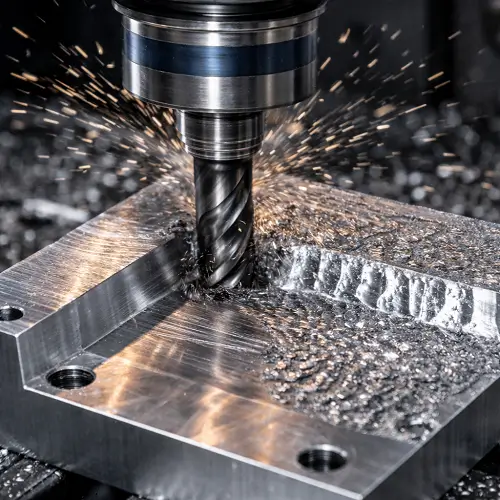
Three-axis CNC machining is often more economical for parts with accessible holes, pockets, and flat surfaces. Five-axis machining can reduce total cost when it avoids repeated setups, complicated fixtures, or difficult tool access. The better choice depends on the part’s geometry, tolerances, and quantity—not the machine’s hourly rate alone.
When ordering custom parts, it is reasonable to question whether five-axis machining is necessary. A higher quote should come with an explanation of what the process achieves for that particular component.
Start with the drawing: which faces need machining, how the part can be held, and which features must align after assembly. These details reveal more about the right manufacturing route than the part’s name or appearance.
Can My Part Be Machined on a 3-Axis CNC Machine?
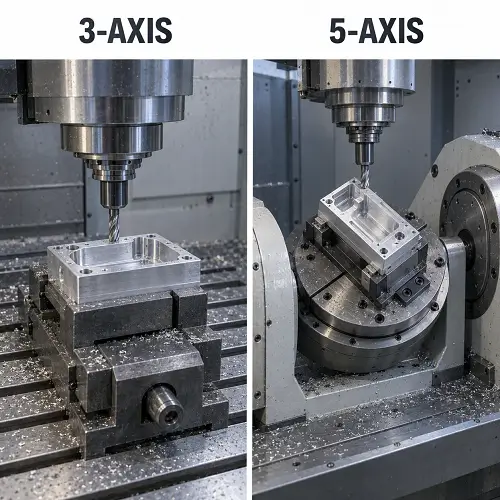
A three-axis CNC mill moves along the X, Y, and Z axes while the tool’s orientation remains fixed during each setup. It can produce many plates, brackets, covers, and housings using standard milling and drilling operations.
An aluminum mounting plate with a shallow pocket, through-holes, and countersinks on its top face is a strong candidate for three-axis milling. If its underside also needs machining, a straightforward second setup may still keep the total cost low.
Multiple machined faces do not automatically require five axes. A shop can reposition the part in a vise, soft jaws, or a dedicated fixture. The question is whether those additional setups remain simple and repeatable.
Three-axis machining becomes less attractive when repositioning requires elaborate fixtures, difficult alignment, or long cutters that must run slowly to avoid deflection.
Which Machining Method Fits My Part’s Features?
The following examples provide a starting point for comparing routes. They are not fixed rules: part size, workholding, tool access, and drawing requirements can change the decision.
| Part and typical features | Practical starting point | When to compare another route |
|---|---|---|
| Mounting plate or cover with holes and shallow pockets mainly on one face | Three-axis machining | Side features or angled holes introduce additional setups |
| Bracket with several perpendicular machined faces | Three-axis machining with repositioning | Holding and locating the part becomes difficult, or relationships between faces are critical |
| Housing with a top pocket and side ports | Compare three-axis setups with 3+2 machining | Indexing may reduce fixture preparation and repeated handling |
| Bracket with angled holes or an inclined mounting face | An angle fixture or 3+2 positioning | Several different angles make separate fixtures less practical |
| Impeller, twisted blade, or surface with restricted tool access | Evaluate simultaneous five-axis machining | Confirm whether changing tool orientation during cutting is necessary or economically beneficial |
An aluminum housing with an open top pocket and mounting holes on the bottom may be economical to machine in two straightforward three-axis setups. If the same housing also has angled ports on several sides, compare that route with 3+2 machining. Indexing the part may eliminate enough fixture preparation and repeated alignment to reduce the total cost.
A bracket with one angled hole presents a different decision. A simple angle fixture may be sufficient, particularly if the shop already has suitable workholding. Several holes at different angles could make indexed machining more attractive.
The deciding factor is what the features require—not whether the component is called a housing, bracket, or precision part.
Does My Part Need Simultaneous 5-Axis Machining or Just 3+3+2?
Not every part produced on a five-axis machine needs simultaneous five-axis cutting. Understanding the distinction helps explain the proposed process.
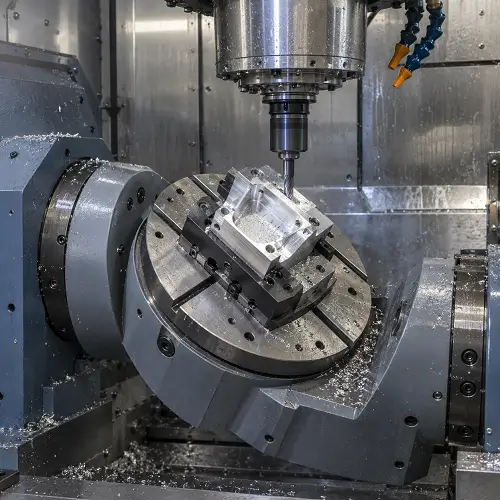
In 3+2 machining, the rotary axes position the workpiece or tool at a selected angle. That orientation remains fixed while the three linear axes perform the cutting operation. The machine then indexes to another orientation when needed.
This can suit angled holes, inclined mounting faces, and features on multiple sides. A bracket does not necessarily need continuous five-axis motion simply because some holes are not vertical.
In simultaneous five-axis machining, tool orientation can change during cutting. This is useful for features such as twisted blade surfaces or areas where changing the cutting angle improves access.
A curved surface alone does not prove that simultaneous five-axis machining is necessary. Many accessible contours can be machined with three axes. The useful question is whether changing orientation during the cut solves an access problem or meaningfully improves the process.
Why Does 5-Axis CNC Machining Usually Cost More per Hour?
Five-axis equipment generally involves higher investment, maintenance, and calibration costs than a comparable three-axis mill. Complex simultaneous toolpaths can also require additional programming, simulation, and verification.
Those costs help explain a higher hourly rate, but they do not establish the final part price. The more expensive machine may spend less total time producing an acceptable component.
For a meaningful CNC machining cost comparison, include programming, workholding, setup, machining, handling, and inspection. A low machine rate can lose its advantage if the part repeatedly needs to be removed, repositioned, and aligned.
Conversely, a simple plate that already fits standard workholding may offer little opportunity for five-axis savings. Paying for additional machine capability does not help unless that capability improves the manufacturing route.
When Can 5-Axis Machining Reduce the Total Part Cost?
Five-axis machining can become economical when it removes enough work to offset its higher operating cost. Potential savings include fewer fixtures, less manual repositioning, and reduced alignment between operations.
Improved access can also allow a shorter, more rigid cutter in some situations. That may permit more efficient cutting than a long tool reaching around an obstruction.
These benefits depend on the geometry and workholding. A five-axis machine cannot reach through a fixture, and the underside of a part may still require another setup.
The following example shows how the comparison works. These are hypothetical planning figures, not JeekRapid prices or market rates. Both routes are assumed to meet the same drawing requirements. The five-axis route uses indexed machining to reduce repositioning and handling, producing a lower recurring cost despite a higher hourly rate.
| Cost item for a 20-part batch | Three-axis route | Five-axis route |
|---|---|---|
| Programming, fixture preparation, and batch setup | $300 | $450 |
| Machining and routine handling per part | $45 | $30 |
| Subtotal for 20 parts | $1,200 | $1,050 |
| Subtotal per part | $60 | $52.50 |
Material, finishing, and inspection are assumed equal and excluded from these subtotals. The five-axis route requires $150 more preparation but saves $15 per part. Under these assumptions, the routes reach the same subtotal at 10 parts; above that quantity, the five-axis route costs less.
For one part, the subtotals would instead be $345 and $480. The higher preparation cost has not yet been recovered.
If the component already needs only simple three-axis workholding, the assumed handling savings may not exist. This example explains how to compare routes; it does not predict that five-axis machining will always be cheaper.
Is 5-Axis Machining Always More Accurate?
Five-axis machining can help maintain relationships between features by reducing reclamping. It does not automatically make every dimension more accurate.
Suppose holes on different faces must align with mating components. Each time the part is removed and repositioned, its location must be reestablished. Machining more of those features in one clamping can reduce one source of variation.
However, accuracy also depends on machine condition, rotary-axis calibration, workholding rigidity, tool deflection, temperature, and inspection. A well-controlled three-axis process can produce highly accurate parts.
For a precision bore accessible from one direction, additional axes may provide little benefit. The finishing method and measurement process may matter more.
Identify the dimensions and geometric relationships that control assembly. The supplier should explain how the proposed route maintains them, rather than treating “five-axis” as a substitute for a process and inspection plan.
How Does Order Quantity Affect the Choice?
For a prototype, programming and fixture preparation can account for a substantial share of the price. Standard three-axis workholding may keep those initial costs low for a simple part.
A complex prototype can lead to the opposite result. Five-axis positioning may avoid making several special fixtures for a component that will only be produced once.
For repeat production, machining time and routine handling become increasingly important. Savings on each component accumulate across the batch, while preparation costs are spread over more parts.
Dedicated three-axis fixtures can also become worthwhile at higher quantities. A fixture that holds several parts or simplifies repositioning may make that route competitive.
There is no universal quantity at which five-axis becomes cheaper. For low-volume CNC machining, provide the immediate order quantity and realistic repeat demand so the supplier can consider both.
Can Design Changes Make 3-Axis Machining More Economical?
A small, approved design change can sometimes remove the feature driving the more expensive process.
If an angled hole has no essential functional reason for its orientation, making it accessible from an existing setup could simplify production. Moving a noncritical side feature to an already machined face may have a similar effect.
Deep, narrow pockets can require long, small-diameter cutters. Where function allows, widening access or reducing depth may improve machining efficiency without changing the machine type.
Larger internal corner radii can also allow larger tools. Five-axis motion does not automatically solve the difficulty of producing sharp internal corners in enclosed pockets.
A useful manufacturability review identifies the feature increasing cost, explains a feasible alternative, and shows what would change. Any modification must preserve function and receive approval before production.
How Should You Compare 3-Axis and 5-Axis Machining Quotes?
First confirm that both quotations cover the same material, quantity, tolerances, finishing, and inspection requirements. Otherwise, the apparent machining-cost difference may come from different assumptions.
If a quote recommends five-axis machining, ask which feature requires it and whether 3+2 positioning would be sufficient. If both three-axis and five-axis routes are feasible, ask what changes in fixtures, setup, cycle time, and total batch price.
For a three-axis proposal involving several setups, ask how the part will be located between operations, especially where features on different faces must align.
The explanation should connect to the drawing. “These angled ports require separate fixtures on the three-axis route” gives a reason to assess. “Five-axis is more advanced” does not explain the price.
Compare the delivered-part cost and included scope. The economical route is the one that consistently meets the requirements at a competitive total price.
Get a Machining Quote Based on Your Part
JeekRapid reviews custom parts for CNC milling and five-axis machining based on geometry, material, critical tolerances, and order quantity. The aim is to select a practical route that delivers the required component without unnecessary processing.
Send the CAD model and drawing with the material, quantity, surface finish, and important assembly requirements. If more than one route appears feasible, request a comparison and an explanation of the features driving the cost.