In many industries such as aerospace and medical devices, standard CNC machining is no longer sufficient to meet the required accuracy. Precision CNC machining refers to the ability to consistently manufacture parts with tolerances of ±0.001 inch or tighter under real production conditions.
At JeekRapid’s production floor, precision is not defined by machine manuals, but by whether parts assemble smoothly, run quietly under load, and continue to perform the same way after thousands of cycles.
In practice, most CNC shops can hold ±0.001 inch on aluminum and mild steel, but maintaining that level across real production is a very different challenge. Fixture design, thermal management, cutting strategy, inspection feedback, and operator discipline ultimately determine whether that accuracy survives through final inspection. If you have ever struggled with parts that pass inspection but fail during assembly, this is exactly where the real problem usually starts.
What Is Precision CNC Machining?
Precision CNC machining focuses on controlling dimensions, tolerances, and surface quality so that parts do not just meet specifications once, but perform consistently in every production cycle.
On real production parts, precision work usually means holding ±0.0004 to ±0.0002 inch while keeping coaxiality, flatness, and position tightly controlled.
More importantly, this accuracy is not accidental. Tolerances are driven by functional requirements. Bearing fits, sealing surfaces, alignment features, and moving components leave no margin for dimensional drift. This functional demand is what elevates precision CNC machining from ordinary manufacturing to engineering-driven production.
Precision CNC Machining Process
Drawing Review and Process Planning
Every precision project begins with a full drawing review. Engineers identify functional surfaces, critical dimensions, and tolerance relationships, then establish machining sequence, datum structures, fixture concepts, and inspection strategies. Many downstream quality issues originate from decisions made at this stage.
Design Modeling
The design process starts from functional requirements and develops into a complete CAD model with dimensional control. Engineers must consider tool approach, fixturing surfaces, machining directions, and how tolerances accumulate across features.
Design for Manufacturability plays a critical role. Features that look simple on screen may require complex setups or introduce unnecessary risk in machining. Experienced engineers refine wall thickness, corner radii, hole depth, and feature spacing early so that the part can be produced reliably and economically.
Once the model is complete, it defines not only the part but the entire manufacturing system. Tooling, fixtures, inspection, and quality control are all driven by this model.
Programming
When the model is finally locked, the real work begins with CNC programming.
Using CAM software, engineers plan cutting strategy based on geometry, material behavior, tolerance targets, and fixturing. Roughing, semi-finishing, and finishing stages are sequenced carefully while controlling cutting load and deformation risk.
Programs are converted into machine instructions using G-code for motion control and M-code for auxiliary functions. Before production, simulations verify cutting loads and collision risk, and feed rates are adjusted based on real cutting behavior. This is the stage where experienced engineers usually spend the most time, because small mistakes here almost always become expensive problems later.
Machining Execution
Before cutting, machines undergo thermal stabilization, tool runout verification, coordinate alignment, and positioning validation. The first article is machined and fully inspected. Any deviation is fed back into programs and fixturing until the process becomes stable.
Post-Processing and Inspection
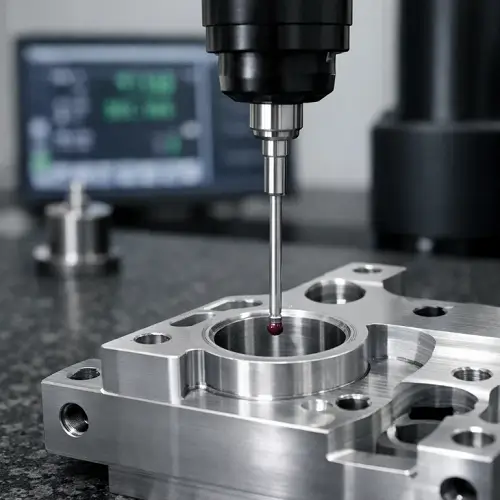
Precision is preserved through continuous inspection, tool wear monitoring, temperature compensation, and process audits. Final validation is performed using CMM measurement and functional verification.
Precision CNC Equipment and Machine Types
CNC Milling Machines
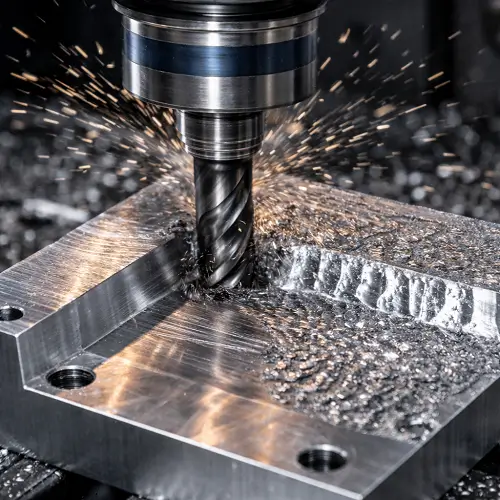
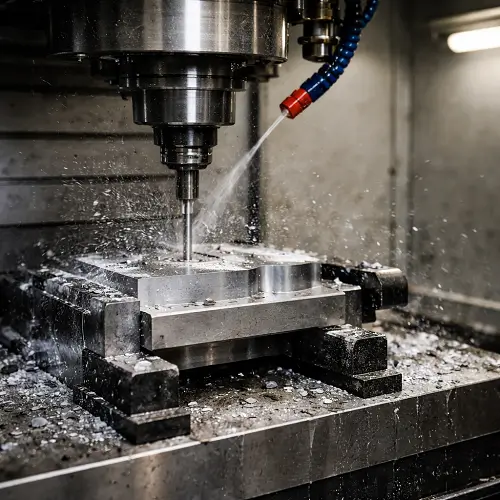
CNC milling machines form the core of most precision workflows. Multi-axis control allows complex surfaces and multi-feature parts to be produced with minimal repositioning, significantly reducing accumulated error. Machine rigidity, spindle stability, and axis synchronization directly affect final accuracy and surface quality.
CNC Turning Machines
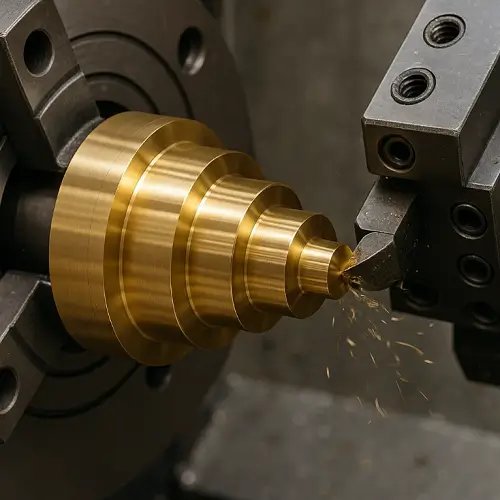
Turning centers handle shafts, discs, and rotational components. Key fits such as bearing seats, sealing surfaces, and alignment features are typically produced by turning, and their stability often determines the service life of the entire assembly.
Multi-Axis Machining Centers
Five-axis machining dramatically reduces setup error and maintains spatial relationships between features. This capability is essential for aerospace, medical, and high-end mechanical systems.
Electrical Discharge Machining
EDM removes material using electrical discharge without cutting force, making it ideal for hard materials, deep cavities, thin walls, and complex mold geometries.
CNC Grinding Machines
Grinding refines final dimensions and surface finish. Precision shafts, guideways, and mold inserts often require grinding to achieve long-term stability.
High-Precision Drilling and Boring Machines
These machines produce high-accuracy hole patterns where positional tolerance directly controls assembly performance.
Advantages of Precision CNC Machining
Dimensional Stability and Repeatability
In day-to-day production, precision CNC machining is what keeps parts consistent across batches. Stable programs and controlled parameters reduce rework and improve assembly efficiency.
Reduced Manufacturing Risk
Automation minimizes human variability, making quality predictable. This is essential for aerospace, medical, and automotive programs.
Complex Geometry Capability
Multi-axis machining enables highly complex structures to be produced in fewer setups, improving geometric integrity.
Material Versatility
Precision machining supports aluminum, stainless steel, titanium, engineering plastics, and advanced alloys. Each material requires different thermal and cutting control strategies learned through real production experience.
Production Flexibility
The same equipment supports prototyping, low-volume production, and scalable manufacturing without rebuilding the process.
Lower Lifecycle Cost
Although unit machining cost may be higher, reduced scrap, fewer defects, improved assembly, and longer service life lower total system cost.
Materials Used in Precision CNC Machining
| Material Type | Common Grades | Machining Behavior | Impact on Precision |
|---|---|---|---|
| Metal | Aluminum 6061 / 7075 | Smooth cutting, low tool wear | Thermal expansion requires control |
| Metal | Carbon Steel 1018 / 1045 | Stable and easy machining | Good dimensional stability |
| Metal | Alloy Steel 4140 | Higher cutting resistance | Heat-affected control required |
| Metal | Stainless 304 / 316 | Work hardening | Prone to dimensional drift |
| Metal | Stainless 17-4PH | Stable cutting | Re-inspection after heat treatment |
| Metal | Titanium Ti-6Al-4V | Poor heat dissipation | High thermal distortion risk |
| Metal | Copper C101 / C110 | Soft, sticky cutting | Surface control difficult |
| Metal | Brass C360 | Excellent machinability | High precision stability |
| Metal | Inconel 718 | Extremely difficult machining | High dimensional control difficulty |
| Plastic | PEEK | Stable cutting | Temperature sensitive |
| Plastic | POM / Delrin | Easy machining | High dimensional stability |
| Plastic | Nylon | Easy machining | Moisture absorption causes drift |
| Plastic | ABS | Easy machining | Moderate precision retention |
| Plastic | PC | Soft cutting | Stress deformation risk |
| Plastic | PTFE | Extremely soft | Precision control challenging |
Applications of Precision CNC Machining
Aerospace
Structural brackets, frames, housings, support blocks, flanges, turbine components, blades, shafts, and complex surface parts.
Automotive
Engine housings, cylinder components, drive shafts, gears, differential parts, brake components, steering components, motor housings, brackets, mounting blocks.
Industrial Equipment
Guide rails, sliders, locating blocks, mounting bases, transmission components, couplings, shafts, precision mating parts.
Medical Devices
Surgical components, orthopedic structural parts, micro support assemblies, connectors, precision sleeves, housings.
Electronics
Heat sinks, enclosures, cavities, precision brackets, frames, connection blocks, micro structural parts.
Precision CNC Machined Parts and Real Production Case
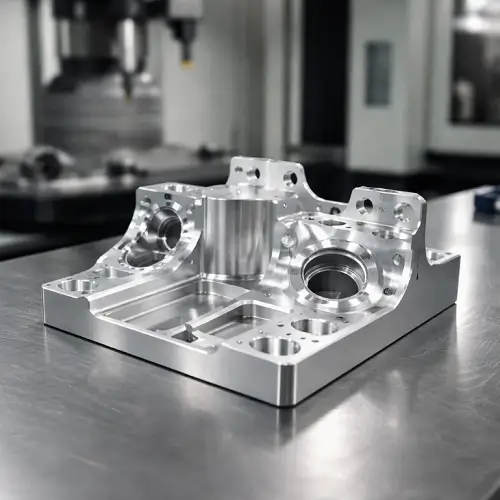
Typical precision components include bearing housings, valve bodies, gear assemblies, sealing surfaces, motion components, and structural parts.
One recent job involved an aluminum automation enclosure that needed ±0.001 inch flatness across a 10-inch sealing surface. Early production showed distortion after rough machining. By redesigning fixturing, controlling cutting heat, adjusting machining sequence, and increasing in-process inspection, final flatness stabilized at ±0.0007 inch across full production.
Why Engineers Choose JeekRapid for High-Precision CNC Machining
Engineers choose partners based on long-term precision stability, not just equipment count. True difficulty lies in maintaining accuracy throughout full production.
Projects begin with full drawing review, datum planning, and process design. Thermal distortion, fixturing deformation, and tool wear are tightly controlled through process optimization and inspection feedback.
Through material utilization and process optimization, cost remains reasonable while maintaining quality stability. Manufacturing follows ISO 9001 quality systems with complete inspection documentation, ensuring long-term reliability in service.
In practice, precision machining is defined by how consistently a process can hold tolerances over time, not by how tight a single dimension appears on a drawing.
Get Your Precision Parts Quote
Precision machining often involves detailed process planning, material-response considerations, and tolerance control that extend beyond isolated operations. For a broader engineering perspective on how these factors integrate across CNC machining decisions, see:
→ CNC Machining Explained: Machines, Materials, Tolerances, and Practical Engineering Decisions
FAQ
What is precision CNC machining?
Precision CNC machining is simply about making parts that hold very tight tolerances and stay consistent from part to part.
How accurate is precision CNC machining?
With proper process control, ±0.001 inch is common, and tighter tolerances are achievable for critical features.
CNC machining vs finishing — what’s the difference?
CNC machining shapes the part, while finishing brings the part to final accuracy and surface quality.
What materials can be used?
Aluminum, steel, stainless steel, titanium, brass, copper, and engineering plastics such as POM, ABS, Nylon, and PEEK.
Is precision CNC machining suitable for small batches?
Yes. It is widely used for prototypes, low-volume production, and scalable manufacturing.