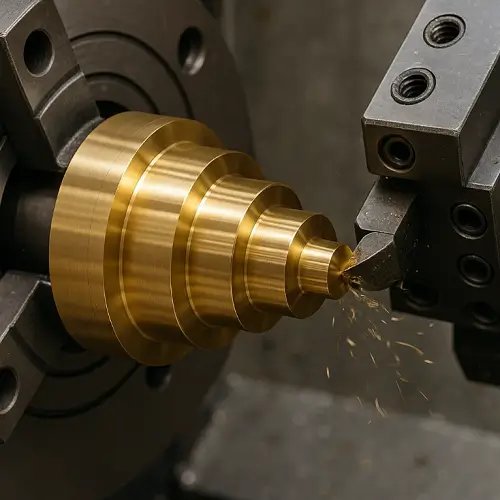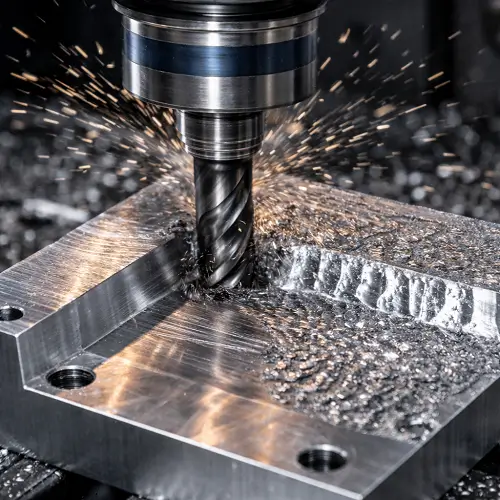
Copper, brass, and bronze are widely used engineering metals known for their high electrical and thermal conductivity, corrosion resistance, and long-term durability. These three copper-based materials are commonly applied in electrical systems, mechanical assemblies, fluid control components, architectural hardware, and industrial equipment. Because their color and general appearance are similar, they are often confused during material selection, especially in early design stages.
Despite these shared characteristics, copper, brass, and bronze differ significantly in composition, mechanical behavior, machinability, cost, and service performance. Choosing the wrong material can lead to unnecessary machining cost, premature wear, electrical inefficiency, or early part failure. This article explains the real engineering differences between copper, brass, and bronze, focusing on material performance, CNC machinability, production cost, and practical applications.
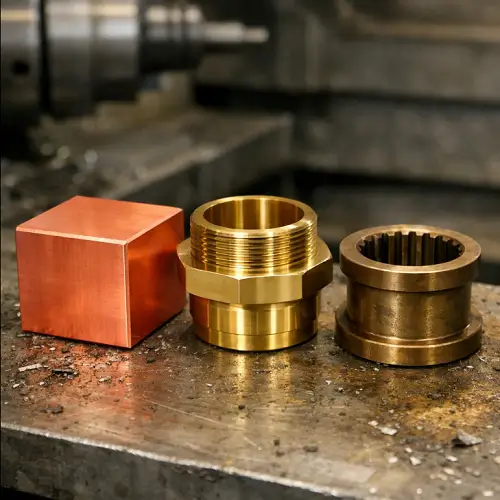
Performance Differences Between Brass, Bronze, and Copper
Electrical Performance
If the part needs to carry current, the discussion almost always starts with copper. Nothing in this group conducts electricity as efficiently. That is why copper shows up in bus bars, electrical connectors, power components, and grounding systems. The problem is not performance, it is mechanics. Copper is soft, deforms under load, and wears quickly under vibration or repeated contact. Once a part must hold shape under stress or survive long service cycles, copper becomes a poor structural choice.
Brass can handle light electrical duties and low-current connectors, but it is rarely selected for serious power transfer. Bronze moves even further away from electrical roles. Its strengths lie elsewhere.
In practical terms, pure copper is around 58 MS/m (100% IACS), common brasses are typically 15–28 MS/m, and most bronzes fall roughly in the 6–15 MS/m range.
Conductivity ranking:
Copper > Brass > Bronze
Thermal Performance
When heat needs to move quickly and reliably, copper again stands at the top. Heat sinks, cooling plates, and thermal transfer components rely on copper because it removes heat faster than brass or bronze. In moderate thermal applications, brass performs acceptably and offers better mechanical stability than copper. Bronze, while mechanically superior, is rarely chosen for heat dissipation and is usually selected when structural strength matters more than thermal efficiency.
For heat transfer:
Copper > Brass > Bronze
Mechanical Strength
When load enters the design, the material hierarchy changes. Bronze handles continuous load, impact, and vibration far better than brass or copper. It maintains geometry under stress and resists deformation over long service life. Brass offers enough strength for most housings, fittings, and precision connectors while maintaining predictable behavior. Copper remains the weakest of the three and should be avoided in load-bearing assemblies.
Wear Resistance
In applications involving sliding, friction, or repeated contact, bronze becomes the natural choice. It resists surface damage and maintains performance long after brass or copper would begin to degrade. Brass provides moderate wear resistance suitable for light-duty mechanical parts. Copper wears quickly under mechanical contact and is rarely used for moving components.
Hardness
From a hardness standpoint, bronze generally ranks highest, followed by copper, then brass, although exact values depend on alloy and temper. Higher hardness is a key reason bronze performs so well in wear-critical components.
Typical hardness values seen in production are roughly 70–150 HB for bronze, 35–100 HB for copper, and 50–120 HB for brass.
Hardness ranking:
Bronze > Copper > Brass
Corrosion Resistance
All three materials resist corrosion reasonably well, but they do so in different ways. Bronze performs best in marine and chemically aggressive environments and maintains stability over long exposure. Brass handles atmospheric corrosion and water systems reliably in most industrial conditions. Copper oxidizes quickly in open air and often requires surface protection when appearance or contact quality matters.
For corrosion resistance:
Bronze > Brass > Copper
Dimensional Stability
Brass and bronze both hold tolerances well in service. Brass is particularly stable in precision components where predictable geometry matters. Bronze maintains shape under load and over long service life. Copper, because of its softness, is more susceptible to deformation and dimensional drift when exposed to mechanical stress.
Service Life
In long-running systems, bronze typically delivers the longest operating life with the least maintenance. Brass follows with stable, predictable wear behavior. Copper remains valuable when its electrical or thermal advantages are essential, but in mechanical roles its service life is usually the shortest.
In wear-driven applications, bronze components commonly last 1.5–3× longer than brass and 2–5× longer than copper under similar operating conditions.
Expected service life trend:
Bronze > Brass > Copper
Machinability Differences of Brass, Bronze, and Copper
CNC machining is often where the real separation between copper, brass, and bronze becomes visible. On the drawing they may look similar, but once the tools start cutting, each material behaves in its own way. Feed rates, tool wear, chip control, and surface finish all respond differently, which directly affects production stability and overall part cost.
In practice, copper tends to push machining limits the hardest, brass runs smoothly and efficiently, and bronze demands patience but rewards the effort with long-term durability in the finished part. Those characteristics guide most material decisions long before the first program ever reaches the machine.
Machinability of Brass
Brass is one of the most forgiving materials on the shop floor. It produces short, well-broken chips and allows aggressive cutting parameters without damaging tools. Surface finish usually comes off the machine clean, and tight tolerances are easy to hold even over long production runs.
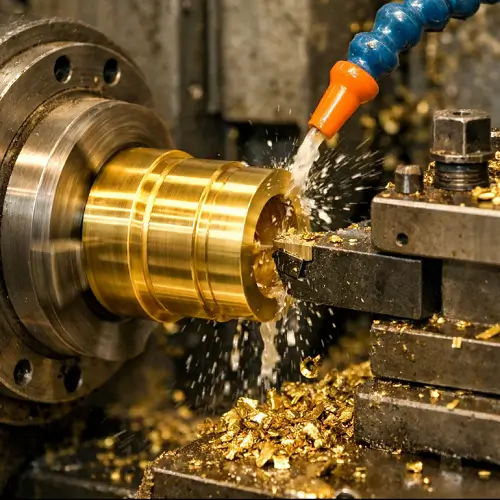
Because of that behavior, brass is widely used for precision fittings, valves, connectors, threaded parts, and components where repeatability and throughput matter. Setup time stays low, scrap rates remain predictable, and production planning is straightforward.
Machinability of Bronze
Bronze machines more slowly and requires more conservative parameters. Cutting forces are higher, tools see more wear, and heat management becomes more important. However, once dialed in, bronze produces extremely stable parts with excellent wear resistance and long-term dimensional reliability, making it ideal for bearings, bushings, and high-load components.
Machinability of Copper
Copper presents the most challenges during machining. Its softness and ductility cause material to smear and adhere to cutting edges, which accelerates tool wear and degrades surface quality if feeds, speeds, and coatings are not carefully controlled.
Cycle times on copper are usually longer, and scrap risk is higher compared with brass or bronze. Even so, copper remains essential for electrical and thermal components where its performance advantages outweigh the added machining difficulty.
Machining Cost of Brass, Bronze, and Copper
For most CNC jobs, if you look at the full picture — material, machine time, tooling, scrap, and risk — brass usually ends up the cheapest, bronze sits in the middle, and copper is the most expensive to machine. That pattern shows up over and over again in real production, even when raw material prices are close.
Machining Cost of Brass
Brass is the material shops like to see on the schedule. It runs fast, the chips behave, tools last, and tolerances come in early. On high-volume parts, that alone can cut production cost more than the price difference between materials. When a job involves a lot of turning, threading, or tight-tolerance work, brass almost always becomes the baseline for cost comparison.
Another cost advantage of brass is process stability. Operators spend less time fighting burrs, tool wear, or surface finish problems, which reduces setup time and scrap. Production planning stays predictable, and cycle times remain consistent across long runs. That reliability is one of the main reasons brass dominates high-volume precision CNC work.
Machining Cost of Bronze
Bronze never runs like brass. Feed rates come down, cutting forces go up, and tool wear becomes part of the conversation. That pushes cycle time and tooling cost higher. Even so, bronze continues to be selected for wear parts, bushings, and load-bearing components because replacing failed parts in service often costs far more than the machining bill.
Machining Cost of Copper
Copper causes the most headaches. Tools dull fast, surface finish can collapse without warning, and setups take longer to stabilize. On small electrical parts that may not matter much, but once part size or quantity increases, copper’s machining behavior becomes a serious cost driver. It is chosen because nothing else does the job electrically or thermally, not because it is friendly to your production budget.
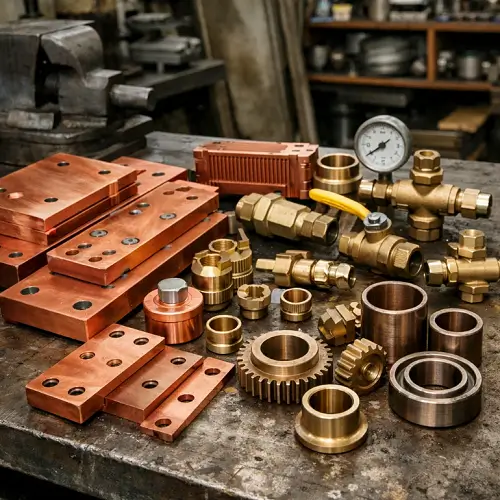
Typical Applications
In real projects, the choice between copper, brass, and bronze is usually driven by what the part has to do every day — not by chemistry textbooks. Each material has a set of applications where it naturally makes sense, and problems start when those roles get mixed up.
Applications of Copper
Copper dominates anywhere electricity or heat is the primary job. Power distribution components, bus bars, electrical connectors, motor parts, transformers, and grounding hardware are all typical copper parts. Copper also appears frequently in heat exchangers, cooling plates, and thermal management systems. In these roles, copper’s softness and machining difficulty are tolerated because no other material in this group can replace its electrical and thermal performance.
Applications of Brass
Brass lives in the world of precision mechanical components. Fittings, valves, connectors, fasteners, housings, and decorative hardware are where brass shines. It is chosen when parts must be produced in volume, hold tight tolerances, and come off the machine with clean surface finish. Brass is also common in plumbing systems, instrumentation, and consumer products where corrosion resistance and appearance both matter.
Applications of Bronze
Bronze is the workhorse for load, wear, and long service life. Bearings, bushings, thrust washers, gears, pump components, marine hardware, and heavy-duty mechanical assemblies rely on bronze because it survives friction, vibration, and harsh environments better than copper or brass. When parts are expected to run for years under continuous stress, bronze is often the safest choice.
Common Grades for CNC Machining
When engineers talk about copper, brass, or bronze, they are rarely talking about the material in general. In practice, material grade is what controls machinability, strength, corrosion behavior, and cost. The following grades are some of the most common choices seen in CNC machining projects.
Copper Grades for Machining
Most CNC copper parts are not pure laboratory-grade copper. In production, the most common machining grades include:
C110 (ETP Copper) – High electrical conductivity, widely used for electrical components, bus bars, and thermal parts. Machinability is poor but performance is excellent.
C101 (Oxygen-Free Copper) – Similar conductivity to C110 with improved purity. Used in high-end electrical and vacuum applications where contamination must be minimized.
C145 (Tellurium Copper) – Much better machinability than pure copper while retaining high conductivity. Often chosen when both electrical performance and production efficiency matter.
C145 is frequently selected when shops need copper performance without copper-level machining pain.
Brass Grades for Machining
Brass offers the widest selection of easy-to-machine grades. Common choices include:
C360 (Free-Cutting Brass) – The standard for CNC machining. Excellent machinability, short chips, stable tolerances, and low tool wear.
C260 (Cartridge Brass) – Good formability and corrosion resistance. Machinability lower than C360 but used when strength and appearance matter.
C464 (Naval Brass) – Improved corrosion resistance for marine environments with reasonable machinability.
C360 is the workhorse of CNC brass parts and often the first option considered.
Bronze Grades for Machining
Bronze selection is usually driven by wear and load requirements:
C932 (SAE 660 Bearing Bronze) – The most common bearing bronze. Excellent wear resistance and compatibility with steel shafts.
C954 (Aluminum Bronze) – High strength, excellent corrosion resistance, good performance in marine and high-load environments.
C907 / C905 (Tin Bronzes) – Strong, wear-resistant alloys used for bushings, gears, and structural components.
C932 remains the default for bushings and sliding components, while aluminum bronze grades dominate in heavy-duty service.
Why Choose JeekRapid for Copper, Brass, and Bronze Machining
Choosing a machine shop for copper-based materials is not just about having CNC equipment. Copper, brass, and bronze each bring different challenges in tooling, cutting behavior, surface control, and quality inspection, and those challenges only become clear once parts reach the machine. JeekRapid works with these materials daily across electrical components, precision mechanical parts, and wear-critical assemblies, allowing machining strategies to be defined correctly from the beginning instead of being corrected later.
JeekRapid operates more than 50 CNC machines covering milling, turning, and multi-axis machining, supported by a complete production chain including stamping, bending, EDM, grinding, drilling, tapping, deburring, and surface finishing. With teams available around the clock, prototypes and production runs can move quickly without compromising quality. The engineering team works directly from customer CAD models to refine geometry, tolerances, and material selection before cutting begins.
From quotation through final inspection, the focus remains on process stability and repeatable quality. Whether the project involves high-conductivity copper parts, high-volume brass components, or heavy-duty bronze wear components, JeekRapid delivers machining solutions that match real engineering requirements and production conditions.Click here to send your CAD file and get a quote!
FAQs
Which material machines best?
Brass offers the best overall machinability. Bronze machines more slowly but provides superior durability. Copper is the most difficult to machine.
Which material is most expensive to machine?
Copper typically has the highest machining cost, followed by bronze, with brass being the most economical.
Why is copper not ideal for structural parts?
Copper is mechanically soft and wears quickly under load and vibration.
Why is bronze widely used for bearings?
Bronze offers excellent wear resistance, load capacity, and long service life in friction applications.
Which brass grade is best for CNC production?
C360 free-cutting brass is the most commonly used grade for high-volume CNC machining.