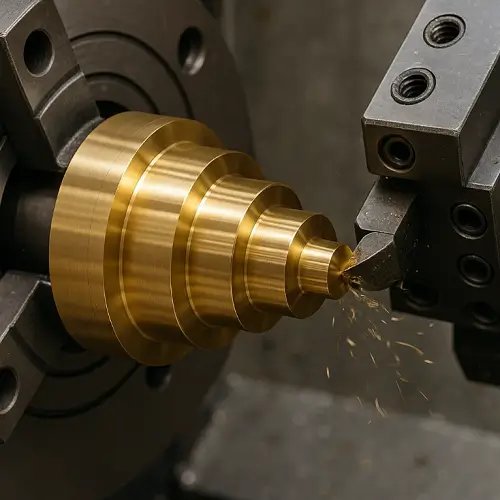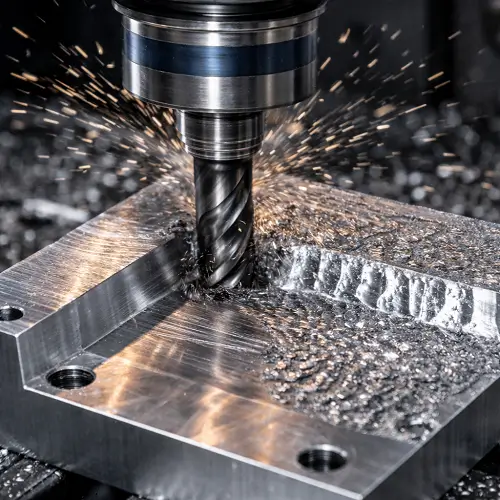
In CNC machining, most discussions naturally focus on metals, including hardness, cutting forces, and tool wear. On the shop floor, however, CNC machining is not limited to metal parts. A wide range of plastic components are routinely produced using CNC processes, particularly in low-volume production, prototyping, and functional applications where precise geometry is still required.
Many engineering plastics can be machined effectively using standard CNC operations. Milling and turning are the most common processes, and in many cases they rely on the same machines and basic fixturing concepts used for metal parts. From an equipment standpoint, plastic machining often appears straightforward and familiar.
The difference lies not in whether plastics can be CNC machined, but in how they behave once material removal begins. Compared with metals, plastics respond differently to cutting forces, heat input, and part support conditions. These differences introduce challenges that are easy to underestimate when plastic machining is approached with a metal-focused mindset.
Why CNC Machining Leads to Warping in Plastic Parts
Warping in CNC-machined plastic parts is not caused by a single parameter setting or tool choice. It results from how CNC machining removes material and redistributes stress throughout the part during cutting.
Unlike metals, most plastics have lower stiffness and lower thermal conductivity. As material is removed, the remaining structure loses support more quickly, while localized cutting heat is retained near the tool and part interface. This allows internal stress, whether present in the raw stock or introduced during machining, to release unevenly.
Internal stress is stored energy inside the plastic stock. When material is removed, that balance changes, and the part moves to a new free state.
Material removal sequence plays a critical role. When one side of a plastic part is pocketed or thinned before the opposite side is addressed, stiffness becomes unbalanced. The part may remain flat while clamped, but distortion often appears during later passes or after fixturing is released.
Fixturing further complicates the issue. Plastics tend to conform to fixture pressure rather than resist it. Once clamps are removed, the part relaxes toward its natural stress state, which may differ significantly from its machined geometry.
Because CNC machining combines localized heat input, asymmetric material removal, and external constraint from fixturing, plastic parts are especially sensitive to warping. The issue is not machining accuracy, but whether stress is allowed to release in a controlled and balanced way.
Common CNC Machining Operations Used for Plastic Parts
Most plastic parts are CNC machined using a small number of core operations. While these processes are familiar from metal machining, their effect on stress release and dimensional stability in plastics is often underestimated.
Turning
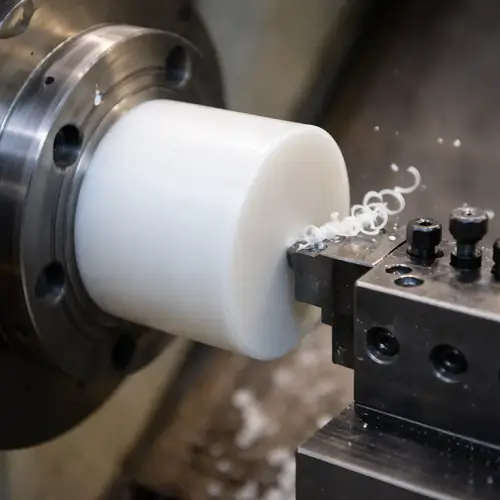
Turning is commonly used for bushings, spacers, and other rotationally symmetric plastic components. Material is removed evenly around the axis, which reduces stiffness in a balanced way.
Because stress is released uniformly, warping is less common than in milling operations. Dimensional movement can still occur after machining, but it is usually gradual and easier to predict.
Milling
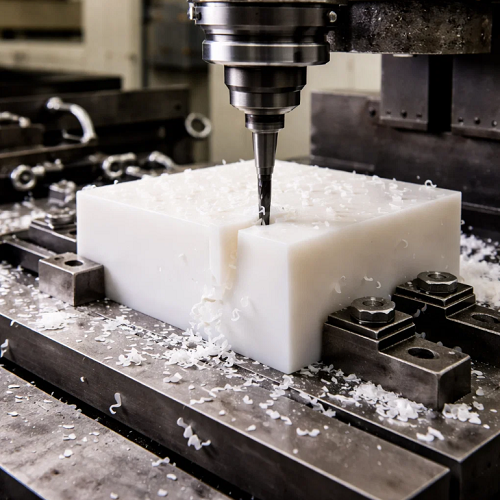
Milling is the most common operation for plastic parts such as plates, housings, and flat components. Material is typically removed from one side first, which quickly creates stiffness imbalance.
Parts often remain flat while clamped and begin to move during finishing or immediately after unclamping, especially on wide or thin sections.
Pocketing
Pocketing removes large volumes of material from localized areas. In plastic parts, this accelerates stress release and heat buildup.
Distortion often appears late in the process or after machining is complete, even when roughing operations appeared stable.
Drilling and Secondary Features
Drilling and other secondary features are often added near the end of the machining sequence. Introducing holes or slots into an already thinned plastic part can release residual stress that was previously balanced.
This late-stage stress release is a common cause of unexpected post-machining deformation.
Process-Level Methods to Control Plastic Warping
Warping in CNC-machined plastic parts cannot be eliminated entirely, but it can be reduced by managing stress release, heat input, and part support throughout the machining sequence.
Unbalanced Material Removal
Removing material from one side of a plastic part before the opposite side is addressed is one of the most common causes of warping. As stiffness drops locally, internal stress is released unevenly.
Balanced roughing on opposing faces should be treated as a baseline requirement rather than an optional optimization.
Aggressive Single-Pass Machining
Large depth of cut strategies remove stress too quickly. Plastics do not dissipate stress the same way metals do, and rapid material removal often leads to immediate shape change once support is reduced.
Separating roughing, rest machining, and finishing allows stress to relax incrementally and produces more stable geometry.
Localized Heat Buildup
Plastic machining generates less cutting force but retains heat near the tool and part interface. Local temperature rise accelerates stress relaxation and softening, especially on thin sections.
Sharp tools, moderate surface speeds, and consistent chip evacuation are more effective than reducing feed alone.
Over-Constrained Fixturing
High clamping force can temporarily force a plastic part flat during machining. Once the fixture is released, the part relaxes to its natural stress state, often resulting in measurable warping.
Fixturing should support the part rather than force it into position.
Unrealistic Process Expectations
Some plastic part geometries cannot be fully stabilized through machining strategy alone. Thin, wide, or highly asymmetric parts will move regardless of toolpath refinement.
In these cases, tighter tolerances increase scrap rather than quality.
Part Geometry That Almost Guarantees Warping
Certain plastic part geometries are inherently unstable once CNC machining begins. No amount of parameter tuning or fixture refinement can fully compensate for designs that lose stiffness too quickly during material removal.
Thin, wide flat sections are the most common example. As thickness drops, bending stiffness decreases rapidly while internal stress remains.
Large pockets machined from one side create stiffness imbalance early in the process. Even if the opposite side is machined later, the initial imbalance is often enough to introduce permanent distortion.
Long unsupported spans such as ribs, arms, or flanges may appear rigid in CAD models but lose stability once surrounding material is removed.
Sharp transitions in wall thickness concentrate stress and are often the first locations where warping appears.
Highly asymmetric designs combine several of these risks at once. In these cases, distortion is not a process failure but a predictable outcome of the geometry itself.
How Different Plastics Respond Under CNC Machining Stress
Not all plastics react the same way once CNC machining starts removing material. Two parts can follow the same toolpath on the same machine and still behave very differently by the time the job is finished.
Hardness and strength numbers rarely explain what actually happens. What matters is whether the material releases stress gradually, all at once, or after machining is already finished.
ABS and Polycarbonate (PC)
ABS and polycarbonate machine easily at first. Cutting forces stay low, and roughing often looks stable.
As the part warms up, stiffness drops quickly, especially on wide faces or thin sections. Movement often appears during finishing or immediately after unclamping.
Nylon (PA6, PA66)
Nylon tends to flex rather than resist cutting forces, which masks instability during machining.
After machining, parts often shift slightly. On asymmetrical components, that movement may continue beyond inspection.
Acetal (POM / Delrin)
Acetal is relatively predictable. Surface finish is clean, and staged machining usually produces acceptable results.
Problems appear when material removal becomes uneven and thin areas begin to bow late in the process.
Glass-Filled Plastics (GF Nylon, GF PEEK)
Glass-filled materials feel stable early on and resist deflection during roughing.
Once stiffness drops below a critical point, stored stress releases quickly and distortion often appears suddenly.
High-Temperature Plastics (PEEK, PPS)
PEEK and PPS tolerate aggressive cutting and resist surface damage.
Heat remains in the part longer, and stress relaxes after machining is complete. Parts that measure within tolerance at the machine may move later the same day.
Low-Stiffness Plastics (UHMW, PTFE)
These materials follow the fixture during machining rather than resisting it.
Once unclamped, geometry that looked acceptable on the machine often fails to hold its shape.
Stress Response Matters More Than Strength
Across all plastic types, nominal strength and hardness provide limited insight into machining stability. The defining factor is how each material stores and releases stress during material removal.
CNC machining reshapes not only the part geometry but also its internal stress state. Understanding how a specific plastic reacts to that change is essential for predicting whether distortion will be immediate, gradual, delayed, or unavoidable.
How to Reduce Post-Machining Deformation in Plastic Parts
Post-machining deformation in plastic parts cannot be fully eliminated, but it can be reduced when the problem is approached as a stress management issue rather than a cutting parameter problem.
Balanced material removal, staged machining, and conservative heat input are the most effective process controls. Excessive clamping force should be avoided, as forcing a plastic part flat during machining often increases distortion after release.
Geometry and material choice ultimately set the limit of what can be achieved. When those factors are mismatched, deformation is not a failure of execution but a predictable engineering result.
Free-State Inspection and Timing
Dimensional inspection of plastic parts is most meaningful when performed in a free state. Measuring parts immediately after unclamping can mask deformation that appears once internal stress has fully relaxed.
For larger or thinner plastic components, allowing the part to rest for several hours before final inspection often reveals movement that was not visible on the machine. This delay reflects material behavior rather than a quality issue.
A Practical Example from CNC Plastic Machining
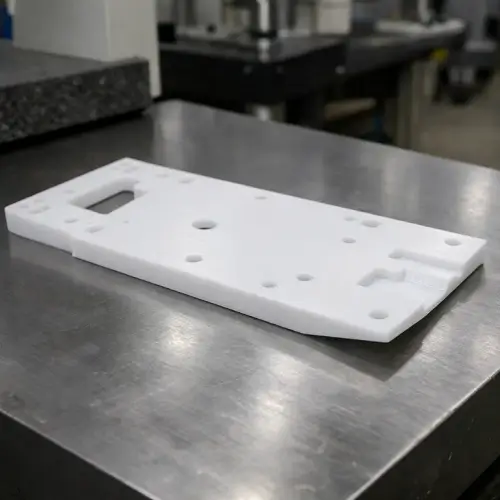
In one common case, a flat ABS plate measuring approximately 300 mm by 180 mm with a final thickness of 6 mm was CNC milled from one side to create a series of internal pockets. During machining, the part remained flat while clamped, and all critical dimensions measured within tolerance at the machine.
After unclamping, the part exhibited visible warping across the long edge, with an out-of-plane deviation of approximately 0.6 to 0.8 mm. Re-machining and increased clamping force did not correct the distortion.
When the process was revised, material removal was balanced across both faces during roughing, and finishing passes were split into two stages with an intermediate dwell to allow stress relaxation. Under the revised process, post-machining deformation was reduced to less than 0.2 mm, meeting the functional requirement without changing the part geometry.
This type of result is typical for wide plastic parts where stiffness drops rapidly once internal pockets are introduced.
Summary
Plastic parts can be CNC machined reliably, but dimensional stability should never be assumed. Warping and post-machining deformation result from how material removal, heat input, fixturing, geometry, and material behavior interact during machining.
CNC machining changes more than part geometry. It alters the internal stress state of the material. Balanced material removal, realistic fixturing, and staged machining can reduce distortion, but they cannot compensate for unstable geometry or unsuitable material selection. In many cases, deformation is a predictable outcome of the design and process combination.
From an engineering standpoint, controlling plastic part distortion is most effective when addressed early through geometry decisions, material selection, and process planning. Attempting to correct instability at the machine is rarely successful once stress has already been introduced.
If you have plastic parts that require CNC machining and are looking for a reliable manufacturing partner, you can upload your CAD file to request a quotation.