Material choice is one of those decisions in CNC machining that looks simple on paper, then quietly controls everything that follows — cycle time, tool life, scrap rate, even whether the schedule survives first article.
Anyone who has run real projects has seen the same drawing produce very different numbers on the quote sheet, just by changing the material line.
If that sounds familiar, you are not alone.
This page is not a catalog of materials.
It is a breakdown of what actually changes on the shop floor when that material changes.
What follows is the practical side of that decision — the trade-offs engineers and buyers end up dealing with once the part hits the machine.
Other Factors to Consider Before Selecting CNC Materials
Before locking in a material, there are several practical constraints that usually matter more than the price per pound.
Machinability
Some materials simply cut clean and predictably.
Others fight the tool, build heat, and turn every tight feature into a risk.
Weight Sensitivity
In aerospace and motion systems, material weight often drives the entire design.
A lighter part can lower system cost even when the individual component becomes more expensive.
Unit Cost
Unit cost is rarely just material plus machining.
Setup time, inspection effort, scrap risk, and finishing almost always dominate the final number.
Thermal Conductivity
For heat sinks and electronic housings, thermal behavior becomes a design constraint, not an afterthought.
The wrong choice here shows up later as stability problems, not as a clean drawing revision.
Corrosion Resistance
Some environments forgive poor material choices.
Marine, chemical, and medical applications usually do not.
Material Cost Factors
Aluminum Alloys — 6061 & 7075
6061 and 7075 are the two most widely used structural aluminum alloys in CNC machining.
6061 is selected for balanced strength, machinability, and corrosion resistance.
7075 is chosen when higher mechanical strength is required without sacrificing weight.
Advantages
Aluminum cuts fast, generates stable chips, and allows high feed rates.
6061 offers excellent machinability and low tool wear, making it one of the lowest total-cost metals in CNC production.
7075 delivers much higher strength-to-weight ratio while remaining easier to machine than most steels.
Trade-offs
6061 trades mechanical strength for speed and cost efficiency.
7075 raises raw material price and slightly increases machining time while reducing corrosion resistance.
In most production scenarios, switching from 6061 to 7075 increases total part cost by roughly 15–60%, primarily due to higher material price and added process control.
Both alloys are prone to distortion when thin sections or deep pockets lack sufficient support.
Applications
Housings, brackets, frames, heat sinks, fixtures, and structural components where weight, cost, and lead time must remain balanced.
Carbon Steel — 1018 & 4140
1018 represents low-carbon mild steel for general mechanical components.
4140 is a chromium-molybdenum alloy steel with significantly higher strength and hardness.
Advantages
1018 provides low raw material cost with reasonable machinability.
4140 delivers superior strength and fatigue resistance, enabling compact load-bearing designs.
Trade-offs
1018 distorts easily and struggles with tight tolerances in thin geometries.
4140 machines slower, consumes tooling, and demands tighter process control.
Moving from 1018 to 4140 commonly raises machining-related cost by 10–40% due to slower cutting speeds, higher tool wear, and heat-treatment requirements.
Applications
Shafts, gears, tooling plates, structural members, and load-bearing components.
Stainless Steel — 304 & 316
304 and 316 are the most common corrosion-resistant stainless steels used in CNC.
304 serves general environments; 316 is selected for marine and chemical exposure.
Advantages
Long-term corrosion protection and structural reliability.
304 offers the lowest machining cost among stainless grades.
316 extends service life in harsh environments.
Trade-offs
Both alloys cut significantly slower than carbon steel and aluminum.
304 work-hardens rapidly.
316 further increases tooling consumption and raw material cost.
Switching from 304 to 316 typically increases total machining cost by 20–50%, with higher impact on tight-tolerance or deep-pocket parts.
Applications
Medical devices, food-processing equipment, chemical handling components, marine hardware, enclosures.
Titanium Alloy — Ti-6Al-4V
Ti-6Al-4V is the most widely used aerospace-grade titanium alloy in high-performance CNC applications.
Advantages
Exceptional strength-to-weight ratio with outstanding corrosion and temperature resistance.
Trade-offs
Extremely low cutting speeds, short tool life, high scrap risk, narrow process window.
Compared with aluminum or carbon steel, titanium parts frequently cost 3–10× more in total manufacturing cost, depending on geometry and tolerance.
Applications
Aerospace structures, medical implants, high-performance mechanical systems.
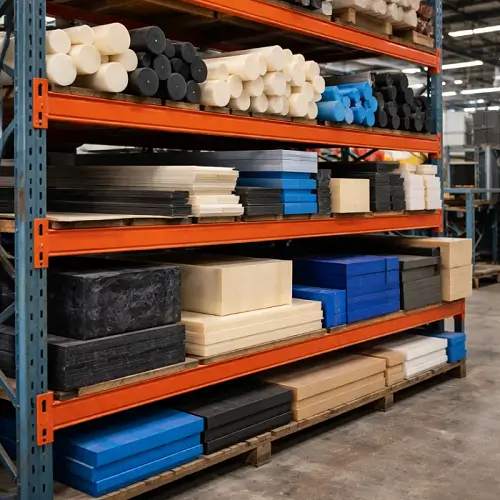
Engineering Plastics — ABS, Nylon, Delrin, PEEK
Engineering plastics range from economical polymers to extreme high-performance materials.
Advantages
Low cutting forces, minimal tool wear, excellent corrosion resistance.
PEEK maintains mechanical performance at high temperature and in aggressive chemicals.
Trade-offs
Dimensional stability varies widely.
High-end plastics carry extremely high raw material cost.
PEEK parts often cost 5–15× more than comparable ABS or Nylon parts in low-volume CNC production.
Applications
Electronic housings, bearings, medical components, chemical-processing parts, lightweight assemblies.
Material Selection Summary
If strength and dimensional stability dominate the requirement, aluminum 7075 or alloy steels such as 4140 should be considered.
For components operating in corrosive or harsh environments, stainless steel or high-grade alloys often become necessary.
For rapid prototyping or lightly loaded parts, materials such as Delrin and ABS provide a cost-effective and flexible solution.
Where electrical or thermal conductivity is critical, copper and brass remain strong candidates despite higher raw material cost.
Material selection should always be driven by the functional requirements of the part and the real manufacturing constraints behind it.
In practice, even within the same material family, different grades and tempers can carry very different costs, machining behavior, and performance characteristics.
If you have ever wondered why two “aluminum” quotes came back so far apart, this is usually why.
For projects where material choice remains uncertain or cost pressure is high, JeekRapid can review drawings, evaluate material and machining strategy together, and provide a stable, production-ready quotation before cutting begins.
Closing Perspective
Most expensive CNC projects fail not because machining is difficult, but because material decisions are made too early and too simply.
When material choice, geometry, tolerance, and surface finish are evaluated together, cost becomes predictable.
When they are not, cost almost never is.
Material behavior is only one part of CNC machining decisions. For a broader engineering discussion covering machine capability, tolerance control, and process planning together, see:
→ CNC Machining Explained: Machines, Materials, Tolerances, and Practical Engineering Decisions
FAQs
What is the best material for CNC machining?
There is no single best material.For low cost and fast machining, 6061 aluminum is usually the most balanced choice.For higher strength, 7075 aluminum or 4140 steel are common upgrades.For corrosion resistance, 304 or 316 stainless steel is preferred.
Which CNC material is the cheapest?
In most production scenarios, 6061 aluminum and 1018 carbon steel deliver the lowest total manufacturing cost when machining time, tooling, and scrap risk are considered together.
What material is easiest to machine on a CNC machine?
6061 aluminum is generally the easiest and most forgiving CNC machining material, offering high cutting speeds, long tool life, and stable dimensional control.