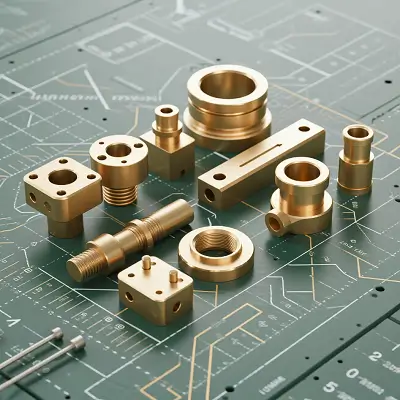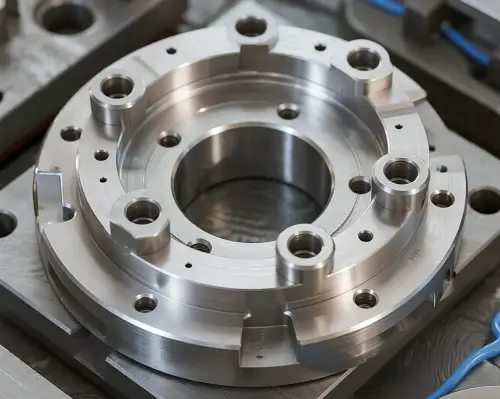
1018 steel is one of those materials most machinists encounter before they learn alloy names or heat-treat charts. It doesn’t make headlines for strength or hardness, but it shows up in CNC machining again and again because it behaves predictably. Cuts are smooth, tool wear is reasonable, and tolerances stay where you put them. In most general-purpose parts, 1018 simply works.
If the question is whether 1018 steel is good for CNC machining, the answer is yes for most brackets, bushings, shafts, spacers, and blocks. It is not selected for extreme duty, but for fast cycle time and dimensional consistency.
1018 Steel in CNC Machining
The chemistry is mild. Carbon falls around 0.15–0.20%, manganese sits near 0.60–0.90%, and the remainder is iron with trace impurities. Low carbon gives it forgiving machining behavior and keeps internal stresses low. It also explains why quench hardening is limited — the core never reaches alloy-steel levels of hardness.
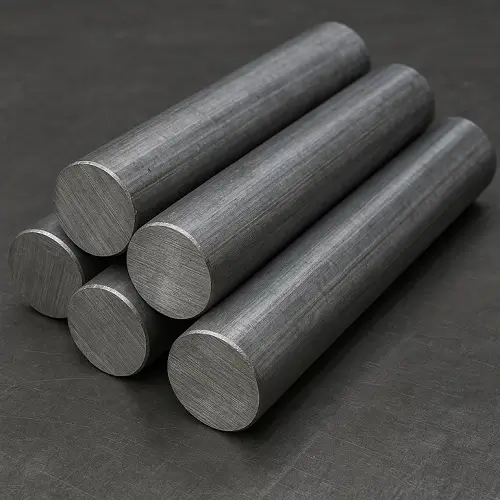
Cold-drawn bars typically come straighter, slightly stronger, and with a finer surface than hot-rolled material. Hot-rolled stock is more ductile but needs finishing to reach the same tolerance window. In CNC machining, most suppliers favor cold-drawn stock for consistent dimensional response.
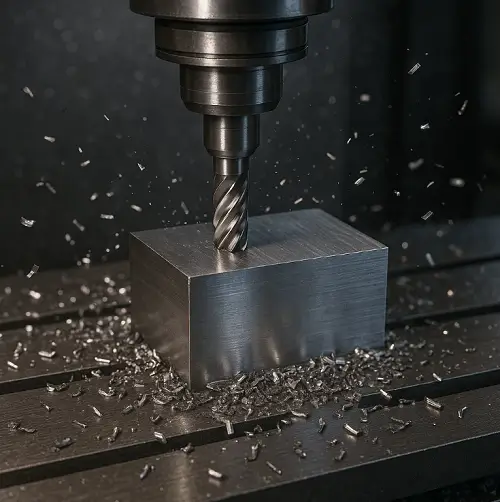
Machinability typically lands in the 70–75% range relative to free-cutting B1112. Cutting temperature stays manageable, chip formation is predictable, and it responds well to aggressive feed without tearing the surface. Anyone running volume production will notice that 1018 does not demand constant tool babysitting.
Is 1018 Steel Easy to Machine?
For most machine shops, yes. A properly prepared toolpath can leave a surface near Ra 1.6 µm without polishing. Finer work can reach Ra below 0.4 µm with controlled finishing passes. Tolerances of ±0.01 mm are routine in turning and milling when thermal drift is kept under control. Nothing about it feels delicate or unpredictable.
Where 1018 begins to show limits is under impact or cyclic stress. Its carbon content does not support a deep martensitic transformation, so strength and fatigue life plateau earlier than 1045 or 4140. The limitation is not machinability — it is mechanical ceiling.
1018 vs 1045 vs 4140 for CNC-Machined Parts
The decision between these steels rarely comes down to price alone. It usually follows a simple material logic familiar to most engineers.
1018 machines quickly, holds tolerance, and keeps tooling cost in check. It is the default choice when volume and consistency matter more than ultimate strength.
1045 carries more carbon and delivers higher yield strength and better fatigue response. Machining slows slightly and inserts wear faster, but performance increases noticeably.
4140 stands in a different category. It can be hardened, carries high tensile strength, and remains stable under repeated load. It requires more power at the spindle, better coolant control, and sharper tooling. It is the steel chosen when parts cannot fail.
In practice: 1018 for production speed, 1045 when strength starts to matter, 4140 when failure is unacceptable.
Welding, Surface Treatment, and Where 1018 Fits
Weldability is one of 1018’s simplest advantages. Thin sections weld cleanly without preheat. Thick plate benefits from a modest 150 °C preheat to control distortion. Post-weld machining remains smooth, which is why this alloy appears constantly in welded-and-machined assemblies.
Surface performance usually comes from treatment rather than base metal. Carburizing creates a hard case in the 55–60 HRC range while leaving a ductile core for shock absorption. Zinc plating and galvanizing extend outdoor durability. Black oxide gives a uniform surface with light corrosion protection. Powder coating adds appearance and weather resistance when the part is visible in service.
If you have torn down agricultural linkages, jigs, fixtures, or low-load shafts, you have seen 1018. It may not stand out, but it keeps machines moving.
Practical Load Example
A cold-drawn 10 mm 1018 dowel has a yield strength near 370 MPa. Cross-sectional area is roughly 78.5 mm², which places theoretical yield load close to 29 kN — about three metric tons. With a safety factor of three, the working load falls near one ton. These numbers are not intended to prove high strength. They illustrate that 1018 is adequate for most alignment and support duties without drama.
When 1018 Steel Makes Sense in CNC Machining
It makes sense when machining speed, cycle efficiency, and repeatability matter more than maximum tensile strength. It fits projects where dimensional control is important, but the part is not expected to survive high-shock impact or fatigue cycles. It is the right material when a component must be made by the hundreds or thousands without chasing the limits of metallurgy.
018 performs well in general-sized components, but behavior changes when the part is heavy-sectioned — heat stays longer, cutting load increases, and tolerance becomes more sensitive to tool pressure.
For details on how wall thickness affects machining performance, see our Wall Thickness CNC machining guide
FAQ
Can 1018 steel be used for CNC machining?
Yes. It is one of the most common mild steels in machining.
Is 1018 steel easy to machine?
It cuts cleanly and holds tolerance without excessive tool wear.
When should 1018 be avoided?
When fatigue resistance or shock loading is critical — 1045 or 4140 are better choices.
CNC Machining Services for 1018 Steel
JeekRapid machines 1018 steel for shafts, bushings, plates, linkages, and general industrial hardware where tolerance stability and cycle time define the success of production. Mild steel is familiar territory, and so is knowing when the job requires something stronger.
If you have a drawing or a material decision to make, you can submit your model for review. We evaluate whether 1018 is appropriate, or recommend 1045 or 4140 when the load case demands it.
Upload your CAD file or request a quote anytime.