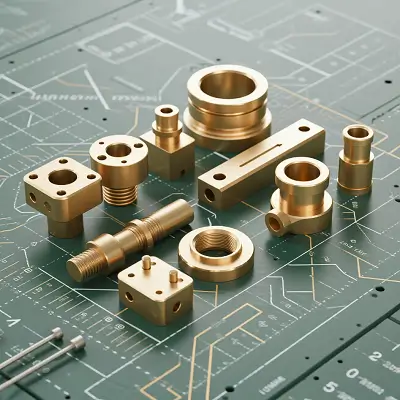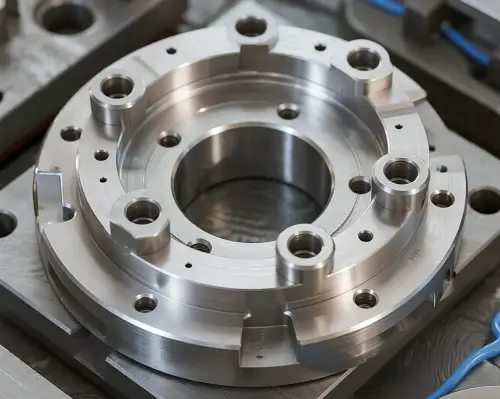
Titanium CNC machining is used for parts that need high strength, low weight, corrosion resistance, and reliable performance in demanding environments. Common applications include aerospace components, medical parts, marine hardware, energy equipment, and high-performance industrial assemblies.
Titanium is more difficult to machine than aluminum and many steels. It holds heat close to the cutting edge, creates high cutting forces, and can deform when thin or deep features are not supported correctly. Accurate titanium machining depends on the right toolpath, coolant, cutting tool, fixture, and inspection plan.
For most projects, the main material choice is between Grade 2 titanium and Grade 5 titanium. The right option depends on part strength, corrosion exposure, geometry, tolerance, and cost target.

When Is Titanium the Right Material for CNC Machining?
Titanium is usually selected when a part needs more than ordinary corrosion resistance or lightweight performance. It offers a strong strength-to-weight ratio and performs well in environments where aluminum may not provide enough strength or where stainless steel adds too much weight.
It is a practical material for parts exposed to repeated loading, elevated temperatures, seawater, chemicals, or long-term corrosion risk. Titanium is also used where non-magnetic behavior, biocompatibility, or fatigue resistance matters.
Grade 2 vs Grade 5 Titanium
| Titanium Grade | Best For | Machining Consideration |
|---|---|---|
| Grade 2 Titanium | Corrosion-resistant hardware, chemical equipment, marine parts, and lower-stress components | More ductile and generally easier to machine than Grade 5 |
| Grade 5 Titanium (Ti-6Al-4V) | Aerospace components, medical parts, high-strength brackets, and performance-critical assemblies | Stronger and more heat-resistant, but creates higher cutting force and faster tool wear |
Grade 2 titanium is commercially pure titanium. It is commonly used when corrosion resistance is the main requirement and maximum strength is not necessary.
Grade 5 titanium, also known as Ti-6Al-4V, is stronger and more widely used for high-performance parts. It is common in aerospace, medical, motorsport, and structural applications, but it requires more controlled machining because of its strength and heat resistance.
Titanium may not be the most cost-effective choice when weight reduction, corrosion resistance, and high strength are not critical to part function. Aluminum is often a better option for lightweight general-purpose parts, while stainless steel may be more practical for components that need strength and corrosion resistance at a lower material cost. Material selection should be based on the working environment, loading condition, tolerance requirements, and total machining cost rather than choosing titanium only for its premium image.
Why Is Titanium Difficult to Machine?
Titanium is not difficult because it cannot be cut. The challenge is that the material places more heat and force on the cutting tool than many common metals. Those conditions can affect tool life, surface finish, cycle time, and dimensional stability.
Titanium Tool Wear
Titanium does not transfer heat away from the cutting zone as easily as aluminum. Much of the heat remains close to the cutting edge, which can wear the tool coating, soften the cutting edge, and shorten tool life.
When heat builds up, the tool may begin to rub instead of cut cleanly. This can create poor surface finish, extra heat, and unstable dimensions. Stable feed, controlled tool engagement, and effective coolant delivery help keep the cutting edge working properly.
Tool wear can also increase when chips remain in a deep pocket or narrow slot and are cut again. Once the cutting edge begins to wear, the tool may create more heat, leave rougher surfaces, and cause dimensions to drift.
Titanium Thin Wall Machining
Titanium creates higher cutting forces than aluminum and many stainless steels. Deep pockets, narrow channels, tall ribs, and long-reach tools can increase tool or part deflection during machining.
Thin-wall titanium parts need careful planning because the material can bend slightly during clamping or cutting. Once the tool retracts or the part is released from the fixture, the wall may spring back and move out of tolerance.
This is common in parts with deep cavities, long unsupported ribs, thin flanges, or light structural sections. The machining sequence should keep enough material in place for support during roughing, followed by lighter finishing passes after the part becomes more stable.
Titanium Cutting Tools
Carbide cutting tools with heat-resistant coatings are commonly used for titanium CNC machining. The cutting tool must remain sharp and rigid under high cutting force.
Toolholders also matter. Shrink-fit, hydraulic, and other rigid holding systems can reduce micro-movement compared with less stable setups. A short, rigid tool is usually more stable than a long tool with excessive overhang.
The best cutting tool depends on titanium grade, feature depth, tool reach, surface-finish requirement, and machine capability. Long unsupported tools can increase vibration, poor wall finish, and dimensional variation.
Titanium Machining Methods and Process Control
Titanium machining depends on controlling heat, rigidity, chips, and workholding at the same time. Tool selection matters, but the machining strategy, fixture design, machine setup, and inspection approach also affect the final result.
Titanium Machining Coolant
Coolant helps manage heat and remove chips before they are cut again. This becomes especially important in deep pockets, narrow slots, and internal features where hot chips can remain near the cutting edge.
Through-spindle coolant or high-pressure coolant can improve chip evacuation for difficult titanium features. Recutting hot chips can damage the tool, increase heat, and leave marks on finished surfaces.
Coolant should support consistent cutting rather than compensate for an unstable toolpath. Good chip evacuation, proper tool engagement, and suitable feed rates still determine whether the cutting process remains stable.
Titanium Workholding
Titanium parts need stable support because vibration and part movement can quickly affect accuracy. The fixture should locate the part from the correct datum surfaces, support weak areas, and leave enough room for the cutter to reach the required features.
For thin walls, long components, and multi-sided parts, CNC workholding and fixtures become part of the machining process rather than a simple setup step. A good fixture can reduce vibration, prevent movement, protect cosmetic surfaces, and improve repeatability across a production batch.
Fixture planning is also important for expensive titanium parts. A stable setup can reduce scrap risk, especially when a part has already received several machining operations before the final finishing pass.
Roughing Deep Pockets in Titanium
Roughing deep pockets in titanium requires stable tool engagement, reliable chip evacuation, and enough support around the remaining walls. Removing material too aggressively can increase heat, tool deflection, and vibration before the final finishing passes.
Deep pockets are more stable when the cutting tool has limited overhang and the remaining walls are not made too thin too early in the machining process. In many cases, roughing is completed first while extra material still supports the part, followed by finishing operations after the geometry becomes more stable.

Titanium CNC Machining Methods
Titanium parts can be produced by CNC milling, CNC turning, 5-axis machining, EDM, or a combination of these methods.
Three-axis CNC milling works well for brackets, plates, housings, flanges, and parts with accessible features. CNC turning is suitable for shafts, rings, threaded parts, bushings, and rotational components.
For complex parts with multiple faces, compound angles, deep cavities, or curved geometry, 5-axis machining can reduce repeated setups and improve access to difficult features. Fewer setups can also reduce the chance of datum error between operations.
EDM can be useful for very narrow slots, sharp internal corners, deep channels, or details that are difficult to reach with a standard cutter. In some projects, CNC machining is used for most features, while EDM is used only for restricted areas.
Titanium CNC Machining Applications
Titanium CNC machining is common in industries where weight, corrosion resistance, fatigue strength, and long-term reliability matter.
Aerospace Titanium Parts
Titanium is used for aerospace brackets, structural supports, engine-adjacent components, pressure housings, landing hardware, and high-fatigue parts. These parts often need careful machining because titanium is expensive, difficult to rework, and frequently used in critical assemblies.
For complex structures and tight tolerance parts, aerospace CNC machining may combine multi-axis machining, rigid workholding, controlled cutting, and detailed inspection.
Medical Titanium Parts
Titanium is used for medical-device structures, surgical tools, custom medical components, and other parts that need corrosion resistance, strength, and biocompatibility.
Medical titanium parts may need close dimensional control, clean finishing, controlled edge breaking, and inspection based on the part’s intended function. The exact material grade, finish, traceability, and documentation requirements should be confirmed before production.
Titanium Parts for Marine and Energy
Titanium is also used in chemical processing, marine equipment, pumps, valves, pressure systems, and corrosion-prone industrial environments.
Grade 2 titanium is often selected for corrosion resistance in chemical and marine applications. Grade 5 titanium is more suitable when the part also needs higher strength, fatigue resistance, or structural performance.
Titanium CNC Machining Cost: What Changes the Quote?
Titanium CNC machining usually costs more than aluminum machining because titanium stock is more expensive, machining speeds are lower, tool wear is higher, and the setup often needs more attention.
As a general budgeting reference, simple titanium prototype parts may start at around US$100–300 per part for small quantities. Medium-complexity parts with multiple machined faces, deeper pockets, or tighter tolerances often fall around US$300–800 per part. Complex 5-axis titanium parts, thin-wall aerospace components, or parts with tight positional tolerances can cost US$800–2,000+ per part, especially at prototype quantities.
These ranges are only early estimates, not fixed prices. Titanium CNC machining cost changes significantly based on material grade, part size, geometry, machining time, tolerance, quantity, surface finish, inspection requirements, and fixture complexity.
The final CNC machining cost depends on more than material size. A small titanium part can still be expensive when it has deep pockets, narrow slots, thin walls, tight hole positions, high surface-finish requirements, or difficult workholding.
| Cost Driver | Why It Affects Titanium Machining Cost |
|---|---|
| Titanium grade | Grade 5 usually creates more cutting force and tool wear than Grade 2 |
| Deep pockets and narrow slots | Long tools and slower cutting increase machining time |
| Thin walls and tall ribs | Extra support, lighter finishing cuts, and careful sequencing may be needed |
| Tight tolerances | More controlled machining, inspection, and possible corrective finishing are required |
| Complex geometry | Multiple setups, 5-axis access, or EDM may be needed |
| Surface finish | Fine finishing passes and additional treatment add time |
| Batch quantity | Dedicated fixtures may add setup cost but improve consistency for repeat orders |
Basic soft jaws or simple setup work may add a small one-time charge, while a dedicated fixture for thin-wall, multi-sided, or repeat-production parts may cost several hundred dollars or more. The fixture cost is not simply a charge for a piece of hardware. For difficult titanium parts, fixture planning can prevent movement, vibration, scrap, and repeated setup adjustments.
For repeat orders, a proper fixture can reduce loading time and improve batch consistency. This is why the first-order price may be higher than later production orders using the same validated setup.
How to Reduce Titanium Machining Cost
Titanium machining cost can often be reduced by simplifying the design where performance allows. The goal is not to lower the quality of the part, but to avoid features that increase machining difficulty without improving function.
Use Grade 2 when the design does not need Grade 5 strength. Keep wall thickness reasonably consistent and avoid extremely thin unsupported areas. Use practical internal corner radii instead of very sharp corners, and avoid deep narrow pockets when a wider or shallower feature can achieve the same function.
Only apply tight tolerances to features that control assembly, sealing, motion, or final performance. Tightening every dimension can increase machining risk and inspection time without improving the finished part.
For parts with several critical holes or faces, try to design those features so they can be machined from the same datum or in the same setup. This helps reduce position variation between operations.
Titanium Machining Tolerances and Surface Finish
Titanium parts can achieve tight tolerances, but the practical result depends on geometry, wall thickness, tool reach, heat control, workholding, and inspection method.
Tight-tolerance features are more practical when the part is stable, the tool can reach the feature without excessive overhang, and the machining sequence controls heat and stress. Critical bores, flatness requirements, hole patterns, and assembly features should be reviewed based on the actual geometry rather than applying the same tolerance to every area.
Inspection timing also matters. A titanium part can measure differently while it is still warm from machining than after it has returned to room temperature. Critical features should be checked after the part has stabilized.
Surface finish can be affected by tool wear, vibration, chip evacuation, and finishing strategy. Light finishing passes, sharp tools, controlled engagement, and stable support help create a more consistent surface.
Where required, titanium parts can also receive surface finishing processes such as bead blasting, polishing, passivation, or other treatments based on functional and cosmetic requirements.
Titanium Part Design Tips
A few design choices can make titanium machining more stable and more cost-effective.
Keep wall thickness reasonably consistent where possible. Avoid long, thin ribs that are difficult to support during machining. Add internal radii that match practical cutting-tool sizes instead of specifying sharp internal corners.
For deep pockets, consider whether the depth-to-width ratio can be reduced. Deep narrow features require longer tools, which are more likely to deflect and leave poor wall finish.
Leave enough material around holes, threads, and thin edges. Small features near weak walls can move during machining or create local distortion after finishing.
For expensive titanium parts, a short DFM review before machining can identify tool-access issues, unsuitable wall thickness, fixture risks, and tolerances that may increase cost without adding functional value.
Get a Titanium CNC Machining Quote
Titanium parts benefit from careful process planning before machining begins. Thin walls, deep cavities, tight tolerance relationships, and complex multi-sided features should be reviewed before production.
JeekRapid provides CNC machining services for titanium prototypes and production parts. Upload your 3D CAD file and 2D drawing, then identify the titanium grade, quantity, critical tolerances, assembly surfaces, and finish requirements. Our engineering team can review the part structure, machining access, workholding approach, and manufacturability before quotation and production.