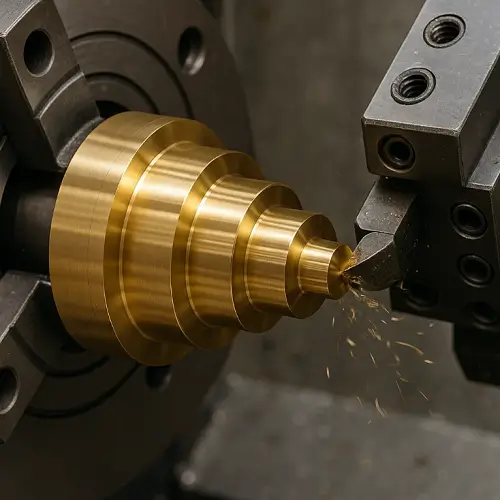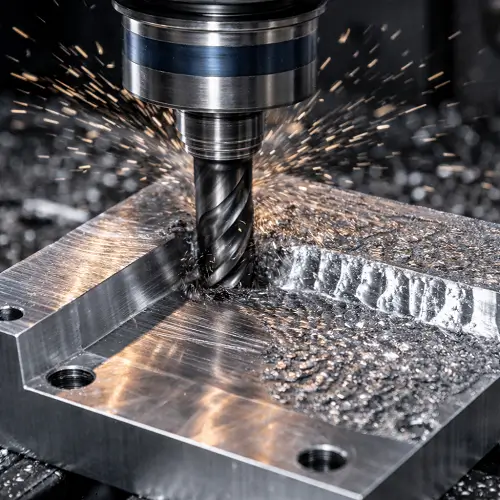
303 and 304 stainless steel are used for precision shafts, fittings, housings, and other CNC machined components. 303 offers easier machining, while 304 provides better general corrosion resistance and greater flexibility for welding and forming. These differences affect production cost, manufacturing options, and the conditions the finished part can withstand.
For customers comparing the two grades, the decision is whether 303 can meet the part’s requirements while reducing machining effort, or whether the application needs the properties of 304. The operating environment and fabrication requirements should establish which materials are acceptable before their prices are compared.
What Is 303 Stainless Steel?
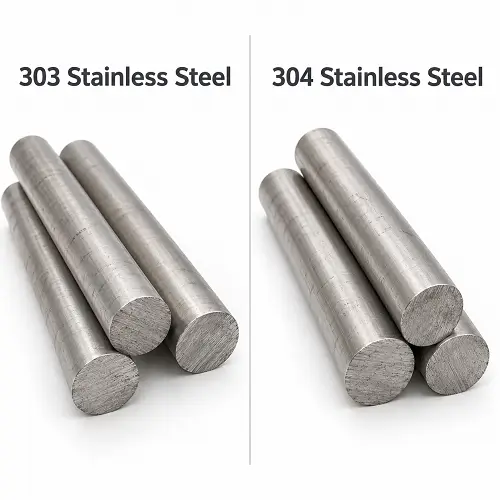
303 stainless steel is an austenitic chromium-nickel alloy designated UNS S30300. It contains added sulfur to improve machinability, making it a common choice for components produced through extensive cutting.
The sulfur forms inclusions that help chips break during turning, drilling, and threading. These inclusions also reduce corrosion resistance, weldability, and formability compared with 304. The defining advantage of 303 is efficient machining, with limitations that must suit the application.
What Is 304 Stainless Steel?
304 stainless steel is a general-purpose austenitic chromium-nickel alloy designated UNS S30400. It combines good corrosion resistance with good welding and forming characteristics.
Standard 304 does not contain the deliberate sulfur addition used to improve 303’s machinability. It is more demanding to cut, but its broader fabrication and service capabilities make it useful for parts that need more than machining alone.
What Parts Are Commonly Made from 303 Stainless Steel?
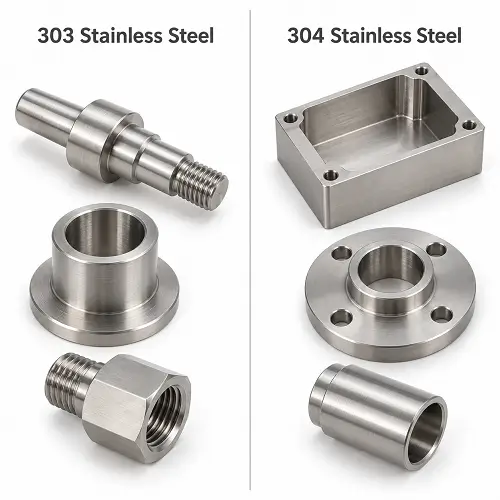
Common 303 stainless steel parts include shafts, bushings, sleeves, spacers, threaded adapters, nuts, bolts, and adjustment components. Many are machined from round or hexagonal bar using repeated turning, drilling, grooving, and threading operations.
303 is particularly useful when substantial machining is needed to produce the finished geometry. Easier chip breaking can reduce interruptions and help maintain consistent production across a batch.
These uses are most appropriate when the component operates in a suitable environment and can be completed primarily by machining. A shaft or fitting should not be assigned 303 solely because it belongs to a common part category.
What Parts Are Commonly Made from 304 Stainless Steel?
Common 304 stainless steel parts include equipment housings, mounting brackets, flanges, fittings, valve components, manifolds, and machined sections of welded assemblies.
304 is useful when precision features must be combined with corrosion resistance, welding, or forming. Bores, threads, mounting faces, and sealing surfaces can be machined into a component that will later become part of a larger fabricated assembly.
For fluid-contact parts, the fluid and cleaning conditions still need to be checked. A 304 fitting suitable for one system may be unsuitable for another operating with different chemicals, temperatures, or chloride levels.
What Industries Use 303 Stainless Steel?
303 is used in industrial machinery, automation, instrumentation, electrical equipment, and precision component manufacturing. These industries often need small mechanical parts with detailed machined features.
Its role is strongest in applications where machining efficiency matters and environmental exposure is limited. Dry indoor equipment, enclosed mechanisms, and hardware that rarely contacts liquids are more favorable starting points than washdown equipment or outdoor components exposed to salt.
Industry names alone are not selection rules. Within the same machine, an enclosed adjustment component and an exposed fluid-contact component may require different materials.
What Industries Use 304 Stainless Steel?
304 is used in food-processing equipment, general industrial equipment, architectural hardware, and selected laboratory and medical equipment components. These applications often require corrosion resistance together with cleanable surfaces or welded construction.
In food-processing equipment, material selection must account for the food product, cleaning chemicals, temperature, and required surface condition. The use of 304 does not automatically establish that a finished part meets all hygiene or food-contact requirements.
For industrial and architectural applications, 304 provides flexibility for combining machined, formed, and welded features. More aggressive chemical exposure or salt contamination may justify a different grade, even when 304 is common elsewhere in that industry.
What Are the Advantages and Disadvantages of 303 vs 304?
303 favors production efficiency when the service conditions allow it. 304 offers greater flexibility when corrosion resistance and subsequent fabrication are more important.
| Selection factor | 303 stainless steel | 304 stainless steel |
|---|---|---|
| Machining | Easier chip breaking can reduce machining effort and tool consumption | More demanding chip control and cutting conditions can increase production effort |
| Corrosion resistance | Suitable for appropriately mild exposure; more vulnerable to localized corrosion than 304 | Generally more resistant, but not suitable for every chemical or chloride environment |
| Welding | Poor weldability limits its use in welded assemblies | Better suited to welding; 304L may need consideration |
| Forming | Less suitable for substantial bending or forming | Better suited to forming operations |
| Precision machining | Can meet tight tolerances with a suitable process | Can also meet tight tolerances; machining difficulty does not mean poor accuracy |
| Finished-part cost | Can be economical for extensively machined parts | Additional machining effort may be justified by the required service performance |
Strength and hardness do not have a universal winner. Cold drawing and other processing affect both grades, so annealed 304 should not be compared with cold-worked 303 as if the numbers describe every product.
For load-bearing parts, specify the required mechanical properties and supply condition. Typical datasheet values are useful for initial comparison, but they do not replace the requirements for the purchased material.
How Are 303 and 304 Stainless Steel CNC Machined?
Both grades can be turned, milled, drilled, bored, and threaded. The geometry determines the machining operations; the material affects the tooling and cutting strategy.
CNC turning produces cylindrical diameters, shoulders, grooves, bores, and external threads. 303 is attractive for parts with extensive turning because chips generally break more readily. 304 can produce the same features, with greater attention to cutting stability and chip evacuation.
CNC milling produces pockets, slots, flats, and mounting features. Thin walls and slender sections need adequate support in either material. Choosing an easier-cutting alloy does not remove the need to control workpiece movement and tool deflection.
Drilling and tapping require particular attention to chips inside the hole. Blind holes need adequate tool clearance, while deeper holes can restrict coolant access and chip removal. Tool wear and rubbing are especially important to control in 304.
Critical dimensions and surface finish should be specified according to the part’s function. Neither “303” nor “304” tells the supplier how closely a shaft must fit a bore or how smooth a sealing surface must be.
Why Is 304 More Difficult to Machine Than 303?
304 is ductile and can produce long chips that wrap around tools or collect inside holes. Those chips can interrupt production and scratch a finished surface if they are not controlled.
It also work-hardens. A tool that rubs instead of cutting effectively can leave a harder surface for the following pass. Worn cutting edges, unsuitable engagement, or repeated rubbing can increase tool wear and make the process less stable.
Machining 304 therefore requires suitable tools, rigid workholding, controlled cutting conditions, and effective coolant and chip evacuation. These requirements influence cycle time and tooling cost.
More difficult to machine does not mean less accurate. A controlled 304 machining process can produce precision bores, threads, and finished surfaces. The additional difficulty belongs in process planning and quotation, rather than being used as a reason to accept dimensions outside the drawing.
303 reduces some of this machining effort through improved chip breaking. It can be easier to produce efficiently, but the advantage does not justify using it where its service properties are insufficient.
When Is 303 a Suitable Choice for CNC Parts?
303 is worth considering when the part requires substantial machining, does not need welding or significant forming, and operates under limited corrosive exposure.
A mild environment generally means relatively dry indoor service with little contact with corrosive liquids or salt contamination. Condensation, maintenance chemicals, and occasional washing still matter. A component housed inside equipment should not be assumed to remain dry throughout its working life.
The conditions supporting a 303 selection should be clear: its corrosion performance is acceptable, the specified stock meets the mechanical requirements, and the design does not rely on welding or substantial forming. Where the drawing leaves the grade open, these conditions provide a basis for requesting a 303 quotation.
Stainless steel passivation can remove manufacturing contamination and help preserve the alloy’s corrosion resistance. It does not make 303 equivalent to 304. A surface treatment should not be used to justify a material substitution that the operating environment cannot support.
When Should You Choose 304 Instead of 303?
304 is generally preferable when welding, forming, or better corrosion resistance is required.
For welded assemblies, the material should be chosen before machining begins. The sulfur content that makes 303 easier to cut also increases its susceptibility to weld cracking. Selecting 303 for machining convenience can therefore create difficulties later in production. Where welded corrosion performance matters, the suitability of 304L should also be reviewed.
Repeated wetting or cleaning makes corrosion resistance more important, but the exposure must be described. The identity and concentration of cleaning chemicals, contact time, and temperature are more useful than a general statement that a part “gets washed.”
304 is not an automatic approval for seawater, concentrated chlorides, or aggressive chemicals. If those conditions are present, evaluate whether 316 or another alloy is needed rather than forcing a choice between 303 and 304.
If a drawing already specifies 304, retain it unless the responsible customer or design authority approves a change. A 303 alternative should be assessed against the original material requirements and recorded in the drawing or purchase documentation before production.
How Does Choosing 303 or 304 Affect Part Cost?
The cost of a finished part includes material, setup, machining, tooling, finishing, inspection, and documentation. Comparing raw bar prices alone can miss the largest difference between the grades.
303 can reduce cost when extensive cutting makes up a substantial share of production. Its machining advantage may matter less for a simple component requiring little material removal, where setup or inspection dominates the quotation.
304 may require more machining effort, but it can avoid additional complications when the product needs welding, forming, or greater corrosion resistance. A lower machining price offers little benefit if the selected material later fails the application requirements.
When both grades are acceptable, compare quotations for the same drawing, quantity, tolerances, finish, and inspection scope. Ask whether the difference comes from stock availability, cutting time, or another operation. There is no reliable fixed percentage by which every 303 part should be cheaper than its 304 equivalent.
Conclusion
303 is a practical candidate for extensively machined parts operating in relatively mild environments without welding or substantial forming. 304 is generally more suitable when corrosion resistance and fabrication flexibility carry greater weight. Both can produce precision CNC parts, while strength and hardness must be checked against the actual material condition.
JeekRapid provides stainless steel CNC machining for custom prototypes and production parts. Drawings with a specified grade can be quoted to that requirement. Where material selection remains open, include the operating conditions and any welding or finishing requirements so 303 and 304 can be assessed for suitability before comparing finished-part costs.