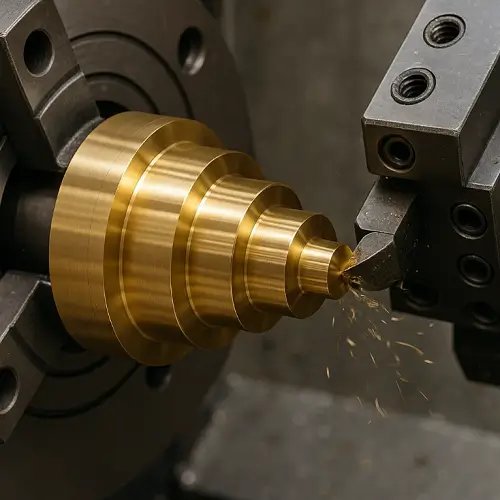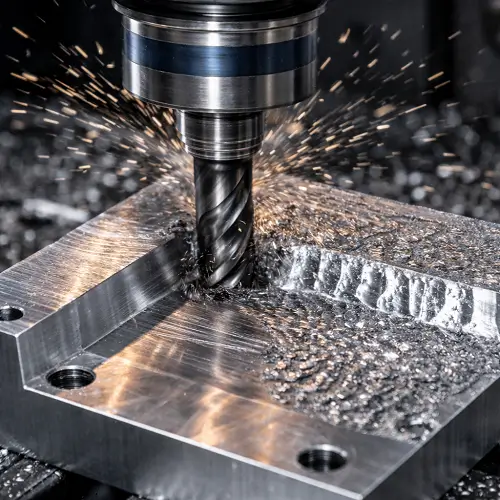
Electrical discharge machining (EDM) is a non-contact manufacturing process that removes material from an electrically conductive workpiece through a series of controlled electrical discharges. Instead of using a cutting edge, an electrical discharge machine creates sparks across a small gap between the electrode and the workpiece. Each discharge removes a microscopic amount of material.
EDM is commonly used to machine hardened steel, carbide, titanium, Inconel, and other conductive materials that may be difficult to cut with conventional tools. The three main processes are wire EDM, sinker EDM, and hole drilling EDM. They are used for precision profiles, narrow slots, mold cavities, deep ribs, small holes, and features that require low mechanical cutting force.
However, EDM is not automatically the best process for every precision part. Machining speed, electrical conductivity, electrode cost, surface finish, recast layer, and required tolerance must all be considered before selecting EDM instead of milling, turning, grinding, or drilling.
What Is Electrical Discharge Machining?
Electrical discharge machining is a thermal material-removal process that uses controlled electrical sparks to erode a conductive workpiece. The electrode and workpiece do not need to make normal cutting contact. They are separated by a small spark gap filled with dielectric fluid.
The terms electrical discharge machining, electric discharge machining, electro discharge machining, spark erosion, and EDM machining normally describe the same basic manufacturing principle.
Unlike milling or turning, EDM does not remove material with a sharp cutting tool. A power supply creates a voltage difference between the electrode and the workpiece. When the electrical field becomes strong enough, the dielectric fluid breaks down and a spark crosses the gap. The localized heat melts and vaporizes a very small amount of material.
Thousands of controlled discharges gradually produce the required geometry. The dielectric fluid cools the cutting area, carries away eroded particles, and restores insulation before the next discharge.
Material hardness has less influence on EDM than it does on conventional cutting. Electrical conductivity, material thickness, thermal behavior, flushing conditions, electrode selection, and machine stability are usually more important.
EDM has very low mechanical cutting force, but it is not a cold process. Every spark produces localized heat, so surface integrity must still be considered on fatigue-sensitive, sealing, medical, aerospace, and tooling components.
How Does Electrical Discharge Machining Work?
Electrical discharge machining works by repeatedly generating controlled sparks between an electrode and a conductive workpiece. A CNC control system maintains the spark gap while the dielectric system controls cooling and debris removal.
The EDM process normally follows these stages:
-
The workpiece and electrode are positioned
The conductive workpiece is fixed inside the machine. Depending on the EDM process, the electrode may be a continuously fed wire, a shaped copper or graphite tool, or a rotating tubular electrode.
-
Dielectric fluid separates the electrode and workpiece
Wire EDM commonly uses controlled deionized water. Sinker EDM usually operates with an EDM dielectric oil. The fluid initially acts as an electrical insulator.
-
Voltage is applied across the spark gap
The electrode moves close to the workpiece without normal cutting contact. The machine servo continuously monitors and adjusts the distance.
-
An electrical discharge crosses the gap
When the voltage overcomes the dielectric strength of the fluid, a plasma channel forms and a controlled spark occurs.
-
A microscopic amount of material is removed
The intense localized heat melts or vaporizes a small volume of workpiece material, leaving a tiny crater on the surface.
-
The dielectric removes debris
Fluid flow carries eroded particles away from the cutting zone. Effective flushing helps prevent unstable arcing, short circuits, wire breakage, dimensional errors, and poor surface finish.
This cycle repeats many times per second. Rough machining settings use higher discharge energy to increase material-removal rate. Finishing and skim-cut settings use lower energy to improve dimensional accuracy and reduce crater size.
What Is an Electrical Discharge Machine?
An electrical discharge machine is CNC-controlled equipment that generates, regulates, and positions the electrical discharges used to remove conductive material.
The phrase EDM machine may refer to a wire-cut EDM machine, sinker EDM machine, or small-hole drilling EDM machine. Although their electrode systems and applications differ, they share several basic components.
| EDM machine component | Primary function | Effect on the finished part |
|---|---|---|
| Pulse power supply | Controls voltage, current, pulse duration, and discharge energy | Influences cutting speed, surface texture, electrode wear, and recast layer |
| Electrode system | Delivers electrical energy to the cutting zone | Determines the available geometry |
| CNC motion control | Moves the wire, electrode, or workpiece along a programmed path | Controls profile accuracy, taper, position, and repeatability |
| Servo gap control | Maintains the correct distance between electrode and workpiece | Prevents unstable arcing and short circuits |
| Dielectric system | Insulates, cools, and flushes the cutting zone | Affects process stability and surface integrity |
| Filtration system | Removes eroded particles from the dielectric fluid | Helps maintain consistent cutting conditions |
| Temperature control | Stabilizes the machine, workpiece, and dielectric | Reduces dimensional drift during precision EDM machining |
A machine’s advertised positioning accuracy does not automatically become the finished-part tolerance. Workpiece thickness, thermal stability, flushing, material condition, fixturing, wire or electrode quality, and inspection method all affect the actual result.
What Are the Main Types of Electrical Discharge Machining?
The three main types of electrical discharge machining are wire EDM, sinker EDM, and hole drilling EDM.
| EDM process | Electrode type | Best suited for | Main limitation |
|---|---|---|---|
| Wire EDM | Continuously fed metal wire | Through profiles, narrow slots, punches, dies, and precision contours | Wire must pass through the workpiece |
| Sinker EDM | Shaped graphite, copper, or copper-tungsten electrode | Blind cavities, deep ribs, mold details, and complex internal forms | Custom electrodes add time and cost |
| Hole drilling EDM | Rotating tubular electrode | Small and deep holes, start holes, and broken-tool removal | Hole accuracy and finish depend strongly on depth and flushing |
Commercial machine builders distinguish between wire-cut EDM and die-sinking EDM systems, while small-hole EDM is commonly treated as a specialized process.
What Is Wire EDM Machining?
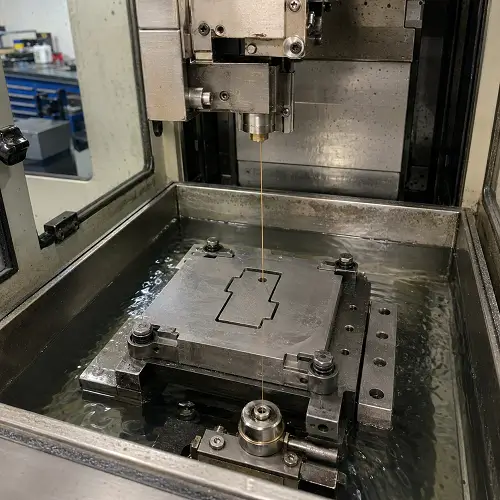
Wire EDM machining, also called wire-cut EDM, WEDM, EDM wire cutting, or wire erosion, uses a thin continuously moving metal wire as the electrode. The wire follows a programmed path while electrical discharges remove material from the workpiece.
The wire does not cut like a saw. It remains separated from the workpiece by the spark gap. Because discharges occur around the wire, the final cut width—or EDM kerf—is larger than the wire diameter. The machine compensates for this offset during programming.
Wire EDM is particularly effective for:
- Hardened tool-steel punches and dies
- Precision inserts
- Narrow slots and keyways
- Internal and external profiles
- Fine contours in conductive plates
- Tapered openings
- Small corner radii
- Parts that could deform under conventional cutting forces
A wire must normally travel completely through the workpiece. External profiles can be approached from an outside edge. Closed internal profiles require a start hole so the wire can be threaded through the material.
Wire EDM cannot produce an ordinary blind-bottom cavity because the wire needs a continuous path between its upper and lower guides. Blind cavities are normally produced with sinker EDM.
Modern wire EDM machines may include automatic wire threading, taper control, multiple skim-cut strategies, thermal compensation, and fine-wire capability. Actual part performance still depends on the complete process, not only the machine model.
What Is Sinker EDM Machining?
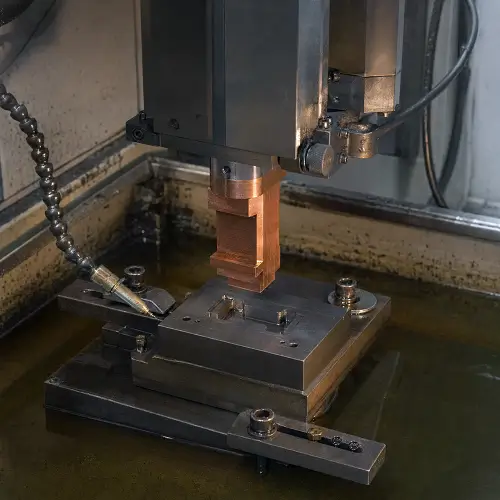
Sinker EDM machining uses a shaped electrode to erode a corresponding cavity into a conductive workpiece. It is also known as die-sinking EDM, ram EDM, plunge EDM, cavity EDM, or spark eroding.
The electrode is usually manufactured from graphite, copper, or copper tungsten. Its shape represents the negative form of the required cavity. As the electrode approaches the workpiece, controlled electrical discharges reproduce that form in the material.
Sinker EDM is used when a wire cannot pass through the required feature. Typical applications include:
- Blind mold cavities
- Deep and narrow ribs
- Internal corners
- Logos, text, and detailed impressions
- Thin slots with limited tool access
- Complex mold inserts
- Thread forms and internal details
- Features in hardened components
The electrode does not remain dimensionally perfect throughout the operation. Electrical discharge also removes a small amount of electrode material. Electrode wear must therefore be included in electrode design, machining strategy, and dimensional compensation.
Complex sinker EDM jobs may require separate roughing and finishing electrodes. This increases electrode manufacturing cost, but it can improve cavity accuracy, surface finish, and production consistency.
What Is Hole Drilling EDM?
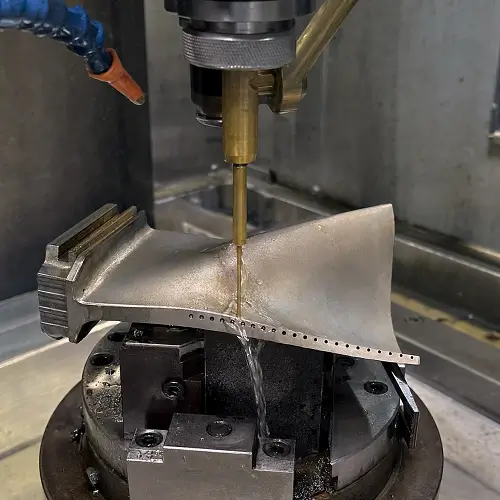
Hole drilling EDM uses a rotating tubular electrode with dielectric fluid flowing through its center. The process is designed for small, deep, or high-aspect-ratio holes in electrically conductive materials.
It is also known as EDM drilling, fast-hole EDM, small-hole EDM, EDM hole burning, or hole popper EDM.
Common applications include:
- Wire EDM start holes
- Cooling holes in turbine and aerospace components
- Vent holes
- Small holes in hardened tool steel
- Deep holes in difficult-to-machine alloys
- Removal of broken taps and drills
- Small orifices in precision components
Hole drilling EDM can machine materials after heat treatment and does not require a conventional drill cutting edge. However, it should not automatically be treated as a replacement for precision reaming, boring, or grinding. Electrode wear, hole depth, flushing, taper, breakthrough conditions, and required surface quality determine whether EDM drilling is appropriate.
Wire EDM vs Sinker EDM: What Is the Difference?
The main difference between wire EDM and sinker EDM is the electrode shape and the geometry each process can produce.
Wire EDM uses a moving wire to cut through the workpiece. Sinker EDM uses a shaped electrode to produce a blind or three-dimensional cavity.
| Comparison | Wire EDM | Sinker EDM |
|---|---|---|
| Electrode | Continuously fed wire | Custom-shaped solid electrode |
| Typical dielectric | Deionized water | EDM dielectric oil |
| Geometry | Through profiles and contours | Blind cavities and internal 3D forms |
| Start hole | Required for closed internal profiles | Not normally required |
| Electrode manufacturing | Usually unnecessary | Usually required |
| Electrode wear | Fresh wire continuously enters the cutting zone | Electrode wear must be compensated |
| Typical parts | Punches, dies, gears, inserts, profiles | Molds, cavities, ribs, internal details |
| Best design question | Can the wire pass through the feature? | Can an electrode approach and flush the cavity? |
A part may require both processes. For example, wire EDM can cut the external profile of a hardened mold insert, while sinker EDM creates its blind ribs or internal cavity.
What Materials Can EDM Cut?
EDM can machine materials that conduct electricity. Material hardness is not the primary limitation, but electrical and thermal properties affect cutting speed, process stability, surface finish, and electrode wear.
| Material group | Common EDM materials | Practical considerations |
|---|---|---|
| Tool steels | D2, A2, H13, S7, M2 | Frequently machined after heat treatment |
| Stainless steels | 304, 316, 17-4 PH, 420, 440C | Conductive and suitable for precision EDM |
| Carbon and alloy steels | 1018, 1045, 4140, 4340 | Generally stable, but prior stress can cause movement |
| Carbides | Tungsten carbide and conductive carbide grades | Brittle surface condition and cobalt binder behavior require attention |
| Titanium | Grade 2, Ti-6Al-4V | Thermal surface effects must be controlled |
| Nickel alloys | Inconel 625, Inconel 718, Hastelloy | EDM avoids conventional tool-pressure and rapid tool-wear problems |
| Copper alloys | Copper, brass, bronze | High thermal and electrical conductivity influence machining parameters |
| Aluminum alloys | 6061, 7075 | Machinable by EDM, although conventional CNC machining is often faster |
| Specialty conductive materials | Kovar, conductive ceramics, PCD-related tooling materials | Feasibility depends on actual electrical conductivity and material structure |
Standard plastics, glass, and most non-conductive ceramics cannot be machined using normal EDM methods. A material should not be described as EDM-compatible simply because it is hard or heat resistant.
Can EDM Machine Hardened Steel?
Yes. EDM can machine hardened steel because material removal is produced by electrical discharges rather than conventional cutting forces.
This allows tool steel, mold steel, and other components to be heat-treated before final profiles, slots, cavities, and holes are produced. Machining after heat treatment can prevent a finished geometry from being changed by later hardening distortion.
However, residual stress may still be present inside the workpiece. When EDM removes a large section or releases a closed profile, that stress can cause the part to move. Low cutting force does not eliminate material movement caused by prior rolling, forging, heat treatment, welding, or rough machining.
For critical hardened parts, the manufacturing sequence may include:
- Rough CNC machining
- Stress relief
- Heat treatment
- Grinding of reference surfaces
- Wire or sinker EDM
- Skim cutting or secondary finishing
- Final dimensional inspection
How Accurate Is Electrical Discharge Machining?
Electrical discharge machining can hold tight tolerances, but there is no single EDM tolerance that applies to every part.
Wire EDM generally offers better profile accuracy because fresh wire continuously enters the cutting area. Sinker EDM accuracy also depends on electrode manufacturing error, electrode wear, spark gap compensation, and cavity flushing.
The following values are practical planning ranges rather than universal machine guarantees:
| EDM operation | General planning tolerance | Important influences |
|---|---|---|
| Standard wire EDM profiles | Approximately ±0.0002 to ±0.0005 in (±0.005 to ±0.013 mm) | Workpiece height, number of passes, flushing, thermal control |
| Precision wire EDM with skim cuts | Tighter than ±0.0002 in may be possible | Machine condition, material stability, wire selection, inspection environment |
| General sinker EDM cavities | Approximately ±0.0005 to ±0.001 in (±0.013 to ±0.025 mm) | Electrode accuracy, wear, cavity depth, flushing |
| Precision sinker EDM features | Tighter values may be achievable on selected dimensions | Separate finishing electrodes and stable process control |
| Hole drilling EDM | Diameter and position are application-dependent | Electrode diameter, hole depth, wear, breakthrough, flushing |
Tolerance should be assigned according to function. Applying an extremely tight tolerance to every EDM surface increases machine time, skim passes, inspection effort, electrode requirements, and cost.
For assemblies with demanding position, profile, flatness, or datum relationships, EDM should be planned as part of the complete precision machining process, not treated as an isolated operation.
What Surface Finish Can EDM Produce?
EDM surface finish is created by thousands of microscopic discharge craters. Higher discharge energy increases material-removal rate but produces larger craters and a rougher surface. Lower-energy finishing passes create smaller craters and a finer finish.
In wire EDM, the first pass usually removes most of the material. Additional skim cuts correct dimensional error, reduce overcut variation, improve straightness, and refine the surface.
| EDM stage | Main objective | Expected surface condition |
|---|---|---|
| Rough cut | High material-removal rate | Larger craters and a visibly coarser texture |
| First skim cut | Correct size and geometry | Reduced surface irregularity |
| Additional skim cuts | Improve tolerance and finish | Finer and more uniform EDM texture |
| Fine finishing | Meet demanding surface requirements | Smaller craters but longer machining time |
On suitable production wire EDM work, multiple finishing passes may achieve approximately Ra 0.4–0.8 µm. Specialized machines and controlled conditions may produce finer surfaces, but these values should never be assumed without confirming the material, cut height, geometry, wire, and machine capability.
Sinker EDM surface finish covers a wider range because discharge energy may be selected to produce anything from fast cavity roughing to a controlled fine texture. Mold drawings may specify Ra, VDI surface texture, or another accepted finish requirement.
A low Ra value does not automatically mean the surface is suitable for every application. Recast-layer depth, microcracks, residual stress, sealing behavior, friction, coating adhesion, and fatigue performance may be more important than roughness alone.
Does EDM Create a Recast Layer or Heat-Affected Zone?
Yes. EDM can create a recast layer and a thermally altered surface zone because material removal is produced by localized heat.
During each discharge, some molten material is removed by the dielectric fluid. A portion may resolidify on the workpiece, forming a thin recast layer. Depending on the material and machining parameters, the surface may also contain tensile stress, small cracks, changes in hardness, or altered metallurgical structure.
The severity is influenced by:
- Discharge energy
- Pulse duration
- Electrode polarity
- Material composition
- Dielectric condition
- Flushing efficiency
- Roughing and finishing strategy
- Number of skim cuts
Rough EDM settings generally create a deeper and more irregular thermally affected layer. Lower-energy finishing and skim cuts reduce the altered layer but may not remove it completely.
For highly loaded aerospace components, medical parts, fatigue-sensitive tooling, sealing surfaces, or components that will receive a coating, the drawing should state the applicable surface-integrity requirement. Secondary grinding, polishing, lapping, honing, or chemical treatment may be needed.
What Are the Advantages and Disadvantages of EDM?
EDM is valuable when part geometry, material hardness, or cutting-force sensitivity makes conventional machining difficult. Its limitations are mainly related to conductivity, speed, thermal surface effects, and electrode requirements.
| Advantages of EDM | Disadvantages of EDM |
|---|---|
| Machines hardened conductive materials | Cannot normally machine non-conductive materials |
| Produces intricate profiles and internal details | Material-removal rate is relatively slow |
| Uses very low mechanical cutting force | Every discharge creates localized thermal effects |
| Can machine narrow slots and small corner radii | A perfectly sharp internal corner is not possible |
| Reduces conventional cutting-tool pressure | Wire EDM requires a through path or start hole |
| Works well after heat treatment | Sinker EDM requires manufactured electrodes |
| Can achieve tight profile tolerances | Electrode wear affects sinker EDM accuracy |
| Avoids conventional cutting-tool wear on hard alloys | Fine finish and tight tolerance require more passes |
| Supports prototype and production tooling | Machine time and consumables can make simple parts expensive |
The absence of normal cutting contact is an important advantage, but it should not be described as “no stress” or “no heat.” EDM reduces mechanical cutting load while introducing a controlled thermal process.
EDM Cutting vs CNC Machining: Which Process Should You Choose?
EDM cutting and conventional CNC machining solve different manufacturing problems.
Milling, turning, and drilling remove material mechanically and are usually faster for accessible geometry. EDM removes conductive material with electrical discharges and is often selected for hardened parts, thin features, narrow slots, difficult internal geometry, and low-force finishing.
| Requirement | EDM cutting | Conventional CNC machining |
|---|---|---|
| Material requirement | Must be electrically conductive | Metals and many engineering plastics |
| Material hardness | Limited influence on cutting mechanism | Directly affects tool wear and cutting parameters |
| Material-removal speed | Generally slower | Generally faster for open geometry |
| Cutting force | Very low | Mechanical force is present |
| Blind cavity | Sinker EDM | Milling when tool access is available |
| Through profile | Wire EDM | Milling, routing, laser, or waterjet may also work |
| Sharp internal detail | Small radii possible within process limits | Limited by cutter radius |
| Surface effect | Recast layer and thermal alteration | Tool marks, burrs, and mechanical stress |
| Tooling requirement | Wire or shaped electrode | Cutting tools and fixtures |
| Best economic use | Difficult geometry or hardened material | Accessible features and higher removal volume |
Many parts use both processes. A practical manufacturing route is to remove most material with CNC machining services, complete heat treatment or stress relief, and then use EDM only for the features that require it.
This hybrid strategy normally reduces EDM machine time while preserving accuracy where it matters.
What Is Electrical Discharge Machining Used For?
Electrical discharge machining is used in moldmaking, tool and die production, aerospace, medical manufacturing, automotive tooling, electronics, energy equipment, and general precision engineering.
Common EDM applications include:
Mold and Die Manufacturing
Sinker EDM creates mold cavities, deep ribs, narrow slots, internal details, textured surfaces, and difficult corner geometry. Wire EDM produces punches, die openings, inserts, stripper plates, and hardened tooling profiles.
Aerospace Components
EDM is used for cooling holes, slots, precision profiles, and features in nickel alloys, titanium, and hardened aerospace materials. Surface-integrity requirements must be reviewed because aerospace components may be fatigue-sensitive.
Medical Components
Small conductive components, precision slots, cutting-tool features, and complex profiles may be produced with wire EDM. Surface condition, cleaning, traceability, and inspection requirements are often as important as dimensional tolerance.
Automotive Tooling
Wire and sinker EDM are widely used for stamping dies, forming tools, extrusion tooling, injection molds, gauges, and wear-resistant production components.
Electronics and Connector Parts
Fine profiles, small slots, conductive inserts, lead-frame tooling, and precision connector features can benefit from low cutting forces and controlled geometry.
Industrial Repair
Hole drilling EDM can remove broken taps, drills, and fasteners without destroying the surrounding component. The process erodes the conductive broken tool so it can be extracted from the original hole.
How Should Parts Be Designed for EDM?
Good EDM part design begins by selecting the correct process and identifying which features genuinely require electrical discharge machining.
Determine Whether the Feature Is Through or Blind
Wire EDM requires the wire to pass through the workpiece. A closed internal profile needs a start hole. Blind cavities require sinker EDM or another machining process.
Avoid Specifying Zero-Radius Internal Corners
Wire diameter, spark gap, electrode geometry, and overcut create a physical minimum corner radius. A drawing should specify the largest acceptable radius instead of requesting an impossible perfectly sharp corner.
Identify Critical Tolerances
Not every EDM surface requires the same accuracy. Critical profile, position, taper, straightness, and surface-finish requirements should be clearly identified. General surfaces can use economical tolerances.
Consider Slug Retention
When wire EDM cuts a closed profile, the internal slug may separate from the workpiece. Small holding tabs, slug-retention strategies, or controlled cutting sequences may be needed to protect the part and machine.
Allow for the EDM Kerf
The final kerf is wider than the wire because sparks occur across the gap on both sides. CAM programming compensates for this effect, but narrow features still need enough space for the selected wire and discharge conditions.
Plan for Flushing
Deep slots, tall workpieces, narrow cavities, and enclosed geometry can restrict dielectric flow. Poor flushing reduces cutting speed and may cause unstable discharges, dimensional variation, wire breakage, or uneven surfaces.
Review Thin Walls and Residual Stress
Low mechanical cutting force helps protect delicate features, but removing material can release stress already present in the workpiece. Thin walls may move after a profile is opened.
Specify Surface Integrity When Necessary
If recast-layer depth, microcracking, fatigue performance, or coating adhesion is important, state the requirement on the drawing. Surface roughness alone may not define the complete functional condition.
How Much Does EDM Machining Cost?
EDM machining cost depends mainly on machine time, geometry, material thickness, electrode requirements, tolerance, surface finish, and inspection.
The most important cost factors include:
- Total wire EDM cutting length
- Workpiece height or cut thickness
- Number of internal start holes
- Number of roughing and skim passes
- Required profile and positional tolerance
- Surface-roughness requirement
- Wire type and diameter
- Sinker EDM electrode material
- Number of roughing and finishing electrodes
- Electrode manufacturing complexity
- Cavity depth and flushing difficulty
- Material conductivity and thermal behavior
- Setup and alignment requirements
- Quantity and repeatability requirements
- Inspection reports and documentation
A simple through profile may require only one wire EDM setup. A precision die insert with multiple closed profiles, several start holes, tight position tolerance, and multiple skim cuts will take considerably longer.
Sinker EDM often has higher initial tooling cost because the electrode must be designed, programmed, machined, inspected, and sometimes produced in separate roughing and finishing versions. Once the electrode and process are stable, it may still be economical for repeat cavities or production tooling.
The lowest quoted EDM price is not always the lowest total manufacturing cost. Incorrect electrode compensation, inadequate finishing, unstable flushing, or incomplete inspection can result in unusable mold inserts and expensive rework.
What Information Is Needed for an EDM Quote?
An accurate EDM quote requires more than a 3D model. The supplier needs enough information to select the process, plan the cutting sequence, estimate machine time, and identify technical risks.
Provide the following information whenever possible:
- STEP, STP, X_T, or another usable 3D CAD file
- PDF drawing with dimensions and tolerances
- Material grade and material condition
- Heat-treatment specification
- Required production quantity
- Critical dimensions and GD&T
- Surface-finish requirements
- Recast-layer or surface-integrity limits
- Through or blind feature identification
- Permitted start-hole locations
- Acceptable corner radii
- Required taper or draft angle
- Inspection and reporting requirements
- Part marking, cleaning, or packaging requirements
- Delivery schedule
For wire EDM, identify whether a start hole already exists or may be added. For sinker EDM, include complete cavity geometry and clearly mark surfaces that require finishing electrodes.
If the part uses milling, grinding, heat treatment, and EDM in the same manufacturing sequence, quoting the complete part is usually more reliable than evaluating the EDM operation separately.
Conclusion
Electrical discharge machining removes conductive material through controlled electrical discharges rather than a conventional cutting edge. It is particularly effective for hardened materials, precision through profiles, narrow slots, blind mold cavities, deep ribs, and small holes that are difficult to produce with ordinary cutting tools.
Wire EDM is generally selected for through profiles and contours. Sinker EDM produces blind cavities and complex internal geometry. Hole drilling EDM creates small or deep holes and provides start holes for wire cutting.
Successful EDM manufacturing depends on more than selecting the correct machine. Material conductivity, spark-gap control, dielectric flushing, electrode wear, thermal stability, tolerance, surface finish, and recast-layer requirements must all be considered during process planning.
Send your CAD model, engineering drawing, material specification, quantity, and critical requirements to JeekRapid. Our team will review whether wire EDM, sinker EDM, hole drilling EDM, CNC machining, or a combined manufacturing process is the most practical solution for your part.