A bushing can be a small part of an assembly, yet its condition affects how smoothly a shaft moves and how quickly the surrounding components wear. When a standard bushing does not match the shaft, housing, or mounting arrangement, CNC machining allows its dimensions and features to be made for the application.
Selecting a suitable bushing involves more than matching its inside and outside diameters. The material, lubrication, movement, and installed fit determine whether it will work as intended. Understanding these requirements helps you choose between a standard component and a custom machined part, and prepare the information a manufacturer needs.
What Are CNC Machined Bushings?
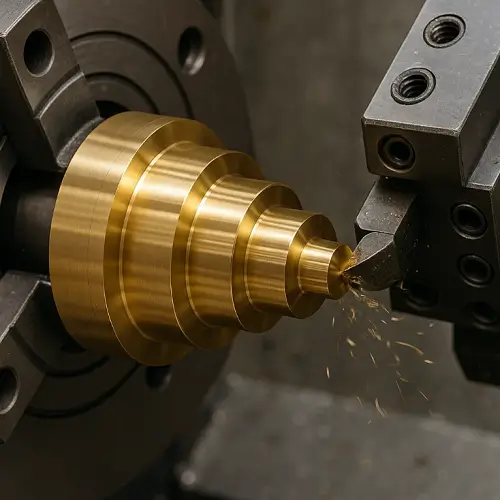
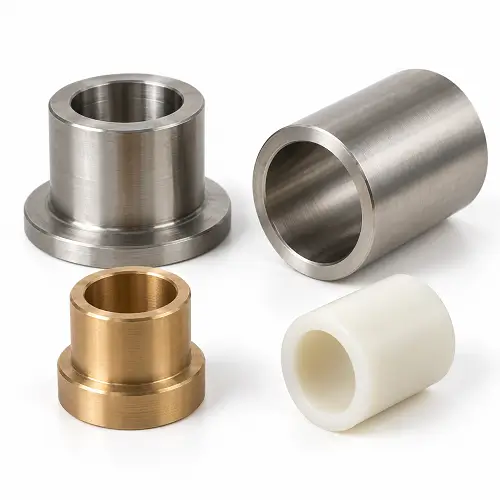
CNC machined bushings are sleeve-shaped components produced by removing material from metal or engineering plastic stock. Turning and boring create the outside diameter, internal bore, and end faces. Additional machining can add flanges, steps, grooves, and lubrication holes.
In a typical bearing application, the bushing fits into a housing while a shaft or pin moves inside it. The bushing provides a replaceable contact surface, helping protect the more expensive housing from wear.
Some bushings serve as stationary locating sleeves, guides, or protective inserts instead. Their requirements differ from those of a bearing supporting continuous movement. Before specifying the part, establish whether its inner surface will carry moving contact or simply position another component.
“Machined” describes the manufacturing method. A CNC machined bushing can follow a standard size or a custom drawing.
What Are Machined Bushings Used For?
Pivot Joints and Hinges
Pivot bushings support pins that move through a limited angle in hinges, linkages, and actuator connections. They provide a serviceable wear surface so the surrounding structure does not need to be replaced whenever the joint develops excessive movement.
The pin and bushing must be assessed together. Installing a new bushing around a scored or undersized pin can leave too much clearance or quickly damage the new bearing surface.
For a replacement order, measure the pin as well as the housing bore. Also explain whether the joint is greased regularly, exposed to dirt, or difficult to access for maintenance. These conditions influence both material selection and lubrication features.
Rotating Shafts
Sleeve bushings can support rotating shafts when the bearing arrangement suits the operating conditions. Speed, load, lubrication, alignment, and heat removal all matter.
A bushing that works in an occasional pivot movement is not automatically suitable for continuous rotation. Continuous sliding generates heat, and the material must tolerate the resulting contact conditions without excessive wear or deformation.
Provide the operating speed and expected load where available. “Fits a shaft” describes the geometry, but it does not give a custom bushing manufacturer enough information to evaluate the intended bearing application.
Sliding Guides
Guide bushings support rods that move back and forth. Their bores help maintain the movement path while carrying contact loads.
When a rod passes through two bushings, their alignment becomes important. Both bores can meet their diameter limits while the rod still binds because the supports are not aligned. Enlarging the bores may reduce binding but also introduce unwanted movement.
For these assemblies, provide the spacing between supports and the relevant housing geometry. The cause of poor movement may be the relationship between the mounting features rather than the bushing diameter alone.
Replaceable Wear Sleeves and Protective Inserts
Some machined bushings protect a housing bore from repeated contact, assembly, or movement. A replaceable sleeve can make maintenance easier than repairing the complete housing.
Before ordering a replacement, check whether the housing bore is still round and within its intended size. A new bushing made to the original dimensions may not remain secure in a worn or enlarged bore.
A worn sample helps identify the shape and features, but its dimensions should not automatically become the manufacturing specification. The repair may require an adjusted outside diameter or restoration of the housing before installation.
Sleeve vs. Flanged Bushings: Which Do You Need?
A sleeve bushing has a straight cylindrical body. It is suitable when the housing and retention arrangement already establish its position. This structure also avoids a projecting flange where space is limited.
A flanged bushing adds a shoulder at one end. When seated against the housing, the flange can establish insertion depth and resist axial movement in one direction. In an appropriately designed bearing, the flange face may also carry thrust.
However, a flange intended only as an assembly stop should not automatically be treated as a thrust bearing. Its contact area, material, thickness, lubrication, and mating surface must suit the axial load.
Stepped bushings have different diameters along their length. They can fit a stepped housing, locate against a shoulder, or provide separate mounting and working sections. The drawing should identify which shoulder controls the installed position.
Grooves and lubrication holes are additional features rather than separate solutions to every bearing problem. Their positions must match the lubricant supply and intended contact area. A lubrication hole that does not align with the housing passage cannot serve its purpose.
A flange also does not automatically prevent rotation inside the housing. If the bushing must remain stationary, its outside fit or another agreed retention feature must provide that function.
What Is the Best Material for a Machined Bushing?
Begin with what happens at the contact surface. Does the shaft rotate continuously, oscillate occasionally, slide back and forth, or remain stationary? Is lubrication available? Will the assembly encounter heat, moisture, cleaning chemicals, or abrasive particles?
These questions help narrow the material options. Choosing the hardest or most corrosion-resistant material alone does not establish that it will work well against the shaft.
Bronze Bushings
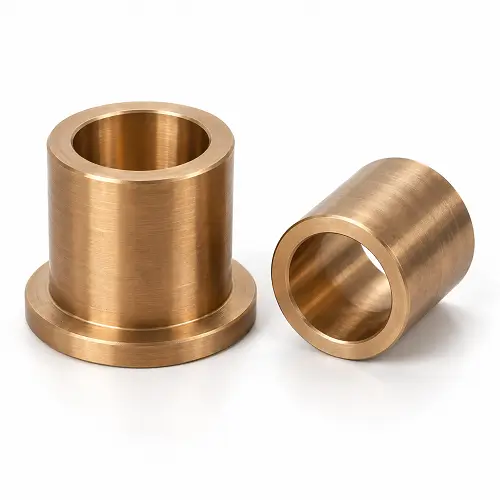
Bronze is widely used for bearing applications, but different bronze alloys have different properties. Selection depends on load, shaft condition, lubrication, and the operating environment.
For a lubricated pivot or sleeve bearing, a suitable bearing bronze can provide a practical combination of machinability and sliding performance. The mating shaft still needs an appropriate surface and alignment. A rough or damaged pin can quickly wear a new bronze bushing.
Solid machined bronze and oil-impregnated sintered bronze are different products. A sleeve machined from solid bronze stock does not contain an internal oil supply simply because it is bronze.
Specify the alloy if it has already been selected. If not, provide the operating conditions so a suitable grade can be evaluated rather than ordering a generic “bronze sleeve.”
Steel Bushings
Steel bushings may be appropriate where strength, impact resistance, or a hardened working surface is required. Applications include certain guide sleeves, locating components, and mechanical connections.
The grade and condition matter. A hardened steel bushing and an unhardened sleeve can perform differently despite having identical dimensions. Heat treatment should be included in the manufacturing plan because it can change the part’s shape and dimensions.
For moving contact, consider the mating material and lubrication. Increasing bushing hardness does not necessarily reduce wear throughout the assembly; it may shift wear to the pin or shaft.
If hardness is important, state the required value and the surfaces to which it applies. This allows heat treatment and final machining to be planned together.
Stainless Steel Bushings
Stainless steel may be considered where corrosion resistance or compatibility with cleaning conditions is important. It can also suit stationary protective sleeves and locating components.
Corrosion resistance does not guarantee good dry-running performance. Sliding stainless steel surfaces can gall under unfavorable combinations of material pairing, pressure, surface condition, and lubrication. Material transfers between the contacting surfaces, potentially causing severe damage or seizure.
If the shaft is also stainless steel, identify its grade and operating conditions. A different bearing material, shaft condition, or lubrication arrangement may be needed.
Stainless steel should therefore be selected for the actual environment and mechanical function, rather than treated as an automatic upgrade over bronze or other materials.
Plastic Bushings
Engineering plastic bushings can provide low weight, electrical isolation, and corrosion resistance. Some bearing-grade polymers contain additives intended to improve friction and wear performance.
The exact grade is important. General-purpose plastic stock is not automatically equivalent to a bearing formulation. Temperature, moisture, sustained load, and the shaft surface can affect dimensions and service performance.
For example, moisture absorption in nylon can influence a close-running fit. A polymer may also deform over time under sustained loading. A material that works in a lightly loaded guide may therefore be unsuitable for a warmer or more heavily loaded assembly.
Where dry operation is required, use material data that addresses the intended conditions. “Plastic does not need lubrication” is too broad to support a reliable selection.
The following comparisons provide starting points for discussion, not final material approvals.
| Application requirement | Material direction to evaluate | Information still needed |
|---|---|---|
| Lubricated pivot with regular maintenance | Suitable bearing bronze | Load, pin condition, movement, and lubricant delivery |
| Corrosion-resistant stationary protective sleeve | Suitable stainless steel grade | Actual medium, temperature, and whether sliding occurs |
| Dry-running guide requiring low weight or insulation | Bearing-grade engineering plastic | Load, speed, temperature, moisture exposure, and shaft material |
| Hard guide surface or wear-resistant locating sleeve | Appropriately hardened steel | Hardness, mating component, lubrication, and finishing requirements |
Can Machined Bushings Run Without Lubrication?
Some can, but this depends on the material system and operating conditions. CNC machining itself does not make a bushing self-lubricating.
A conventional solid-metal bushing may require grease, oil, or another suitable lubricating medium. An oil groove distributes lubricant supplied to it; it does not create lubricant or guarantee that the contact stays lubricated.
Self-lubricating products use specific material systems, such as an oil-bearing porous structure, solid lubricants, or a bearing-grade polymer formulation. Each has limits for load, speed, temperature, and mating surfaces.
If external lubrication is unavailable, state that before the material is selected. Describe whether movement is continuous or intermittent and whether dirt, water, or cleaning chemicals can reach the contact.
For an existing self-lubricating product, confirm whether secondary machining is permitted. Cutting or finishing its bearing surface can affect the working layer or porous structure of some products. Enlarging the bore is not always an acceptable way to adjust the fit.
When Do You Need Custom Bushings?
Custom bushings are useful when a standard part cannot meet the assembly requirements without compromising fit or function.
One common situation is an existing shaft and housing with an unusual dimensional combination. A standard sleeve may fit the shaft but not the housing, or its length may leave insufficient support. A custom machined bushing can accommodate the combination if the wall thickness and bearing arrangement remain suitable.
Special features provide another reason. A flange may establish the installed position, a step may match a housing shoulder, or a lubrication hole may need to align with an existing passage. These features should be defined before machining rather than improvised during assembly.
Replacement orders also require care. If the original part is unavailable, provide measurements of the mating shaft and housing alongside the worn bushing. Otherwise, the replacement may reproduce the old shape without correcting the fit problem.
When a standard component already meets the size, material, and operating requirements, using it may be more practical. Customization is worthwhile when it solves a specific mismatch or provides a necessary feature.
How Are CNC Bushings Machined?
Most round bushings begin with CNC turning. The workpiece rotates while tools produce the outside diameter, end faces, steps, and flange.
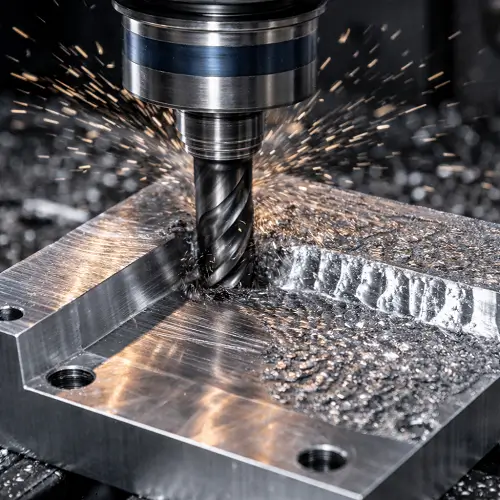
The internal opening may be drilled and then bored or finished through another suitable operation. A drilled hole alone may not provide the size, geometry, or surface needed for the working bore. The finishing method follows the drawing requirements and intended contact.
Machining related inside and outside features in a suitable common setup can help maintain their alignment. If the workpiece must be repositioned, its locating method needs to preserve that relationship.
Lubrication grooves and cross-holes may require additional operations. Their intersections must be deburred so sharp edges or loose chips do not damage the shaft or contaminate the assembly.
Thin-wall bushings need controlled clamping. Excessive pressure can distort the sleeve, allowing a bore to appear correct while held but change after release. Inspection must reflect the specified free-state or installed condition.
JeekRapid machines custom metal and engineering plastic bushings from drawings, with bore requirements, mating features, lubrication details, and the finishing sequence reviewed before production.
Why Can a Bushing Become Too Tight After Installation?
Pressing a bushing into a housing can reduce its internal diameter. The change depends on the interference, material, wall thickness, housing stiffness, and geometry. A shaft that passes through the loose bushing may therefore become tight after installation.
This is why bushing fit tolerance must distinguish the outside mounting fit from the internal operating clearance. The outside fit holds the bushing in place, while the installed bore and actual shaft size determine the clearance available for movement.
Tightness can also come from a tapered housing bore, installation damage, contamination, or misaligned supports. Enlarging the bushing bore without identifying the cause can create excessive clearance while leaving the underlying problem unresolved.
The drawing should state whether the bore requirement applies before or after installation. If final machining after installation is required and suitable for the bushing type, agree on who performs it and how the finished bore is checked.
Do not assume every bushing can be reamed after installation. Some lined or self-lubricating products can lose important surface properties when reworked.
How Do You Check the Quality of Machined Bushings?
Inspection should follow the features that control the assembly. Checking only the overall length and the bore entrance may miss problems farther inside the part.
Where the drawing requires it, bore measurements at different depths and orientations help identify size variation, taper, or ovality. A correct reading at one location does not establish that the complete working surface meets the requirement.
The relationship between the bore and outside diameter may also matter. If the outside locates in a housing while the inside guides a shaft, misalignment between these features can affect the assembly. A flanged part may additionally need control of the flange face relative to the bore axis.
Measuring methods must suit the requirement. Size checks alone do not fully establish roundness, cylindricity, or other geometric controls. Confirm how these features will be inspected when they are specified on the drawing.
Surface condition deserves attention as well. The working bore should meet its specified finish, lubrication passages should be clear, and cross-hole intersections should be free of harmful burrs. Excessive edge rounding should not remove functional locating or seating features.
Ask a machined bushings supplier to identify which drawing characteristics will appear in the inspection report. Also confirm whether acceptance occurs after heat treatment, coating, or installation where those steps affect the final part.
What Should You Provide to a Custom Bushing Manufacturer?
Send the drawing or CAD model, required quantity, material specification, and finishing requirements. Identify the inside diameter, outside diameter, length, and any flange, step, groove, or lubrication hole.
Provide the mating shaft and housing dimensions where they influence fit. State which component remains stationary and which moves. Also identify whether critical bore dimensions apply before or after installation.
Describe the operating conditions in plain language. A note such as “oscillating joint, greased during maintenance, exposed to washdown” gives useful context. Add load, speed, temperature, and other available design data where applicable.
If the material is still undecided, explain the requirement rather than selecting a grade solely to obtain a quotation. The manufacturer can then review machining options, while the bearing material and clearance are checked against the intended service conditions.
For replacement bushings, include photographs and measurements of the worn part, shaft, and housing. Distinguish known design dimensions from measurements taken from worn surfaces. Photographs help establish the structure, but they do not replace the dimensions needed to manufacture a reliable replacement.
When comparing quotations, confirm that both suppliers include the same alloy, heat treatment, finishing, inspection, and documentation. Matching nominal dimensions do not necessarily mean matching delivered specifications.
Conclusion
A suitable CNC machined bushing needs to fit the assembly and work with its shaft, movement, lubrication, and environment. Selecting the structure and material together helps avoid a part that installs correctly but binds, wears quickly, or damages the mating component during use.
JeekRapid supports custom sleeve, flanged, and stepped bushings in metals and engineering plastics. For a new design, send your drawings, quantity, shaft and housing dimensions, and operating requirements for a manufacturability review and quotation.
For a replacement, include photographs of the old bushing and measurements of the mating parts. Mark any dimensions or material details that remain uncertain so we can identify what needs confirming before production.