Author name: jeek

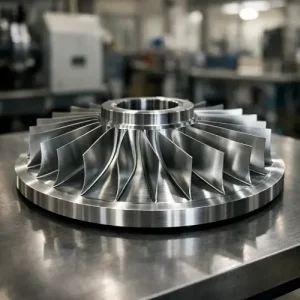
Finished CNC machined metal impeller part with complex curved blades and precision surface finish

Impeller Machining: 5-Axis CNC for Complex Blade Geometry and Accuracy

In real production, impellers almost always require 5-axis CNC machining. This is not a matter of machine preference or equipment marketing. The reason is straightforward: the hydraulic performance of an impeller is controlled by blade geometry, hub alignment, and the consistency of the flow surfaces, and these features cannot be held reliably with simple 3-axis …

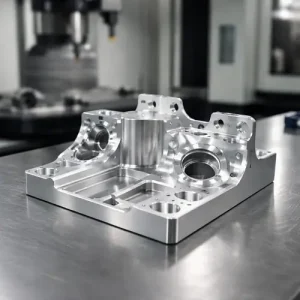
Finished aluminum part produced by precision CNC machining with high dimensional accuracy

What Is Precision Machining? Process, Advantages, and Applications

In many industries such as aerospace and medical devices, standard CNC machining is no longer sufficient to meet the required accuracy. Precision CNC machining refers to the ability to consistently manufacture parts with tolerances of ±0.001 inch or tighter under real production conditions.

At JeekRapid’s production floor, precision is not defined by machine manuals, but …

CNC machined aluminum part made from 6061 and 7075 aluminum on industrial workbench

CNC Material Selection and Cost Trade-offs

Material choice is one of those decisions in CNC machining that looks simple on paper, then quietly controls everything that follows — cycle time, tool life, scrap rate, even whether the schedule survives first article.

Anyone who has run real projects has seen the same drawing produce very different numbers on the quote sheet, just …

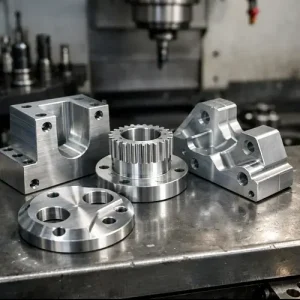
CNC machined parts

Top CNC Machining Companies in 2026: Leading Suppliers in Asia & Worldwide

The CNC machining industry in 2026 looks very different from just a few years ago. Global supply chains have become more regional, product lifecycles are shorter, and engineers now expect manufacturing partners to contribute technical input rather than simply execute drawings. Speed, engineering feedback, process stability, and real production transparency are now as important as …

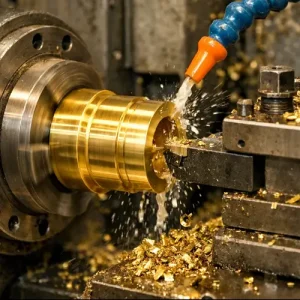
Brass CNC machining process with cutting tool and metal chips in real workshop environment

Copper vs Brass vs Bronze: How to Choose the Right Material for CNC Machining

Copper, brass, and bronze are widely used engineering metals known for their high electrical and thermal conductivity, corrosion resistance, and long-term durability. These three copper-based materials are commonly applied in electrical systems, mechanical assemblies, fluid control components, architectural hardware, and industrial equipment. Because their color and general appearance are similar, they are often confused during …

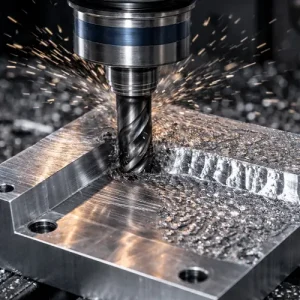
CNC machining chatter causing vibration and uneven surface finish during milling

What Causes Tool Chatter in CNC Machining?

Tool chatter starts when the cutting system loses stability.
In practical terms, the tool, machine, and workpiece stop behaving like a rigid structure and begin vibrating against each other. Once that vibration becomes self-exciting, surface finish degrades, tool life drops, and dimensional accuracy becomes difficult to hold.

On the shop floor, chatter rarely appears without …

CNC machined aluminum part shown next to engineering drawing and measurement tools during production review

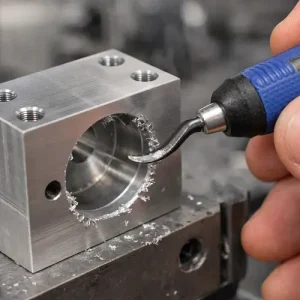
Burrs in CNC Machining: Causes, Risks, and Proven Solutions

If a part “looks fine” but still won’t assemble, burrs are usually the reason. Dimensions can be on print and surface finish acceptable, but edge condition causes assembly failure. A small exit burr can stop a press-fit, a micro burr on a sealing land can cause a slow leak, and a sliver of copper burr …

Standard CNC machining tolerance chart for precision parts

CNC Machining Tolerances: Standards, Charts, and Inspection Methods

On real CNC jobs,CNC Machining tolerances show up when parts stop fitting, when inspection starts rejecting pieces that look “fine,” or when cost suddenly jumps for no obvious reason. Most of the time, the root cause is the same: tolerances were chosen without thinking through how the part will actually be machined and measured.

If …

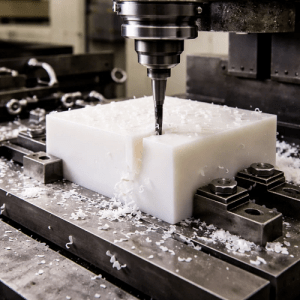
CNC machining aluminum thin-wall parts during milling

Challenges of CNC Machining Thin-Wall Parts

Thin-wall machining appears in far more CNC projects than many people expect. Thin edges, ribs, and reduced wall sections are rarely added for appearance. In most cases, they exist because the part must fit into a tight assembly, meet weight targets, or satisfy functional constraints.

The real question is not whether thin walls exist in …

Low-volume CNC machined parts showing complex geometry, surface finish, and secondary operations

What Drives the Cost of Low-Volume CNC Machining

When requesting a quote for low-volume CNC machining, many buyers have the same reaction: the quantity is small, so why isn’t the price low?
This is a common question—and a reasonable one. The answer lies in how cost behaves in small batch production, where preparation and process control matter far more than part count.

Low-volume …

Scroll to Top